
Picture the Rhine in August, but instead of barges gliding past, you see their hulls scraping gravel. That was the scene this week as one of Europe’s busiest trade arteries kept shrinking under a punishing dry spell, and by Thursday it had become a problem serious enough to pull Germany’s Transport Minister, Steffen Bilger, into an emergency meeting with logistics companies in Bonn. His message afterwards was almost apologetic: “We can’t influence the weather, but we could make sure that our economy gets through these difficult weeks better.” What that means in practice is trucks now being allowed to break the usual Sunday driving ban to move oil, steel and other essentials that barges can no longer carry at full capacity, and DB Cargo shifting more freight onto the rail network to fill the gap. It sounds like a niche transport story, but the Rhine quietly carries a huge share of the raw materials that keep German factories running chemicals, coal, construction materials, fuel so when the water drops, costs for moving goods rise, deliveries slow down, and those extra euros per tonne have a way of showing up later in prices on shelves and in showrooms. Freight companies are already warning that the fix is only partial: any extra Sunday driving still has to be balanced with mandatory rest days elsewhere in the week, so this isn’t a problem that gets solved by simply working harder.
Meanwhile, over thirteen hundred kilometres away in Mumbai, the Reserve Bank of India was choosing caution of its own kind. Meeting between August 3rd and 5th, the RBI’s rate-setting committee voted unanimously to leave its benchmark interest rate untouched, holding steady rather than cutting further, and keeping its “neutral” stance intact. The backdrop to that decision was global unease ongoing conflict in West Asia, unpredictable oil prices, and currency markets that don’t like surprises — so the central bank essentially chose to keep its powder dry rather than risk stirring things up.
Stock Market
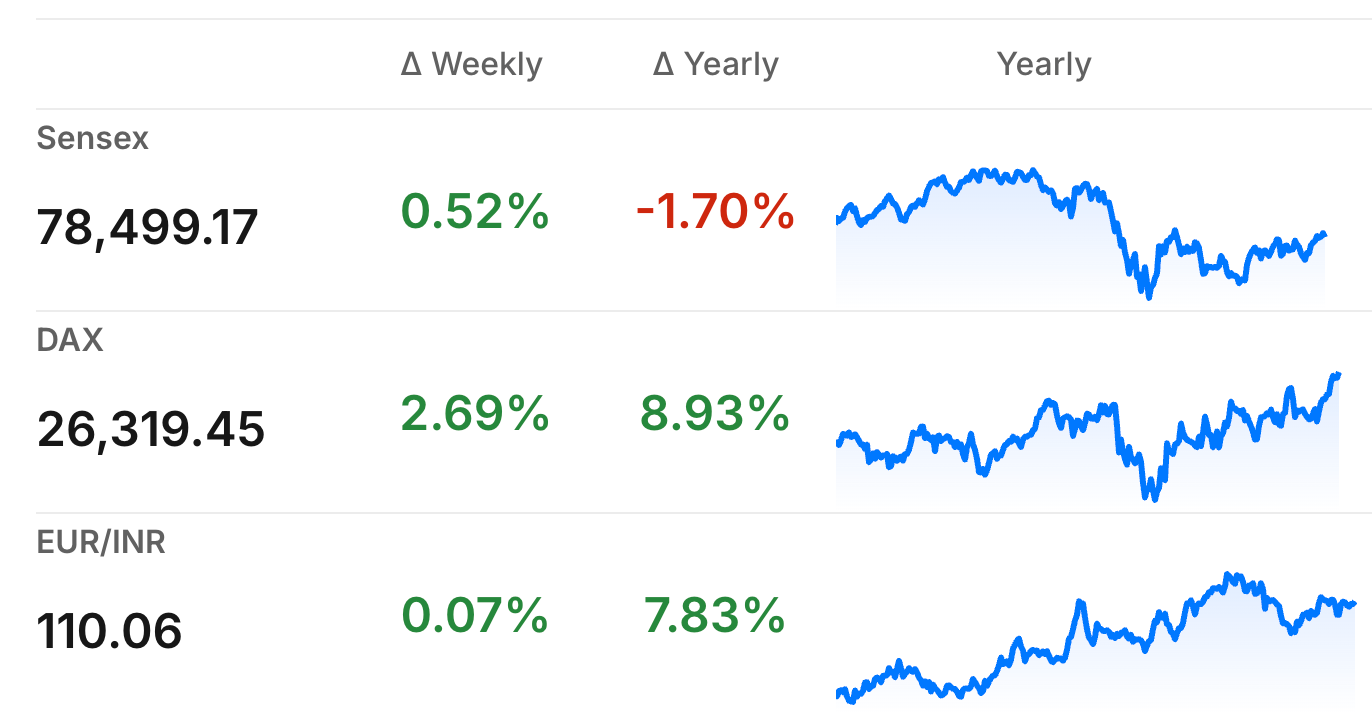
Sensex closed at 78,499.17, gaining 0.52% from the previous week’s close of 78,094.64. Despite a challenging transition to SEBI’s new closing auction regulations, the Indian market extended its gains for a second consecutive week. However, the end of the week saw minor pullbacks driven by rising Brent crude oil prices and ongoing geopolitical tensions, which pressured heavyweight financial stocks like Bajaj Finance and ICICI Bank. Overall sentiment remained slightly positive, supported by robust foreign institutional investor (FII) inflows and the Reserve Bank of India’s steady monetary policy, which kept market confidence afloat despite sector-specific volatility.
DAX hit a major milestone, surging past the 26,000-point barrier to close the week at 26,319.45. This represents a solid 2.69% increase from the previous week’s close of 25,629.24. The German market rallied sharply as a flood of promising corporate earnings reports rolled in from more than half of the DAX-listed companies. Additionally, early-week sentiment was heavily lifted by falling oil prices and hopes for renewed US-Iran diplomacy, which briefly eased global geopolitical concerns. Positive domestic factory output data and anticipation of further government liquidity also provided a strong floor for the index, allowing the DAX to continue its upward momentum and maintain a nearly 9% gain over the past year.
Germany News Roundup
The Association of German Engineers reported that the country's engineering and IT sectors are facing their highest unemployment levels since 2011.
An economic slowdown has hit white-collar hiring, resulting in a record 58,392 unemployed individuals in technical and engineering fields.
According to the Global Unicorn Index 2026, Germany has now reached a record 38 billion-dollar startup "unicorns."
German auto suppliers are reportedly facing growing debt burdens and higher interest expenses amid intense price competition from China.
A catastrophic fire near Augsburg on August 7 destroyed a pig barn and killed over 1,000 animals, impacting local agricultural output.
Fierce privacy debates and calls for regulatory bans intensified in Germany regarding the consumer risks of Meta's new AI "smart glasses."
India News Roundup
The Union Government proactively released ₹1.09 lakh crore as advance tax devolution to states on August 3 to bolster regional budgets.
The Supreme Court mandated enhanced motor third-party insurance periods of six years for two-wheelers and four years for four-wheelers.
PepsiCo, Red Bull, and Monster face a 90-day deadline from regulators to drop "energy drink" labels from their high-caffeine beverages.
Astrobase Space Technologies prepared to unveil India’s first fully integrated 80‑ton‑class Full Flow Staged Combustion rocket engine on August 8.
IIT Hyderabad and Crimson Energy Experts launched ANUGYAN, a new Nuclear Technology Orientation Programme, on August 3.
Opportunity
India's Healthcare Story
For two decades, India’s pharmaceutical identity was built on one word: cheap. The country earned its “Pharmacy of the World” tag by manufacturing generic drugs at massive scale and shipping them to nearly 200 countries. This week offered a glimpse of that story quietly changing shape. Gland Pharma and Neuland Labs announced a strategic tie-up for sterile API manufacturing, Piramal Pharma expanded a peptide manufacturing facility, and the 9th India Medical Device expo opened in Delhi with a FICCI report projecting the medical devices industry alone could reach $250 billion by 2047. The common theme running through all of it: India isn’t just trying to make more medicines anymore, it’s trying to make more sophisticated ones, and build the diagnostics, hospital, and device infrastructure to match a population that’s ageing, insuring itself, and demanding better care.
For investors who’d rather not pick individual pharma or hospital stocks, dedicated healthcare and pharma mutual funds offer a way to own this shift broadly rather than betting on any single company’s pipeline. These sectoral funds pool exposure across pharmaceuticals, hospitals, diagnostics chains, and biotech, meaning a bad quarter for one drugmaker doesn’t sink the whole investment.
For a fuller comparison of pharma and healthcare fund options: Tickertape — Best Pharma Mutual Funds in India
As with any sector fund, the catch is concentration, these funds rise and fall with a single industry’s fortunes, and healthcare stocks have already had strong multi-year runs, meaning some of this growth story may already be priced in. Most advisors suggest capping sector fund exposure to 10–15% of a portfolio and holding for a genuine 5–7 year horizon rather than chasing recent returns, since regulatory shifts (US drug pricing policy, for instance) can swing sentiment quickly.
Until Next Sunday…
Conclusion
Whether it's water levels on the Rhine or interest rates in Mumbai, this week was a reminder that stability is its own kind of decision, sometimes the biggest move is choosing not to make one. As always, the details worth watching aren't always the loudest headlines; they're the quiet shifts that decide what gets more expensive, or cheaper, in the weeks ahead.
See you next Sunday,
Jimit Patel