
Six weeks ago, nobody outside a few Telegram groups had heard of the "Cockroach Janta Party." Then a satirical youth movement, born out of anger over a leaked university entrance exam, did something India's organised opposition parties have failed to do in over a decade: it made Narendra Modi's government blink. Tens of thousands of Gen Z protesters filled the streets of New Delhi, and the pressure eventually forced Education Minister Dharmendra Pradhan's resignation. But it's what happened after the camps were cleared that matters more.
The government has since set up a high-powered task force chaired by Infosys co-founder Nandan Nilekani to redesign the country's public examination system from the ground up, using technology to make papers harder to leak and easier to trace. Alongside it, the Union Cabinet cleared an amendment toughening the anti-paper-leak law, with penalties now stretching up to ten years in jail and fines up to ten crore rupees for those running organised exam fraud. It's a rare instance of street pressure translating into concrete legal reform within weeks rather than years.
While Delhi cooled down politically, Germany heated up literally. This past week brought the country’s most intense summer spell in years, with temperatures crossing 40 degrees Celsius in Bavaria, Saxony-Anhalt and Baden-Württemberg, new July records in all three states. The heat broke into storms by Friday, but not before schools began shutting for the summer break and utilities scrambled to manage electricity demand from a nation of air conditioners that, until recently, barely needed them. It’s a small but telling shift: a country whose infrastructure and building stock were designed for mild summers is now having to budget, quite literally, for heat the way it once budgeted for cold winters, a cost that shows up eventually in energy bills and insurance premiums, even if nobody notices it in the moment.
Stock Market
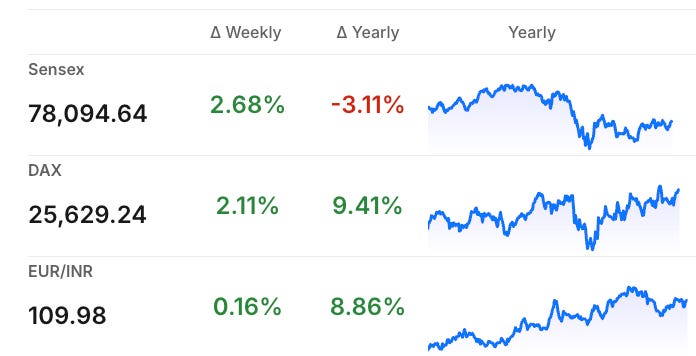
The BSE Sensex snapped a brutal five-day losing streak this week, closing out Friday at 78,094.64. This represents a strong 2.68% gain for the week, recovering from the previous week's close of 76,059.77. The broader 1-year performance currently sits at -3.11%. The market’s sharp turnaround was largely driven by a heavy drop in global crude oil prices, with Brent crude falling to $91 per barrel, following a pause in US-Iran military tensions. The recovery was broad-based but particularly led by the IT sector, which rebounded over 3%. Heavyweights like Bajaj Finance, Infosys, and FMCG stocks supported the upward momentum, bringing a wave of relief to investors who had faced massive sell-offs the prior week.
Germany’s DAX demonstrated notable resilience, ending the week at 25,629.24. This marks a solid 2.11% gain from last week's close of 25,099, bringing its 1-year growth to a healthy 9.41%. The German market climbed steadily, heavily supported by the same easing of geopolitical tensions and sliding oil prices that lifted global markets, which eased immediate inflation worries. The week's upward trajectory was heavily bolstered by a strong rally in the technology sector, led by index heavyweight SAP—which surged over 10% and robust performances from Infineon and Siemens Energy. Improving domestic business sentiment and lower bond yields further encouraged investors, pushing the DAX back toward its record highs set earlier in the month.
Germany News Roundup
Shallow water levels on the River Rhine have severely disrupted cargo shipping, forcing vessels to sail partially empty and increasing costs for the German industrial sector
Porsche announced plans to cut 5,000 jobs by 2035 as the German automotive industry navigates structural and economic headwinds.
GSK’s newly announced cost-cutting initiatives and global layoffs are expected to impact bio-manufacturing operations in Germany.
Minimum salary requirements for Skilled Worker Permits in Germany were confirmed to rise to EUR 55,770 annually starting in 2026.
The 139 member firms of the 'Made for Germany' corporate initiative pledged to invest over €800 billion in the country through 2028 to resuscitate investor confidence.
The European Union laid out €10 billion in funding for AI gigafactories, heavily boosting private tech investment prospects and infrastructure in Germany.
India News Roundup
PM Narendra Modi constituted a high-powered Exam Reform Task Force chaired by Infosys co-founder Nandan Nilekani to revamp the NTA public examination system.
The Union Cabinet approved an amendment to strengthen the Anti-Paper Leak Law with strict penalties of up to 10 years in jail and a Rs 10 crore fine.
The Union Cabinet approved the Rs 3,030 crore BHAVYA Rasayan Scheme to establish three new chemical parks across the country.
The government amended FDI rules to allow foreign e-commerce firms to operate inventory-based models strictly for exporting Indian-made goods.
Flipkart expanded its zero-commission policy across all fashion products to benefit over 90,000 sellers and MSMEs.
India and China agreed to officially resume border trade through the Nathu La pass in Sikkim starting August 1, 2026.
Opportunity
Germany's Building Boom
Bonn’s Friedrich-Ebert-Brücke was supposed to celebrate its 50th anniversary next year. Instead, it’s being demolished. Structural damage discovered during a routine inspection in early June forced authorities to shut the bridge one that used to carry up to 100,000 vehicles a day and it now joins a growing list of German infrastructure failures, including Dresden’s Carolabrücke, which collapsed into the Elbe less than two years ago, and Berlin’s Ringbahnbrücke, torn down after being declared unsafe. These aren’t isolated incidents. Roughly a third of Germany’s motorway and federal highway bridges are now flagged as needing repair or replacement, and a quarter of the country’s railway bridges show significant damage. Decades of what one engineering professor called “build and forget” have finally caught up with Europe’s largest economy and now the money to fix it is arriving all at once.
That money comes from several directions converging at the same time. Germany’s €500 billion infrastructure Sondervermögen is releasing funds over the next twelve years, NATO’s new defence-spending targets funnel additional billions into dual-use transport infrastructure, and a chronic housing shortfall now at a record 1.4 million missing units is finally translating into rising building permits, up nearly 11% last year. Add in a broader European construction upswing (Ifo Institute expects the sector to grow over 2% annually through 2027) and demand from data-centre construction tied to tech expansion, and you get what one asset manager bluntly called decades of underinvestment being crammed into a very short window. For investors, that convergence is the story: several German companies sit directly in the path of this spending, each exposed to a different slice of it.
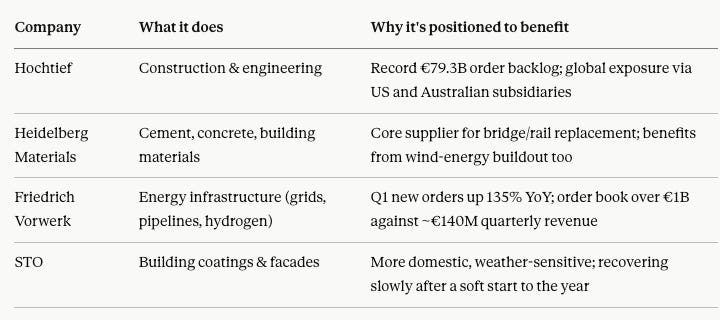
Worth noting: this isn’t a uniform rally. Hochtief’s valuation has already run up sharply and trades more like a growth stock than a traditional construction firm, while STO is still working through a genuinely slow first quarter with cautious full-year guidance. The clearest, most direct exposure to Germany’s own bridge-and-rail crisis sits with Heidelberg Materials and Friedrich Vorwerk, both of which are seeing order books swell well ahead of revenue, a good sign, but one that depends on the government actually spending the money it has allocated, something critics have already questioned happening slower than promised.
Source: FOCUS MONEY — “Deutschlands Baumeister: die Top-Aktien für einen historischen Boom”
Until Next Sunday…
Conclusion
India's exam system just got a legal backbone and a tech overhaul in the same week, worth watching whether the Nilekani task force's recommendations actually reach classrooms before the next admission cycle. Small signals this week, but the kind worth remembering months from now.
See you next Sunday,
Jimit Patel