
A shipment of Scotch whisky leaving Glasgow this week will cost less to bring into Mumbai than it did a month ago and a container of Bengaluru-made leather shoes heading to London will clear customs faster than at any point in the last decade. That’s the quiet, unglamorous reality of the India-UK trade agreement, which formally came into force on July 15 and is now, in its first full week of operation, being tested by actual shipments rather than press releases. The deal removes duties on 99% of Indian exports entering Britain, tariffs that ran as high as 70% on processed foods and 18% on engineering goods are gone overnight while India opens roughly 90% of its own tariff lines to British goods over a longer, staggered timeline. For a textile exporter in Tiruppur or an auto parts supplier near Pune, this isn’t abstract policy; it’s the difference between competing on price in a market of 68 million people or watching that business go to Vietnam or Bangladesh instead. Businesses on both sides are still working through the paperwork, origin certificates, HMRC registrations, customs codes but the direction of travel is clear: cheaper goods, faster shipping, and a bilateral relationship worth £48 billion trying to grow meaningfully bigger.
While India was opening its trade lanes, its Parliament was opening a different kind of debate. The Monsoon Session began on July 20 and will run into mid-August, and tucked inside 28 pending bills is one that’s drawing outsized attention: a Joint Parliamentary Committee has finalized its report on a constitutional amendment that would automatically remove a Prime Minister, Chief Minister, or minister from office if they remain in judicial custody for 30 consecutive days. Supporters call it a necessary check on power; critics call it a tool ripe for misuse against opposition-led states. Either way, it’s the kind of structural change that tends to matter more in the long run than in the headline of the day. The session will also take up income-tax reforms and a bill to overhaul India’s higher education regulators, so there’s substance beyond the political theater, even if the theater is what dominates the news cycle.
Stock Market
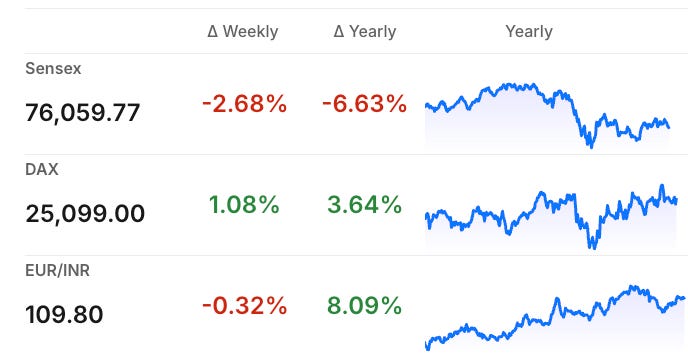
Sensex ended the week at 76,059.77, down 2.68% from last week's close of 78,151.45, marking a sharp fall for Indian markets. Dalal Street opened the week strong on IT earnings optimism but reversed course as banking and financial stocks came under heavy pressure through the middle of the week. Elevated Brent crude prices near 85 dollars a barrel, persistent foreign institutional investor selling, and a weakening rupee remained key drags on sentiment throughout the week. Renewed Middle East conflict escalation kept oil prices high for most of the week, adding to investor caution, though markets found some relief on Friday as tensions eased slightly and Sensex and Nifty rose over 0.3% on lower expectations of a Fed rate hike.
DAX closed the week at 25,099, up 1.08% from last week's 24,830.98, though the path there was volatile. The index fell sharply mid-week, dropping 1.56% on Thursday to 24,763 after the European Central Bank held interest rates steady, with Infineon, Commerzbank and Deutsche Telekom leading the losses amid rising oil prices tied to the Iran conflict. The market staged a strong recovery on Friday, jumping 1.36% to close at 25,099, driven by SAP surging over 10% on stronger-than-expected quarterly revenue, along with Siemens Healthineers and Fresenius gains, as investors welcomed upbeat PMI data and a pullback in oil prices following reports de-escalation in US-Iran tensions.
Germany News Roundup
Germany's Composite PMI jumped to 51.2 in July from 49.5 in June, signaling the private sector's return to growth after four months of contraction, led by a manufacturing rebound.
Despite the improving PMI, BDI (Federation of German Industries) warned that German industry is losing roughly 15,000 jobs a month, citing US tariffs and Chinese competition as major pressures.
Germany's cabinet approved a 152-measure startup strategy aimed at cutting bureaucracy, improving finance access, and retaining scale-ups domestically.
Chancellor Friedrich Merz reshuffled his cabinet this week amid ongoing political pressure to deliver economic growth.
India News Roundup
Nationwide protests over the NEET-UG 2026 paper leak intensified, with PM Modi promising fast-track courts for accused offenders.
The US imposed 10% tariffs on Indian goods over forced-labor concerns, adding fresh strain to bilateral trade worth nearly $141 billion in 2025.
External Affairs Minister Jaishankar addressed the East Asia Summit, pressing for safe international waterways and a two-state solution for Israel-Palestine.
Paras Semiconductors signed a deal with Madhya Pradesh to build a ₹6,200-crore OSAT (chip assembly and testing) facility on the Ujjain-Indore corridor.
AWS announced expansion of its Hyderabad cloud region with a new data centre, part of Amazon’s $21 billion India cloud/AI investment plan through 2030.
Reliance Retail confirmed a disciplined but aggressive push into online retail for FY27, per comments this week.
Opportunity
India's Railways
For most people, Indian Railways means overnight trains and reserved tickets not exactly what comes to mind when thinking “growth sector.” But this year’s record ₹2.62 lakh crore railway budget, the highest ever allocated, is quietly turning that assumption on its head. Of that outlay, $15.3 billion has been specifically set aside for manufacturing new passenger coaches and wagons not just running more trains, but building the physical hardware that goes into them, largely on Indian soil. It’s part of a broader modernisation push that spans safety systems, station upgrades, and rolling-stock production, and it’s starting to show up in how investors are pricing railway-linked companies.
The opportunity here isn’t in owning the railways themselves, Indian Railways is government-run but in the ecosystem of listed companies that build, engineer, and service it. Coach and wagon manufacturers stand to benefit most directly from the new spending, since that’s precisely where the $15.3 billion is headed. Alongside them, engineering and construction firms handling track-laying, electrification, and infrastructure projects are seeing their order books swell as execution ramps up nationwide.
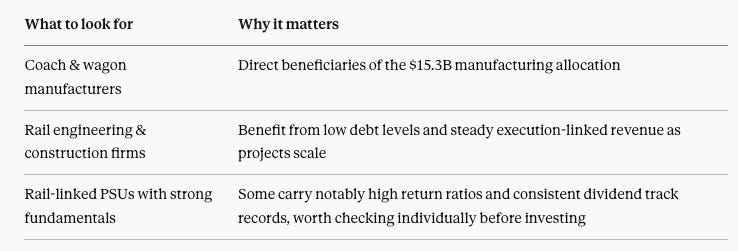
As with any policy-driven theme, the caveat matters: railway stocks have already rallied hard this year on the back of budget announcements and management changes, meaning some of the optimism may already be priced in.
For a full breakdown of specific railway stocks, their financials, and how each fits into this theme, Samco’s complete list is worth a read: Top 9 Railway Stocks of India in July 2026
These are largely capital-intensive, execution-dependent businesses delays in project rollout or budget slippage in future years could cool sentiment quickly. This is a sector to research individual names carefully rather than buy on headlines alone.
Until Next Sunday…
Conclusion
The next few weeks will bring fresh signals worth watching on both sides, India's Q1 earnings season kicks into gear, and Germany's construction and infrastructure spending should start showing up in on-the-ground activity rather than just budget line items. Neither story will resolve quickly, but small updates over the coming months will tell you far more than any single headline can right now. As always, the more interesting question isn't what got announced, but what gets built.
See you next Sunday,
Jimit Patel