
Picture two governments, thousands of kilometres apart, both trying to answer the same question this week: how do you put more money back into people’s hands without breaking the bank?
In Berlin, Chancellor Friedrich Merz’s coalition rolled out its “Programme for Revival and Employment,” a package of 34 reform measures designed to jolt Europe’s largest economy back to life. At its heart sits roughly €10 billion in annual income tax relief for lower and middle earners, due to kick in from January 2027, alongside an overhaul of the pension system and a promised reduction in Germany’s notoriously thick bureaucracy. To pay for it, the government is leaning harder on the country’s highest earners through a restructured income surcharge, a trade-off Finance Minister Lars Klingbeil framed as making sure “the highest earners take on a larger share” of the load. It’s a package born of pressure: with the far-right AfD polling strongly ahead of state elections in September, Merz admitted his government is “under pressure from many sides” to prove it can still deliver growth.
Not everyone in Germany is convinced the sacrifices are landing fairly, though. Over 33,000 Mercedes-Benz workers walked out to picket lines outside factories across the country this week, pushing back against management plans to stretch the 35-hour work week to 40 hours without extra pay, and against a proposal to delay a promised 18.4% special payment already due. Organised by IG Metall, the protests are a reminder that reform packages announced in Berlin’s chancellery gardens don’t always look the same from the factory floor and that the tension between “reviving the economy” and “protecting take-home pay” is being fought out in real time.
India, meanwhile, is tackling a version of the same puzzle from the opposite direction, not by cutting taxes, but by speeding up access to money people have already saved. The Employees’ Provident Fund Organisation’s long-awaited EPFO 3.0 overhaul is now rolling out, and it’s arguably the biggest shake-up to the country’s retirement savings system in decades. Gone are the days of waiting weeks for a provident fund claim to clear: withdrawals up to ₹5 lakh will now be auto-settled without manual approval, 13 confusing withdrawal categories have been folded into three simple ones, and members will soon be able to pull funds directly via UPI or a dedicated ATM card, all without needing an employer’s sign-off. For the roughly 30 crore Indians with an EPF account, most of whom rarely think about that quietly growing balance until a medical emergency or a home purchase forces the issue, this is a genuine change in how accessible their own money is.
Stock Market
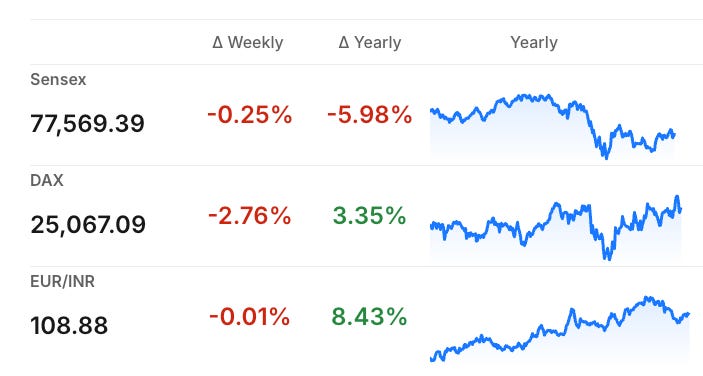
The Sensex closed the week at 77,569.39, down about 0.25% from last week’s close of 77,763.91. The market started strong on Monday, July 6, rising for a fourth straight session to 77,763.91 as realty, auto and oil & gas stocks led gains. Sentiment turned choppy midweek as weak global cues and rising oil prices triggered a sharp pullback, with the index snapping its winning streak. By Thursday and Friday, IT stocks staged a strong rebound, helped by TCS’s Q1 results pushing the Sensex back up over 800 points to close the week at 77,569.39, even as realty and auto cooled off.
The DAX ended the week at 25,067.09, down 2.76% from the prior week’s close of 25,779.31. The index had touched fresh record highs above 25,800 points earlier in the week, extending a strong rally into July. However, sentiment reversed sharply from Tuesday, July 7, with the DAX falling over 1% and then dropping a further 2.2% by Wednesday, as profit-booking set in after the record run and weak Asian cues around AI-related stocks weighed on investor confidence. Broader market caution tied to Middle East tensions and firmer oil prices added to the pullback through the rest of the week.
Germany News Roundup
Chancellor Merz said Germany faces its "gravest economic challenge since World War II" while defending his reform push to business leaders.
Germany’s coalition reopened debate over wider Sunday retail opening hours, a notable policy issue for the retail industry.
Germany's business lobby DIHK has criticised the coalition's slow pace on structural reforms despite the new package.
German industrial orders rose 1.9% in May, beating expectations, led by an 85% jump in aircraft, ship and train orders
Germany’s Mittelstand (small and mid-sized firms) is pushing the Merz government for a clearer reform roadmap to restore business confidence.
India News Roundup
PM Modi began a three-nation visit to Indonesia, Australia and New Zealand starting July 6.
India's auto sector saw a 29% surge in June sales, with EVs and hybrids grabbing record market share.
India's Services PMI fell to a 17-month low, highlighting a slowdown in the dominant services sector's growth momentum.
Commercial LPG price cuts brought major cost relief to hotels and restaurants this week.
AI-driven demand is fuelling a surge in optical fibre orders, with Indian industry eyeing Europe as its next big export market.
Opportunity
India’s Chip Rush
On July 4, Prime Minister Modi stood inside CG Semi’s newly commissioned chip-packaging plant in Sanand, Gujarat, and made a promise that would have sounded far-fetched a decade ago: 1.5 crore semiconductor chips a day, scaling toward 500 crore a year, made entirely on Indian soil. It’s the third such facility to go live this year, after Micron’s plant in February and Kaynes Semicon’s in March. Days earlier, the Finance Ministry quietly cleared something arguably more consequential for investors: a ₹1.25 lakh crore expansion of the India Semiconductor Mission, aimed at meeting 75% of India’s own chip demand by 2030, up from near-total import dependence today. Put simply, India is trying to stop just designing chips and start actually making, packaging, and testing them at scale, and the money is now backing that shift.
For everyday investors, the relevant question is who benefits as this ecosystem gets built out. The government’s incentive stack works like a funnel, the semiconductor mission subsidises fabs and packaging plants directly, a separate scheme supports the materials and components layer, and design-linked incentives back chip-design startups, with fresh customs-duty relief on battery and electronics inputs sweetening the deal further. A handful of listed Indian companies sit directly in this funnel’s path.
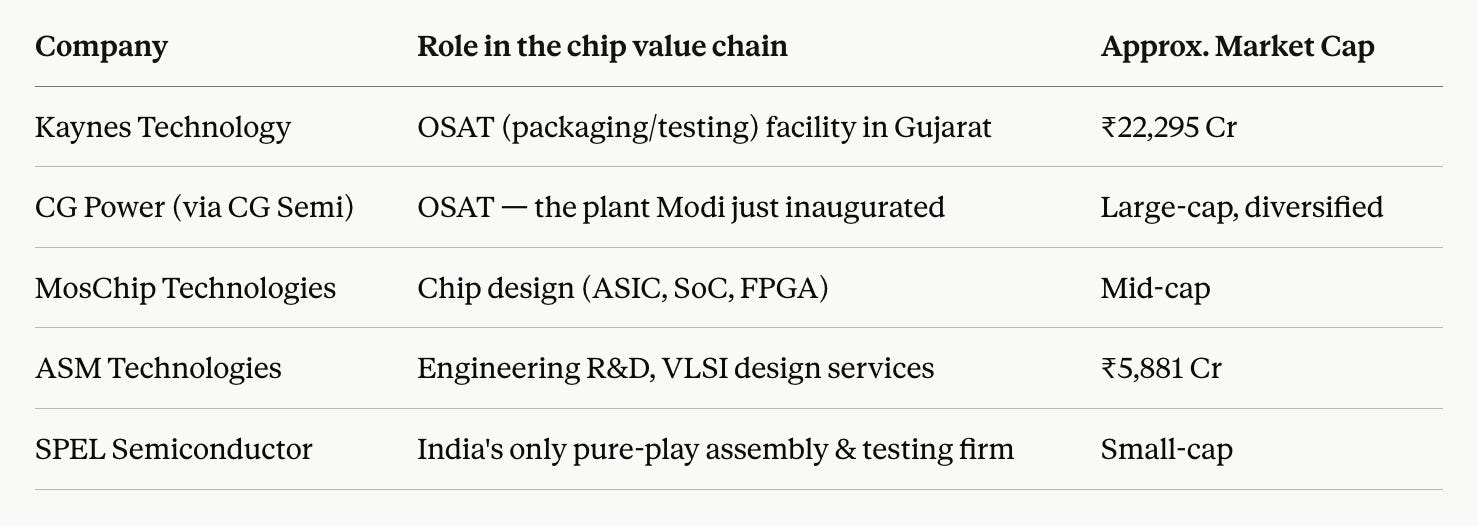
The honest caveat: this is a long-horizon, execution-dependent bet, not a quick trade. India still imports over 90% of its semiconductor equipment and specialty chemicals, meaning even domestic "manufacturing" leans heavily on foreign machinery for now. Building fabs takes years and enormous capital, and several of these stocks already trade at rich valuations on the strength of policy announcements rather than earnings delivered, CG Power and Kaynes, for instance, carry "Reduce" ratings from at least one major brokerage even as others turn bullish. The opportunity is real, but it rewards patience over excitement.
Sources: Tradebrains, Business Standard, BusinessToday
Until Next Sunday…
Conclusion
The coming weeks will show whether policy promises turn into paychecks — whether Germany's tax relief actually reaches the people it's meant for, and whether India's chip ambitions create jobs as fast as they create headlines. Q1 earnings season kicks off shortly on Indian markets, which should offer the first real test of whether the optimism baked into current prices holds up. Keep an eye on how the Mercedes-Benz dispute resolves, too. It's a preview of how far German industry is willing to bend as it hunts for growth. Whatever direction these stories take, the pattern connecting them is worth watching: big plans are easy to announce, and the real story is always in the follow-through.
See you next Sunday,
Jimit Patel