
Two governments, separated by five and a half time zones, arrived at the same conclusion this week: the old way of doing things wasn’t working. Both reached for the rulebook. Both rewrote it.
In India, July 1st marked the end of MGNREGA, the Mahatma Gandhi National Rural Employment Guarantee Act, a scheme that has been a fixture of Indian policy life since 2005. For over two decades, it was the safety net that tens of millions of rural households fell back on: a guaranteed 100 days of paid work a year, funded almost entirely by the central government. In its peak years it absorbed the labour of more than five crore families providing income during lean seasons, between harvests, when nothing else was available. From this week, it is gone.
In its place comes VB-G RAM G, the Viksit Bharat-Guarantee for Rozgar and Ajeevika Mission (Gramin). The name is a mouthful; the changes are significant. The new scheme raises the guaranteed workdays from 100 to 125 per household per year and sets a floor wage of ₹300 a day, a meaningful increase for the 21 states where wages had been below that level. The government has framed this as a modernisation: better wages, direct bank transfers and digital oversight. The allocation stands at ₹95,692 crore for the coming year.
Seven thousand kilometres away in Berlin, Chancellor Friedrich Merz was also reaching for a reset, one that had been a long time coming.
On Thursday, after seven hours of coalition talks in the Chancellery garden, the CDU/CSU-SPD government announced what it called the “Programme for Revival and Employment”: 34 separate measures aimed at shaking Germany’s economy out of a years-long slump. The package includes roughly €10 billion in annual income tax relief for lower and middle-income earners, amounting to about €600 more per year for an average family, funded by raising taxes on those earning above €250,000. The pension system is to be overhauled in line with all 33 recommendations of a government-appointed commission.
The measure that has generated the most immediate reaction is arguably the smallest in scale but the most personal in impact: the end of sick leave by telephone. Since the pandemic, German workers had been able to get a sick note from their doctor by phone, without an in-person visit. That option is now abolished. From early next year, a doctor’s certificate will be required from the very first day of absence, not the fourth, as has been the norm. Merz has spoken repeatedly about what he called Germany’s “extraordinarily high” sick leave rates. Whether tightening the paperwork will change that, or simply add friction and frustration to workers who are genuinely unwell, is a debate that is only just beginning.
Stock Market
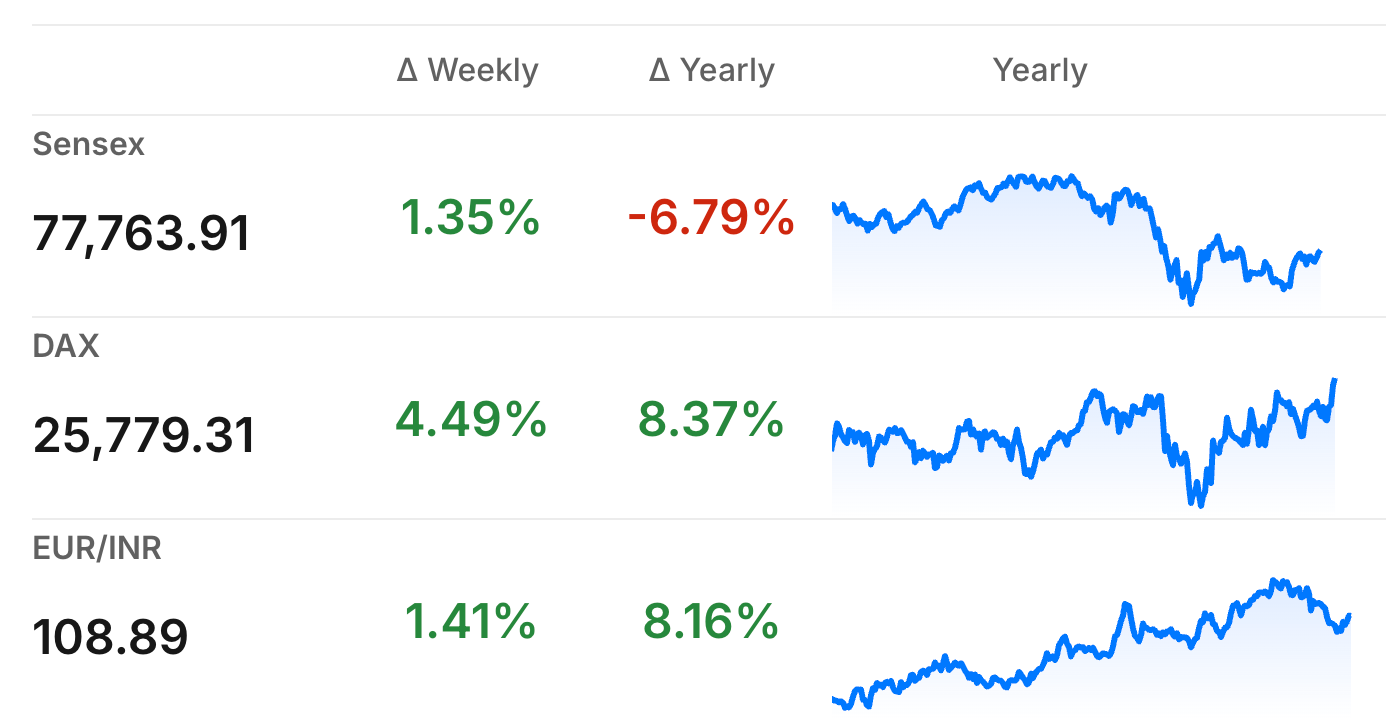
The Sensex closed the week at 77,763.91, up 1.35% from last week. Markets opened cautiously on Monday, June 29, weighed down by renewed Iran-US conflict tensions that pushed crude oil prices higher. Auto, IT, and PSU banking stocks came under pressure early in the week, while Pharma, Healthcare, and Metal sectors held up as defensive gainers, with names like Dr. Reddy’s, Trent, and Coal India leading the advance.
The DAX surged to 25,779.31, gaining 4.49% from last week, marking one of its stronger weekly performances. The index climbed steadily through the week. Cyclical and industrial stocks led the rally, aided by expectations that US interest rate hikes would be delayed rather than imminent, which lifted broader European sentiment. The move also coincided with Germany’s ruling coalition unveiling a growth-focused economic reform package, including tax relief measures, which added a supportive domestic backdrop to the market’s advance.
Germany News Roundup
Germany’s coalition agreed on a major growth package on July 2, marking one of the week’s biggest policy headlines.
Volkswagen was reported to be weighing another round of job cuts as pressure on the auto sector continued.
Infineon opened a new semiconductor plant in Dresden, strengthening Germany’s push to rebuild chip manufacturing capacity.
German industry leaders continued pushing for faster reforms as growth remained weak and production costs stayed high.
Middle East tensions continued to influence German industry, especially through energy prices and supply-chain effects.
India News Roundup
India lifted restrictions on petrol and diesel sales from July 1 after global supply disruption concerns eased.
India’s industrial output rose 5.1% in May, helped by electricity growth, while manufacturing stayed softer because of West Asia supply disruptions.
Reuters reported that India’s gasoline and diesel consumption rose in June, showing steady transport fuel demand.
Zerodha plans to enter investment banking and has sought Sebi registration, marking a notable shift in India’s broker landscape.
Monsoon deficit reached 43% and June was the driest since 2009, keeping weather and farm-linked issues in the spotlight.
Opportunity
Pictet's AI-Enhanced ETF
Pictet Asset Management, a 221-year-old Swiss institution that has never been known for making noise made a notable move this week. On July 1st, it launched four AI-powered, actively managed equity ETFs on Xetra (Germany) and Euronext (Italy), each carrying a name and ticker that signals exactly what it aims to do: use artificial intelligence to slightly but consistently beat the market. The four funds cover global equities (PQWD), global equities ex-US (PQWX), US equities (PQUS), and European equities (PQEU). The logic behind them is neither glamorous nor complicated, the AI scores roughly 1,200 stocks monthly, makes hundreds of small overweight and underweight bets simultaneously, and aims to collectively squeeze out about 1% extra return per year above the benchmark index.
The precedent that Pictet points to is the Quest AI-Driven Global Equities fund, which uses the same AI engine and has been running since March 2024. That fund returned 50% in the period up to May 2026, compared to 45.9% for the MSCI World over the same period, a 4.1 percentage point lead, net of fees, over roughly 26 months. The model is retrained every quarter on at least a decade’s worth of clean data, and human quantitative experts retain oversight at every stage. The strategy is available to retail investors through these UCITS ETF wrappers, listed directly on Xetra and accessible through most German brokerage accounts, including Scalable Capital, Trade Republic, and ING.
Read more about this in dasinvestment.com
Until Next Sunday…
Conclusion
Next week’s attention turns to two live wires. In India, the clock on trade talks with Washington keeps ticking, the July 24th tariff deadline is now barely three weeks away, with no deal yet signed, and the monsoon’s fragile revival will be closely watched as the IMD releases fresh rainfall data that could shift the outlook for crops and food prices. In Germany, the dust settles on Chancellor Merz’s reform package, but the real verdict won’t come from economists, it will come on September 6th, when Saxony-Anhalt goes to the polls with the AfD sitting at 41 percent.
See you next Sunday,
Jimit Patel