
This week, US Trade Representative Jamieson Greer arrived in New Delhi on June 22nd for two days of high-level talks with Commerce Minister Piyush Goyal on a first phase bilateral trade agreement. The timing was deliberate: a temporary 10 percent US tariff regime, which has given Indian exporters a reprieve from steeper duties, expires on July 24th. That deadline has turned what might otherwise have been slow-moving diplomacy into something with real urgency. Both sides described the discussions as covering “substantial progress”, a phrase that in trade parlance means enough was achieved to keep talking, but not enough to announce a deal.
What India wants is straightforward: preferential tariff rates that give its exporters in textiles, pharmaceuticals, technology, a competitive edge over rivals like Vietnam. What the US wants is market access, movement on digital trade rules, and reduced non-tariff barriers that have long frustrated American companies trying to sell in India. The Modi-Trump meeting on the sidelines of the G7 summit just two weeks ago in France injected fresh political momentum. Whether that momentum translates into an interim deal before July 24th remains the open question.
Meanwhile in Germany, a quieter but equally consequential countdown is ending. At midnight on June 30th, this Tuesday, the government’s two-month fuel tax rebate expires. Since May 1st, the so-called Tankrabatt had been shaving roughly 17 cents off every litre of petrol and diesel, introduced as an emergency response to the surge in energy prices triggered by the Iran war and the closure of the Strait of Hormuz. The relief cost the federal budget an estimated €1.6 billion.
Stock Market
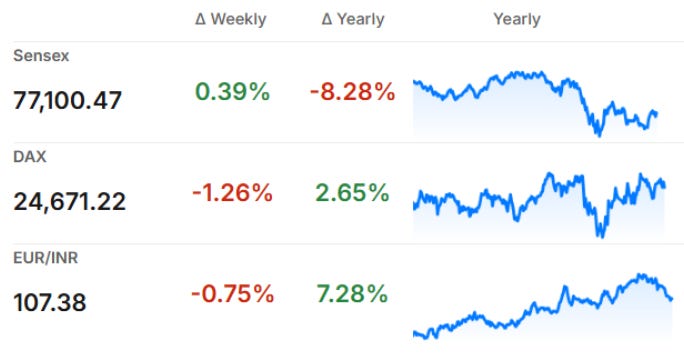
The Sensex closed the week at 77,100.47, up 0.39% from last week’s close of 76,802.90, marking its third consecutive weekly gain. The week was not without turbulence — markets dipped sharply on Monday (June 23) as the index fell nearly 893 points to 76,200 before recovering strongly through the week. The key driver behind the recovery was a significant fall in crude oil prices following the US-Iran peace process. On the flip side, IT stocks were a notable drag, after global tech giant Accenture issued a weaker-than-expected revenue outlook and warned of a $400 million hit to its Middle East business, sending Infosys, TCS, HCL Tech, and Wipro lower. Defence, pharma, and broader mid- and small-cap stocks helped cushion the week’s gains, while Reliance Industries drew attention after announcing plans to file for Jio Platforms’ IPO.
The DAX closed the week at 24,671.22, down 1.26% from last week’s close of 24,985.82, with the index sliding below the key 25,000 level during the week. The biggest blow came on Tuesday (June 23) when Germany’s Flash Composite PMI dropped to 48.0, the lowest in 18 months, confirming a third straight month of economic contraction, driven by a sharp decline in the services sector, which fell to a 43-month low of 46.8. A broader global tech selloff, which also hit Asian and US markets, compounded the selling pressure in Frankfurt. While Germany’s manufacturing segment held slightly above 50, providing limited support, weak new business orders and deepening services stress kept sentiment negative through the week.
Germany News Roundup
Germany's services sector continues to be the biggest drag on the economy, with both activity and new orders declining at accelerated rates in June.
Germany's PMI data confirmed the economy contracted for the 3rd consecutive month in June, keeping political pressure high on the ruling coalition.
Germany's growth of 0.5% in 2026 makes it one of the slowest-growing major economies in Europe, limiting near-term equity upside.
Germany's expert pension commission delivered 33 reform recommendations to Chancellor Merz on June 23, including gradually raising the retirement age beyond 67
Volkswagen is weighing another round of large-scale job cuts, according to a June 26 AFP report, as the auto giant continues to struggle with slowing EV demand and high production costs in Germany.
India News Roundup
ISRO successfully hot-tested its semi-cryogenic engine power head on June 24 at Mahendragiri, Tamil Nadu, a key milestone for India's next-generation launch vehicle program.
India conducted its first satellite-based jet aircraft landing (GAGAN system) at Udaipur airport on June 27, marking a leap in aviation safety tech.
Indian Navy commissioned three indigenously built vessels — INS Dunagiri, INS Agray, and INS Sanshodhak at Kolkata's GRSE shipyard on June 22.
India initiated an anti-dumping investigation into steel imports from China, Japan, and Russia, signaling protection of domestic steel industry.facebook
West Bengal set to table a Uniform Civil Code Bill on June 29, making it a politically significant legislative session.
Opportunity
NSE IPO
You Can Now Own a Piece of India’s Stock Market Itself
“Every time someone in India buys or sells a stock, NSE earns a fee. What if you could be on the other side of that?”
Most investors spend their lives buying stocks on the National Stock Exchange. This December, for the first time, you may be able to buy a stock of the National Stock Exchange.
On June 17, 2026, NSE, India’s largest stock exchange and the world’s biggest equity derivatives exchange, filed its 607-page Draft Red Herring Prospectus (DRHP) with SEBI, formally beginning the process for what could become the largest IPO in Indian stock market history.
Why This IPO Is Different From the Rest
It is not raising fresh money. The IPO is entirely an Offer for Sale, meaning existing shareholders like SBI, Canada Pension Plan (CPPIB), and Singapore’s Temasek are selling a small portion of their stakes. NSE itself gets none of the IPO money. This is a pure liquidity event for long-held institutional stakes. Importantly LIC, NSE’s largest shareholder with 10.72% stake is not selling, suggesting long-term confidence in the business.
It is a near-monopoly. NSE controls close to 100% of India’s equity derivatives market by volume, a position it has held unchallenged since the early 2000s. No competing exchange has managed to take meaningful market share in F&O. This is the kind of structural moat that investors pay a premium for.
The financials are exceptional with one catch. With ₹10,302 crore in net profit and over 50% net margins on zero debt, NSE reads like a dream investment. However, FY26 profit fell 15.5% from FY25’s ₹12,188 crore. The reason? SEBI tightened F&O trading rules in October 2024, which reduced speculative options volumes, NSE’s biggest revenue driver. The honest question every investor must ask is: Was FY26 a temporary dip, or the start of a new normal?
Things to Watch Before Applying
🕐 Timing: SEBI will take 30–75 days to review the DRHP. The IPO is expected to open for subscription around September–October 2026.
📊 Valuation: Current grey market pricing implies a valuation of ~₹5 lakh crore, or about 48–50x FY26 earnings. That is not cheap, but for a monopoly infrastructure asset, many analysts consider it fair.
⚠️ Risk: If SEBI further restricts F&O activity in future, NSE’s revenue could fall further. Keep this in mind as a regulatory risk unique to this investment.
📰 Decade-Long Wait: NSE first tried to list in 2016. It was blocked due to governance concerns (the “co-location controversy”). NSE settled the matter with SEBI in June 2025 by paying ₹1,388 crore, the largest-ever SEBI settlement. The IPO path is now clear.
Disclaimer: This is not financial advice. Please consult a SEBI-registered financial advisor before making any investment decision.
Until Next Sunday…
Conclusion
India is in a moment of quiet confidence. GDP at 7.7%, crude oil falling, a once-in-a-generation IPO wave building, and the government commissioning warships while signing trade deals. There is a real sense that India is no longer waiting for the world, it is setting its own pace.
Germany, on the other hand, is at an honest crossroads. The country that built its identity on engineering excellence had its entire train network shut down by a scheduled software update on a 30-year-old communication system. The same week, its industrial lobby cut the GDP forecast, services entered recession, and the pension system came under its biggest reform pressure in a generation.
See you next Sunday,
Jimit Patel