
Wednesday, June 3rd, was supposed to be a diplomatic formality. Germany, Europe’s largest economy, the second-biggest financial contributor to the United Nations, a country that has served on the Security Council six times without ever losing a bid, walked into the General Assembly Hall in New York fully expecting to walk out with a seat. It didn’t.
In secret ballots cast by member states for the Western European seats, Portugal received 134 votes and Austria received 131. Germany received 104, falling 23 short of the two-thirds majority required for election. It was the first time Germany had ever failed to enter the Security Council. Chancellor Friedrich Merz had flown to New York for the occasion. German Foreign Minister Johann Wadephul called it “a real disappointment.”
The question everyone started asking immediately after: why?
Speaking to reporters after the vote, Wadephul suggested Berlin’s support for Ukraine and Israel may have played a role. “We have always taken a clear stance on certain issues, and these are positions that not all member states share,” he said. “The fact that Germany must always assume a special responsibility for Israel in the Middle East conflict may also have cost votes.”
But the picture is more layered than that. Since October 2023, the UN General Assembly voted on at least seven resolutions related to Gaza and the broader question of Palestine. Germany abstained on four of them, including two resolutions that called for a humanitarian truce or ceasefire. Berlin also abstained on a vote to support Palestine’s bid for enhanced UN membership and on a resolution demanding that Israel end its unlawful presence in the occupied Palestinian territory. It later voted in favour of ceasefire resolutions in 2024 and 2025 by which point tens of thousands of Palestinians had already been killed.
The Global South was watching all of it. For the 193 nations that cast a ballot, a vote for Germany would have been a vote to seat, at the world’s most powerful table, a country that many view as having shielded a conflict from accountability. The arithmetic of the UN General Assembly, where every nation, from Germany to Tuvalu, gets exactly one vote — doesn’t always reward economic weight or diplomatic history.
Meanwhile, the countries that did win reveal something about what the world currently rewards. Austria highlighted its neutrality. Portugal leveraged its role as a bridge between Europe and its former colonies to secure support. Both offered something Germany couldn’t in this moment: a reputation untangled from the most divisive conflict of the past three years.
Back in Berlin, the opposition Greens labeled the result an “embarrassing defeat,” with deputy leader Agnieszka Brugger claiming the government did “far too little to underpin this bid with modern ideas.” Merz, for his part, insisted Germany remains a “reliable pillar of the multilateral system.”
What the vote actually revealed is something more uncomfortable: that Germany’s self-image as a moral anchor of the international order, rebuilt painstakingly after the Second World War took a visible hit this week, not from its adversaries, but from a majority of its nominal partners. A seat at the world’s most powerful table is, in the end, not simply claimed. It is granted. And this week, 89 countries decided not to grant it.
Stock Market
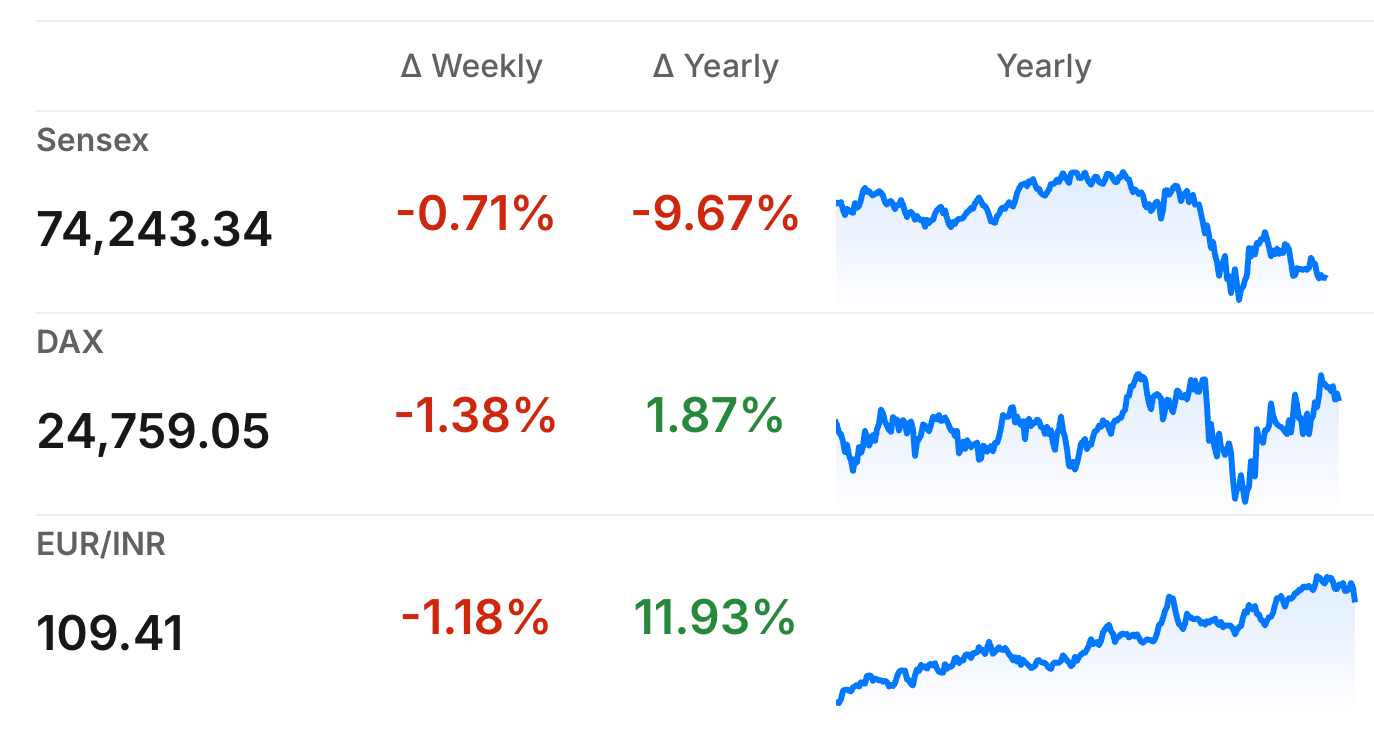
The Sensex closed this week at 74,243, down 0.71% from last week’s close of 74,775. It was a turbulent week dominated by two big events: the RBI’s monetary policy decision on Friday and ongoing anxiety over the US-Iran conflict’s impact on oil prices. The rupee tumbled to near-record lows as oil prices extended their recovery, driven by renewed hostilities in the Middle East, while foreign funds continued flowing out of Indian equities. IT stocks were a relative bright spot mid-week, while financials and autos stayed under pressure.
The DAX closed the week at 24,759, down 1.38% from last week’s 25,104. The index fell for most of the week, with two forces working against it. Ongoing tensions in the Middle East and stalled US-Iran negotiations weighed on sentiment, while a disappointing earnings report from US chipmaker Broadcom cooled enthusiasm for AI-linked technology stocks. Infineon Technologies, the DAX’s leading semiconductor stock, slid over 5% on Friday as the tech selloff hit hard. Heavyweight industrials Siemens and Siemens Energy also declined, while defensively positioned stocks like Symrise, Hannover Ruck, and E.ON posted modest gains.
Germany News Roundup
Lufthansa Dreamliner Incident at Frankfurt Airport, results in nose gear collapse injuring staff and prompting an ongoing investigation, with the affected plane being towed for repairs. - hessenschau
Trade Republic Enables Open IPO Participation, allowing customers to invest directly via smartphone at official allocation prices with minimal fees on selected IPOs, expanding access beyond institutional investors. - Stadt Bremerhaven
Rewe, IKEA, H&M Workers Strike Two Days, protesting insufficient wage offers amid rising corporate profits, demanding 250 euros monthly raises and better terms to match inflation pressures. - hessenschau.de
Germany Accelerates Massive Military Buildup, breaking decades of fiscal restraint with multi-billion euro defense spending beyond debt limits and boosting troop numbers, weapon production, and NATO roles by 2027 and beyond. - OkDiario
Lilly Cuts Germany Investment by Half, redirecting funds to Pennsylvania or a new U.S. site due to cost caps in Germany's health insurance system, impacting Alzey plant capacity and jobs. - whtc.com"
India News Roundup
India Signs Strategic BrahMos Missile Deal with Vietnam, marking a significant defense cooperation step as India prepares a similar agreement with Indonesia and builds ties with ASEAN nations through advanced technology sharing. - DW
India’s Gen Z Cockroach Party Protests, mobilizing thousands in New Delhi demanding Education Minister’s resignation over exam irregularities, reflecting youth frustrations on jobs and education reforms under Modi’s government. - France 24
Siemens Sells Motors Business to Innomotics India, for Rs 2,200 crore, completing the transfer of Low Voltage and Geared Motors operations, enhancing Innomotics’ market presence in India. - Rediff Money
Coca-Cola Plans Public Listing for Indian Bottler, aiming for a 2027 listing on Bombay and National Stock Exchanges to capitalize on growth and partially sell shares through Hindustan Coca-Cola Holdings Pvt. Ltd. - The Coca-Cola Company
RBI Doubles NRI Investment Limit to 10%, allowing increased participation in Indian markets and considering similar access for other foreign investors to simplify investments further. - NewsBytes
German Airports Remove Transit Visa for Indians, starting June 3, allowing layovers without visa but travelers cannot leave the airport transit zone, reflecting stronger Indo-German relations and easing travel. - Times of India
Opportunity
Gold Mutual Funds - India’s Quiet Outperformer

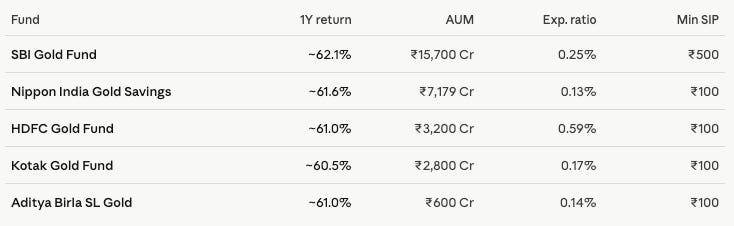
Gold mutual funds have delivered roughly 60–62% returns over the past year, a remarkable figure, especially when the Sensex is down nearly 10% over the same period. The shift began in 2024 when central banks globally accelerated gold purchases, and accelerated sharply through 2025 as US tariff wars, Fed rate uncertainty, and geopolitical tensions drove institutional money into safe havens. The real inflection point came in early 2026: the US-Iran conflict disrupted the Strait of Hormuz, oil prices spiked, and the rupee fell from ₹90 to nearly ₹96 against the dollar. In Q1 2026, India’s domestic gold price rose 20% quarter-on-quarter and 81% year-on-year, and India’s investment demand surged 52% year-on-year, surpassing jewellery consumption for the first time on record. That shift from gold as ornament to gold as asset, reflects a maturing investor mindset that is here to stay.
All five funds in the table work the same way: they invest in gold ETFs backed by physical gold, tracking the MCX domestic price. Returns are tightly clustered because the underlying is identical, what separates them is cost and accessibility. Nippon India Gold Savings stands out for having the lowest expense ratio (0.13%) and the smallest minimum SIP (₹100), making it the most accessible. SBI Gold leads on AUM at ₹15,700 crore, the sheer scale reflecting investor trust. Aditya Birla and Kotak both combine low expense ratios with competitive 3-year CAGRs. ICICI Bank Research expects domestic gold prices to trade between ₹1.5 lakh and ₹1.8 lakh per 10 grams through 2026, a consolidation phase rather than a sharp correction, with structural support intact. For investors not yet holding any gold exposure, a staggered SIP entry rather than a lump sum at near-record prices, remains the prudent approach.
Read more:
🔗 List of Top Gold Mutual Funds in India 2026 — Smallcase / Tickertape — fund screener with live NAV, 5-year CAGR, and AUM data
🔗 Gold Demand Trends India Q1 2026 — World Gold Council — primary source on ETF inflows, investment demand, and import data
🔗 Why experts see gold trading between ₹1.5–1.8 lakh through 2026 — BusinessToday — price outlook and expert commentary
Until Next Sunday…
Conclusion
As the calendar moves deeper into June, attention is already turning toward the next gathering of global leaders at the G7 summit in France later this month, where trade, energy security, technology, and economic resilience are expected to remain high on the agenda. At the same time, the arrival of the monsoon season across India serves as a reminder that weather can be as important to markets as policy, influencing everything from agriculture and consumption to inflation expectations. The week ahead may offer fewer headlines than some, but it arrives at a moment when investors are watching both boardrooms and clouds on the horizon with equal interest. Wishing you a calm and productive week ahead.
See you next Sunday,
Jimit Patel