
Last week, we wrote about India’s fuel prices beginning to move again after years of staying still. This week, that story didn’t slow down, it accelerated. The fourth revision in under two weeks landed on Monday, pushing the cumulative increase in petrol and diesel to nearly ₹7.5 per litre since May 15. And the uncomfortable part? Sources indicate a fifth hike has not been ruled out analysts note that with Delhi petrol at ₹102.12, prices may still be below the break-even cost for oil marketing companies at current crude levels.
To put that in perspective: in roughly three weeks, the cost of filling a 40-litre tank has gone up by around ₹300. The trigger runs deeper than just the hike cycle, India’s crude oil import basket has jumped from $69 per barrel in February 2026 to an average of $113–114 per barrel more recently, driven by the ongoing US-Iran conflict and disruptions to energy flows through the Strait of Hormuz. State-run oil companies were losing roughly ₹1,000 crore daily by early May, making the price freeze financially unsustainable. The hikes, then, are not a policy choice as much as a delayed reckoning, years of absorbed losses finally surfacing at the pump.
Meanwhile, Germany handed markets a small but meaningful piece of good news on Friday. Inflation came in at 2.6% for May, below both the previous month’s 2.9% and the market’s own expectation of 2.8%. That might sound modest, but the direction carries weight. For months, the same energy shock pushing up fuel costs in India has been stoking price pressures in Europe too. German energy prices are still up year-on-year, but the rate of increase is slowing and core inflation, which strips out food and energy, held at 2.5%, suggesting the broader price environment is steadier than the headlines suggest.
Stock Market
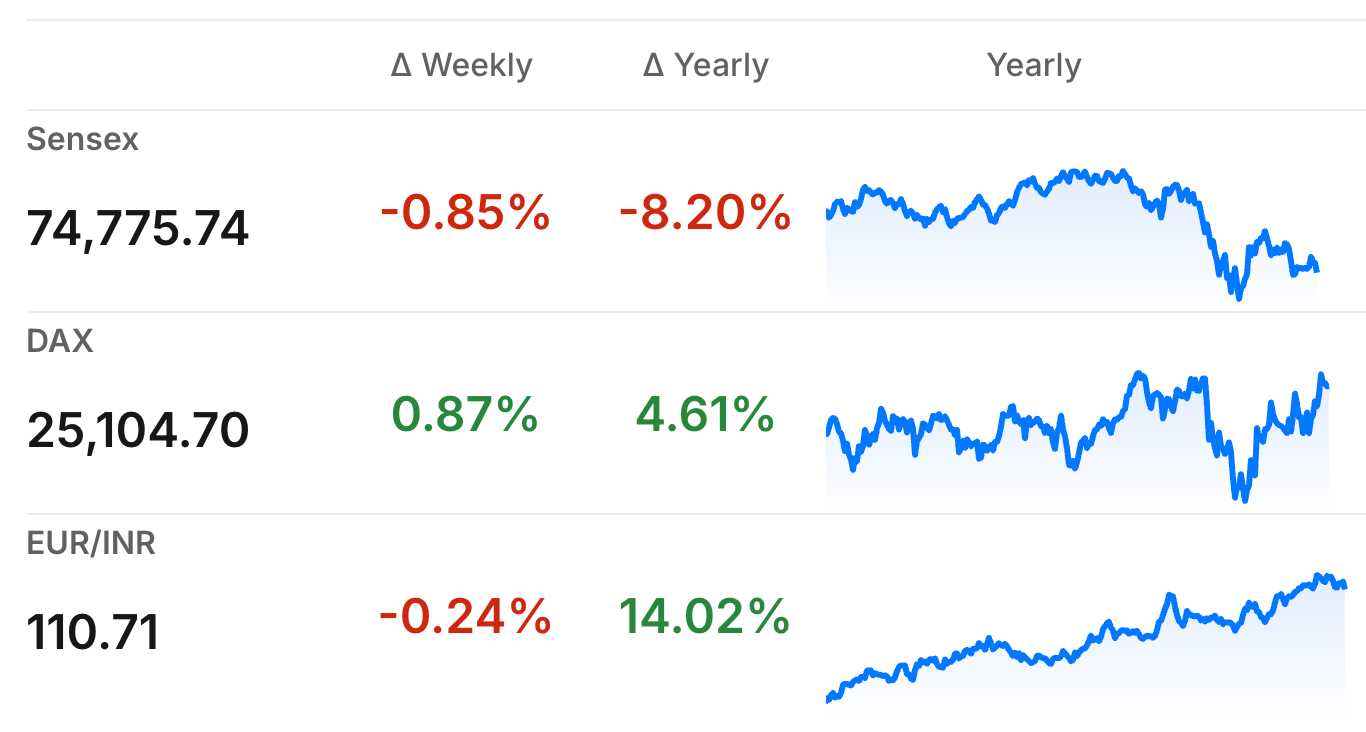
The Sensex closed the week at 74,775.74, falling 1,092 points on Friday alone, the third consecutive session of decline. It was a week of two contrasting halves. Monday opened strongly, with the index surging over 1,000 points after crude prices dipped below $100 per barrel on hopes that the Strait of Hormuz could reopen, but that optimism evaporated quickly. By Friday, broad-based selling pressure took hold as three factors converged: a below-normal monsoon forecast from the IMD, continued uncertainty around the US-Iran ceasefire, and persistent selling by foreign investors. Oil & gas was the worst-hit sector, down 2.47%, followed by metals, autos, and infrastructure, all facing concerns around inflation and a weaker demand outlook. IT was the only sector to close the week in the green, supported by strong corporate news including Wipro’s AI partnership with ServiceNow.
The DAX told a different story. Closing the week at 25,104.70, up 0.87% from the prior week’s 24,888.56, Frankfurt managed a modest but meaningful gain. The index was buoyed by rising hopes of a near-term US-Iran agreement, with reports of a draft deal to extend the ceasefire, while oil prices fell to more than one-month lows, easing cost pressures across energy-sensitive sectors. SAP and Zalando led the gains, while Bayer, Siemens Energy, and Beiersdorf underperformed.
Germany News Roundup
CDU Proposes Children Pay Parents’ Care Costs, forcing earlier financial responsibility to prevent rising care insurance contributions and counteract wealth shielding via inheritance strategies in Germany’s healthcare system. - Tagesspiegel
Childfree Adults Face Higher Elder Care Contributions, with a proposed tax increase to 2.5% income contribution rate, while parents pay lower rates based on number of children, affecting all full-time workers over 23. - DW
Bundesnetzagentur Plans Solar Grid Fee Reform, proposing higher network charges for private solar panel owners as electricity prices turned negative during surplus solar production. - RP-Online
Chinese E-Truck Makers Target European Market, planning to replicate their passenger car success by capturing significant shares in Europe’s electric commercial vehicle sector with well-prepared launches and competitive offerings. - Handelsblatt
Germany’s Economy Faces Prolonged Stagnation, with forecasts lowered to minimal growth amid rising energy costs, aging population, and competitive global pressures challenging economic recovery and budget stability. - DW
German Economy Minister Advocates Dialogue with China, emphasizing open communication to enhance bilateral economic relations during his visit amidst global trade challenges. - MSN
India News Roundup
India-US Critical Minerals Supply Framework Signed, boosting cooperation in mining, processing, recycling, investments, and supply chain security for critical minerals and rare earths, advancing strategic collaboration between the two nations. - MEA India
Myanmar President's Official Visit to India, to strengthen historical ties, engage in business forums, and support multi-faceted relations under India’s Neighborhood First and Act East policies. - MEA India
$500 Billion US Goods Deal Questions India's Gains, as tariff framework collapses, trade concessions lose value, risking India's economy and currency amidst increased dollar outflows and a growing trade deficit. - The Wire
Australia Foreign Minister's Strategic India Visit, advancing bilateral cooperation across trade, defence, education, and regional security, while reaffirming commitment to a free Indo-Pacific and planning future dialogue in Australia. - MEA India
RBI Plans Polymer Currency Notes in India, to reduce production costs, increase durability, and meet rising demand amid surging currency circulation and technological readiness. - Business Standard
Eicher Motors, Volvo form 50:50 JV for financing, aiming to combine Volvo’s financial expertise and Eicher’s network to enhance vehicle financing options in India, subject to regulatory approvals. - Hindustan Times
German HAS to Invest in Nano-Agriculture in India, with a €1 million plan to enhance crop health, reduce chemical use, and promote sustainable farming through advanced nanotechnology innovations for Indian farmers. - The Hindu Business Line
Opportunity
The Case for a Junior Depot
Every month, the German state quietly deposits money into your account that most parents treat as household budget. Kindergeld, Germany’s universal child benefit — pays €259 per month per child, regardless of income, to every eligible parent in the country. Over 18 years, that’s nearly €56,000 per child, sitting in your current account, slowly losing value to inflation. But there’s a smarter way to use it.
Enter the Junior Depot - Germany’s version of a custodial investment account, opened in the child’s name, managed by the parent, and one of the most tax-efficient wealth-building tools available to families living here.
How it works
A Junior Depot is a brokerage account that legally belongs to the child from day one. Parents manage and invest the money until the child turns 18, at which point the child gains full control of the account and everything in it. The parent decides where to invest, most families use low-cost index ETFs via a monthly savings plan (Sparplan) and the compounding does the rest over two decades.
The key advantage isn’t just the investment returns. Because every child is treated as an independent taxpayer in Germany, they receive their own annual tax-free allowance (Sparerpauschbetrag) of €1,000 per year on investment income. In addition, children can use the general income tax exemption (Grundfreibetrag) of €12,348 per year, meaning that in combination, up to €13,348 in annual investment income can be completely tax-free, as long as the child has no other income.
The best platforms right now
In 2026, the top-rated Junior Depot providers are Trade Republic, Scalable Capital, Finanzen.net Zero, Consorsbank, and ING — all of which charge zero account fees and offer a broad selection of investable ETFs.
What to invest in
For most families, a single globally diversified accumulating ETF is all that’s needed. The go-to options are the MSCI World (covering ~1,500 large and mid-cap companies across 23 developed markets) or the FTSE All-World (which also includes emerging markets). Both keep annual costs well under 0.25% and have historically delivered strong long-term returns. “Accumulating” variants automatically reinvest dividends, keeping taxable events low and compounding working quietly in the background.
The numbers, simply put
If you invest just the Kindergeld, €259 a month into a globally diversified ETF starting at birth, and assume a conservative 6% annual return, you’d be handing your child a portfolio of roughly €95,000 on their 18th birthday. That’s education fees, a first flat deposit, seed capital for a business, or simply a financial head start that most young adults never get.
Until Next Sunday…
Conclusion
Next week, much of Germany slows down for a day. Fronleichnam - Corpus Christi, falls on Thursday, June 4th, a public holiday in Bavaria, NRW, Baden-Württemberg and several other states, when streets fill with processions, flowers, and a rhythm that feels deliberately unhurried. It's one of those calendar moments that reminds you Germany still knows how to pause, even mid-week. And two days later, Berlin opens its universities and research labs to the public for the Long Night of the Sciences from 5pm to midnight, dozens of institutions throw their doors open, turning one of Europe's great capital cities into a giant, walkable curiosity. Two very different events, same week, one ancient, one forward-looking. Not a bad way to start June.
See you next Sunday,
Jimit Patel