
Something shifted at the fuel pump this week. Quietly, with little fanfare, the price of petrol climbed again in India, the third hike in just ten days, pushing prices to levels the country hasn’t seen since May 2022. For most people, it registered as a small but undeniable pinch: a heavier auto-rickshaw bill, a slightly more expensive grocery run, a delivery charge that crept up without explanation. By May 23, petrol had touched around ₹99 per litre in Delhi and ₹110 in Kolkatam marking a cumulative rise of nearly ₹5 per litre in major cities within less than two weeks.
The ripple effects extend well beyond the price board at your nearest petrol station. When fuel costs rise, so does the cost of moving everything, food, medicine, manufactured goods. Businesses that had budgeted their freight costs months ago are now quietly recalculating. India’s private sector activity remained in expansion territory through May, but growth in new orders, exports, employment, and overall business activity softened noticeably, according to HSBC’s flash PMI survey. The good news, such as it is: experts warn that elevated crude prices, a weak rupee, and persistent under-recoveries could force tougher policy choices if the West Asia crisis drags on, suggesting this story is far from over.
Meanwhile, across the world in Berlin, Germany’s Chancellor Friedrich Merz took a step that could quietly reshape the political map of Europe. On May 21, Merz proposed granting Ukraine an unprecedented “associate member” status within the European Union, an intermediate position that would bring Kyiv closer to the bloc while its full membership bid continues. The proposal was shared through a letter addressed directly to European Commission President Ursula von der Leyen and European Council President Antonio Costa.
This matters more than it might first appear. Full EU membership for Ukraine has always been a long, bureaucratic road , years of reforms, negotiations, and unanimous agreement from all 27 member states. An associate status would be something new: a way to deepen economic and political ties without waiting for that entire process to conclude. For businesses and workers across Europe, it could eventually open up labour markets, supply chains, and investment corridors in ways that have rarely been discussed openly.
And then, fittingly, this week ended with a quiet but meaningful moment. On May 23, Germany marked the 77th anniversary of its Basic Law, the constitution adopted in 1949 that laid the foundation for a democratic Germany rising from the ashes of World War II. In 2026, for the first time, Germany officially designated May 23 as its Day of the Basic Law, an initiative launched by President Frank-Walter Steinmeier to encourage residents to engage in public and political life. Buildings across the country flew flags. Schools held discussions. Citizens were gently reminded of what it took to build something worth protecting.
Stock Market
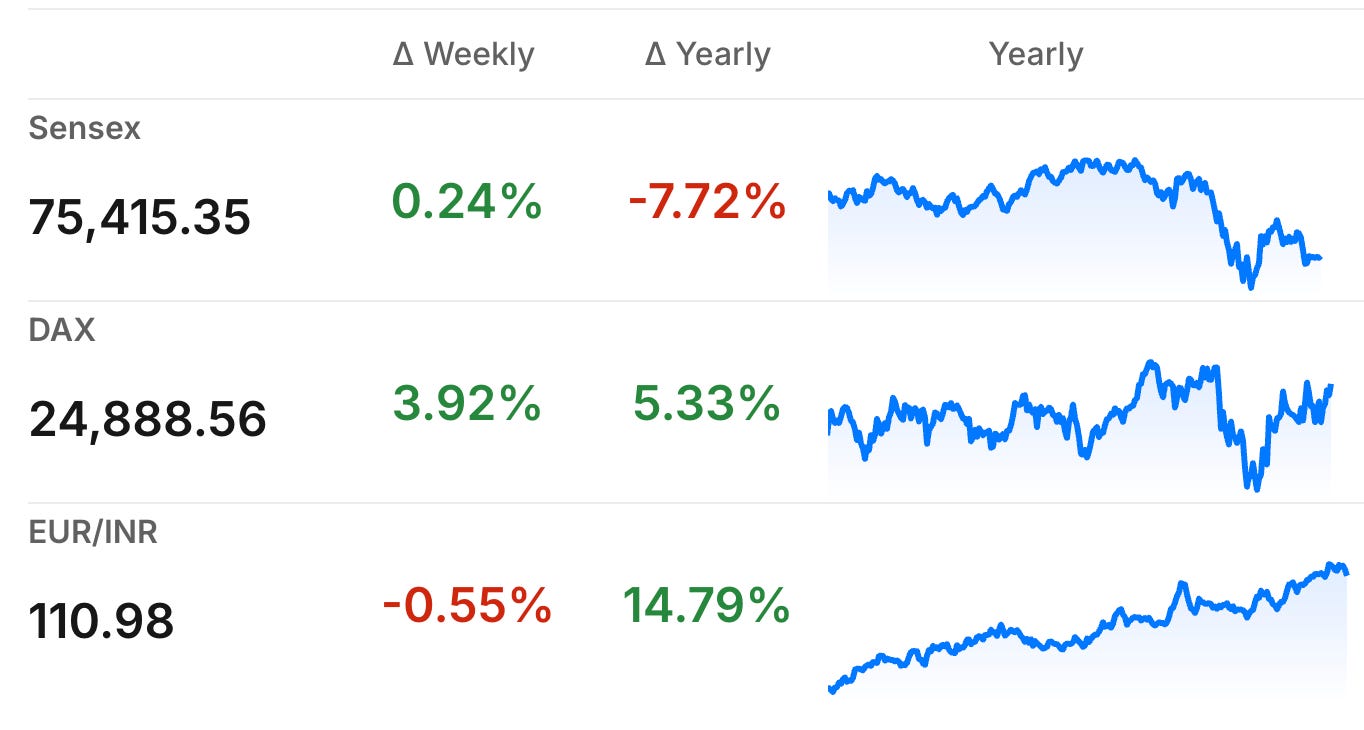
The Sensex closed the week at 75,415.35, a modest gain of 0.24% from the previous week.It was a cautious week for Indian markets. The key macro driver remained geopolitical: markets closely tracked US-Iran peace talks, watching whether Washington and Tehran could make progress on access to the Strait of Hormuz. Any hint of a resolution lifted sentiment briefly; any setback pulled it back. Banking stocks provided the clearest support, with Axis Bank (+2.5%), ICICI Bank (+1.8%), and HDFC Bank (+1%) among the top performers, while pharmaceuticals and utilities lagged, with Sun Pharma falling 2.7%. Foreign investors remained net sellers, FII outflows on Friday alone stood at ₹4,440 crore, with domestic institutions stepping in to partially absorb the pressure at ₹6,003 crore in net purchases. Elevated oil prices from the ongoing Iran conflict continued to weigh on sentiment, keeping the overall mood measured rather than confident.
The DAX had a strong week, closing at 24,888.56 — up 3.9% from the previous close, its highest level in over two weeks. The rally was driven by a combination of tech momentum, improved German consumer and business sentiment heading into June, and growing hopes for a negotiated resolution to the Iran conflict. Infineon Technologies was the standout performer, surging over 7%, while Deutsche Post gained 3.9% after Deutsche Bank upgraded the stock to "buy." Sportswear names Puma and Adidas gained 5.9% and 2.4% respectively, buoyed by strong results from US rival Deckers Outdoor and growing anticipation around the FIFA World Cup. On the downside, real estate firm Vonovia fell 5.3% and Fresenius Medical Care dropped 3.9%.
Germany News Roundup
Porsche Pauses Production Over Taycan Sales, due to reduced demand for the electric Taycan, impacting profitability and prompting a shift toward combustion and hybrid models amid declining sales and profits. - SWR
Germany and Japan Lead Hydrogen Vehicle Innovation, as BMW and Toyota jointly develop advanced fuel cell technologies aiming for mass production to reduce reliance on fossil fuels by 2028 and expand green hydrogen use amid growing industrial demand. - DW
Germany Invests Heavily in Defense Firm KNDS, with plans to acquire a 40% stake initially, reducing to 30% over three years while maintaining strategic voting rights alongside France. - ua.news
Uber Considers Full Takeover of Delivery Hero, as part of its strategic expansion into Germany’s competitive food delivery market, potentially increasing its European presence significantly. - MSN Money
Mercedes Plans Urban Assisted Driving Launch Germany, with MB. DRIVE ASSIST PRO available in select cities by end 2026 to compete with BMW and Tesla in European automated driving tech. - Marketscreener
Stihl’s Breakthrough in Battery-Powered Chainsaws, introduces a high-performance battery boosting power by 60%, enabling professional use and marking a major shift from traditional petrol engines in forestry equipment. - Schwaebische
India News Roundup
India-Italy Elevate Ties to Strategic Partnership, expanding cooperation in trade, technology, defence, science, culture, and multilateral initiatives with goals to boost bilateral trade to €20 billion by 2029 and advance global connectivity projects. - pmindia.gov.in
India's Viral 'Cockroach' Movement Surges, millions of young Indians join this satirical yet serious political platform expressing frustration and demanding democratic change amid rising politicization and activism. - DW
India, Norway Form Green Strategic Partnership, strengthening collaboration on clean energy, climate resilience, blue economy, green shipping, technology, and space, with shared commitments to innovation and global digital solutions. - Newsonair
India Issues Ebola Advisory for Travelers, cautioning those linked to affected African regions amid a major Bundibugyo strain outbreak and WHO global health emergency, despite no cases reported in India so far. - Down To Earth
PM Modi Returns After Transformative Five-Nation Tour, signing key pacts on energy, defence, critical minerals, and elevating ties with Italy, Netherlands, Sweden, and Nordic countries while receiving multiple honors abroad. - The Hindu
Volvo and Eicher Motors Form India JV, to expand financial services support tailored for the Indian commercial vehicle market under a new joint venture partnership. - Volvogroup
Varun Beverages Extends PepsiCo Deal to 2049, gaining broader business freedom and expanding operations domestically and internationally, including African markets and potential new beverage categories. - Economic Times","
Nikhil Kamath Urge to Simplify NRI Investment Rules for India's Growth, to remove unnecessary barriers and encourage greater participation of overseas Indians in India's economic development with easier digital onboarding and reduced paperwork hurdles. - Whalesbook
Eurobank Launches UPI Remittances to India, offering the first European bank service for Greece and Cyprus to send cross-border payments with minimal transaction charges and opening a Mumbai office to boost EU-India trade ties. - Economic Times
Opportunity
Indian IT Sector
India’s information technology sector, the industry that put the country on the global economic map is going through its most significant rethink in decades. The arrival of powerful AI tools capable of automating the core work that Indian IT firms have sold to global clients for years triggered a brutal sell-off earlier in 2026. The Nifty IT index lost nearly 27% between early February and mid-May, against a much milder 9% decline in the broader market. This is not a routine correction. Mutual funds have collectively slashed their technology exposure to an eight-year low of 6.7% as of April 2026, reflecting a genuine structural debate about whether the old IT services model, built on deploying large teams of engineers for global clients can survive the age of AI agents that do the same work faster and cheaper.
The data from 203 actively managed diversified funds tells a fascinating story of a market at a crossroads. Of those tracked, 177 funds reduced their exposure to the sector, some dramatically cutting technology allocations by as much as 13 percentage points. Yet 26 funds moved in the opposite direction, quietly adding to positions in a falling sector, betting on a recovery.
Industry analysts estimate that AI could cause 2–3% annual revenue deflation in traditional IT services for the next two years, with the peak disruption window running through FY28, but they also project an AI-driven expansion of the addressable market worth $300–400 billion by 2030, as enterprises eventually spend more on AI transformation than they currently do on conventional outsourcing.
For everyday investors, this divide between the cautious and the conviction-buyers is itself the signal worth studying. Broadly diversified funds not sector-specific bets are the right lens here, precisely because they allow professional fund managers to make and revise these difficult calls on your behalf. The risk of getting the timing wrong on a sector in genuine transition is real; so is the risk of missing a recovery entirely. The full breakdown of which funds cut, which bought, and what it means for portfolios sitting in IT-heavy schemes is worth reading carefully.
Read the full analysis and specific investment recommendations here: Value Research
Until Next Sunday…
Conclusion
Today morning, over a million young Indians will sit down at exam centres across the country to attempt the UPSC Civil Services Preliminary exam, the first and most gruelling gate in what many call the hardest career path in India. Each of these candidates has spent months, sometimes years, preparing for four hours that could define the rest of their professional lives. Whatever one thinks about institutions, bureaucracies, or the pace of change, there is something quietly stirring about a democracy where a million people still believe that public service is worth that kind of sacrifice.
See you next Sunday,
Jimit Patel