
On May 10, 2026, Prime Minister Narendra Modi stood before a public gathering in Hyderabad and made an unusual appeal to the nation, not about borders or ballots, but about everyday choices. He urged Indians to work from home, avoid international trips, and hold off on buying gold. He asked families to carpool, take the metro, and even rethink how much cooking oil they use. For a country that loves its weddings, its foreign holidays, and its jewellery, it was a striking ask. But behind it lay a story that’s been building quietly for months.
The backdrop is a world on edge. Crude oil prices have been trading above $100 per barrel due to the West Asia crisis, with prices touching a 52-week high of $126 per barrel at the end of last month, while the deadlock in the Strait of Hormuz persists. For India, this is not just a geopolitical headline, it hits the economy where it hurts most. India is the world’s third largest oil importer after China and the US, and crude oil is the single largest contributor to its import budget. When oil gets expensive, the country bleeds dollars faster. And right now, those dollars need to be guarded.
Gold makes the problem sharper. India is among the biggest buyers of gold worldwide and relies heavily on imports to meet domestic demand, so each surge in jewellery or bullion purchases adds to the import bill in dollars and weighs on India’s foreign exchange reserves and the rupee, especially when crude oil is also expensive. Indians imported gold worth $72 billion in the 2025–2026 fiscal year, second in the world only to China. Add to that the roughly 32.7 million Indians who travelled abroad in 2025, each trip converting rupees into foreign currency, and you begin to see the scale of the outflow. India’s foreign exchange reserves have already slipped from $728.5 billion in late February to $690.69 billion as of May 1, a fall of nearly $38 billion in just over two months.
Modi framed his message as “economic patriotism”, linking everyday household choices, fuel use, jewellery purchases, international vacations directly to macroeconomic stability. “Patriotism is not only about the willingness to sacrifice one’s life on the border,” he said. “In these times, it is about living responsibly and fulfilling our duties to the nation in our daily lives.” Whether or not Indians heed the appeal, the speech itself signals something important: the government is worried, and it’s asking citizens to share the weight. In the weeks ahead, how India navigates this pressure through policy, restraint, or both will be worth watching closely.
Stock Market
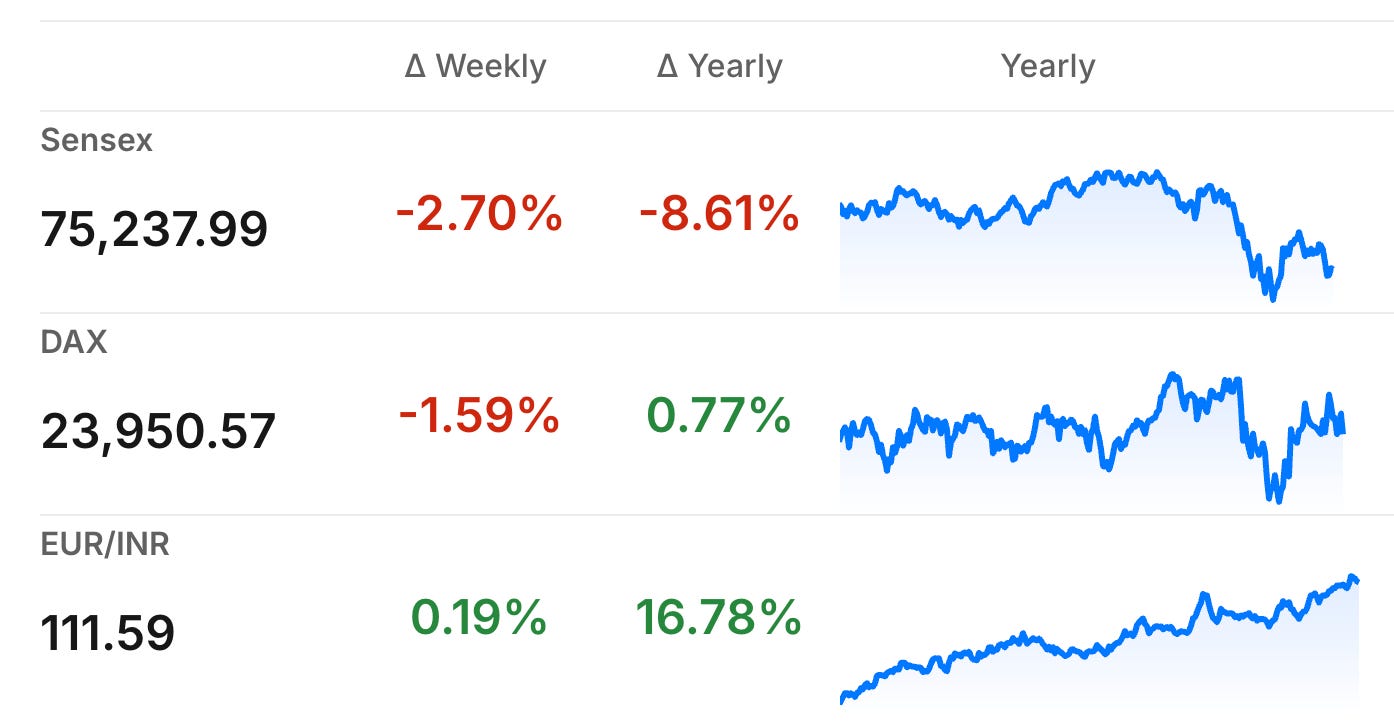
The Sensex had a difficult week, shedding 2,090 points to close at 75,237.99 and the headline number alone tells a larger story. This week, the pressure came from multiple directions at once. India raised petrol and diesel prices for the first time in four years by ₹3 per litre to partially offset losses from elevated global crude prices, while foreign outflows continued to weigh on sentiment. The inflation concern this triggers is real: the rupee hit an all-time low, touching 95.6250 against the dollar, as Brent crude held around $105 a barrel, keeping foreign fund outflows persistent. Metals and oil & gas stocks led the losses on Friday, wiping out most of the day’s intraday gains, with Tata Steel and Reliance Industries among the notable laggards though technology names like Infosys and Tech Mahindra managed to hold up, offering some cushion to the index.
DAX closed the week 1.59% lower at 23,950, with Friday alone dragging the index down over 2% as a late-week selloff erased the gains built earlier. Market sentiment was dented by stalled progress on the Iran conflict and inflation fears, alongside risks of renewed military escalation with US President Trump threatening Tehran again, signalling he would not be patient much longer. Investors had hoped the long-awaited Trump-Xi summit in China would bring some clarity on trade, but disappointment over the lack of concrete results from the summit, particularly on trade and the Iran issue, added to the week’s unease.
Germany News Roundup
Mercedes Considers Entering Defense Production, highlighting the need for European defense capability expansion and its potential contribution to the company’s growth despite being a small business segment. - Spiegel
Merz Government Ends Eight-Hour Workday, introducing a weekly 48-hour limit to enhance flexibility with mandatory electronic time tracking, while facing unions’ opposition and mixed public opinion. - Ruhr24
Germany’s Economy Hit by $52 Billion Tax Shortfall, due to fallout from the Iran war, impacting growth and fiscal revenues significantly this year. - MSN
German Auto Jobs at Risk by 2035, with 125,000 positions threatened due to EV transition, rising costs, competition, and EU climate policies impacting industrial competitiveness and employment. - News.Az
Tesla Expands Giga Berlin Battery Capacity, more than doubling production to 18 GWh and creating 1,500+ jobs with a $250 million investment, aiming for full local battery manufacturing integration in Germany. - Drive Tesla Canada“,”
Germany Expands Economic Ties in Johor, by sending 70 business representatives to explore investment and cross-border cooperation opportunities in the Johor-Singapore Special Economic Zone. - The Star
Munich Ends Free Kindergarten; Fees Triple, increasing municipal and private daycare charges from 2027 to 2029, impacting families financially in Germany’s most expensive city. - Sueddeutsche
Google Finance Expands AI Tools to Europe, bringing real-time data, advanced research, and live earnings calls with AI insights to users as part of a global rollout to 100 countries. - Pluang
India News Roundup
India Ranks Third in Renewable Energy Capacity, with significant growth in solar module and cell production, while still relying on imports for key components, particularly from China, as non-fossil fuel capacity surpasses 50%. - NewsOnAir
India Raises Bullion Import Duties to 15%, aiming to curb gold and silver imports amid a declining rupee and rising trade deficit driven by elevated energy costs and strong bullion demand in early 2026. - CNBC
India-U.K. Trade Deal Faces Steel Import Challenge, delaying implementation as both sides seek solutions to new UK steel quotas not included in initial negotiations, aiming for early activation despite late-stage issues. - The Hindu
India-UAE Sign Deals Enhancing Energy Security, bolstering strategic petroleum reserves and long-term LPG supplies, reducing vulnerabilities from geopolitical tensions and supply disruptions. - Times of India
Rajnath Singh Visits Germany for Defence Talks, aiming to enhance defence cooperation and likely discuss submarine deal opportunities between India and Germany during his visit starting Tuesday. - MSN
Opportunity
European Defence Merger and Acquisitions
We have covered the German defence theme in these newsletter several times, Rheinmetall, Hensoldt, Renk, and the ETFs that wrap them together. But this week, a detailed analysis from international law firm Bird & Bird offers a sharper lens on why this opportunity is far from over. The foundation is a spending commitment that governments across Europe cannot easily walk back. Crucially, all 32 NATO members are now on course to meet the 2% of GDP defence spending threshold, something only the UK and the US had consistently managed since 2010. Some member states have already signalled targets well above 2% by 2035. For investors, this is not a cyclical bump, it is a decade-long structural reorientation of European industrial policy.
What makes this moment particularly significant is a shift that is easy to miss: institutional money that was previously banned from touching defence is now actively moving in. For years, ESG frameworks categorically excluded defence companies from eligible portfolios, it wasn’t just unfashionable, it was structurally blocked. That changed after Russia’s invasion of Ukraine, and the European Commission has since made clear that defence investment is not excluded from sustainable finance frameworks. The European Investment Bank, which historically kept defence off its lending list, has now broadened its financing scope to cover defence-related investment.
The knock-on effect has been the emergence of dedicated defence funds across the continent from CataCap and ETNA in Denmark, Marondo Capital in Germany, and Tikehau Capital in France, to US heavyweight Warburg Pincus establishing a dedicated European defence investment platform.
Even Ireland, traditionally one of the most defence-averse markets in Europe due to its military neutrality has seen a dedicated defence fund, Fulcrum, set up within its borders. That alone speaks to how far the consensus has shifted.
For retail investors watching from the sidelines, the article points to two emerging angles worth understanding. The first is the rise of “neo-primes”, AI-driven defence companies built outside the traditional contractor model. Germany’s own Helsing, founded just in 2021, is reportedly raising $1.2 billion at a valuation approaching $18 billion, having already secured AI software contracts with the Bundeswehr and the UK Ministry of Defence. The second angle is the supply chain, which Bird & Bird describe as the more practical entry point for many investors. Tier-two and tier-three suppliers in propellants, semiconductors, advanced materials, simulation software, and maintenance services are seeing strong, sustained demand. Critically, the years-long qualification processes that once made these businesses unattractive are now precisely what make them defensible, they are hard to replicate and hard to displace.
Read the full Bird & Bird analysis here: European Defence M&A: The Investment Opportunity — Lexology
Until Next Sunday…
Conclusion
Before we sign off, here is something to look forward to. In less than four weeks, on June 11, the FIFA World Cup 2026 kicks off across the United States, Canada, and Mexico, the first edition ever to feature 48 teams across three host nations simultaneously. It arrives at a peculiar moment: crude oil above $100, markets under pressure and a war reshaping global supply chains. And yet, somewhere in all of that noise, a billion-plus will find a screen to watch, many quietly expecting their team to go deep into the tournament.
See you next Sunday,
Jimit Patel