
Germany just quietly tore up one of the most sacred rules in modern European economics and the ripple effects are only beginning to show.
For decades, Germany's "debt brake" was the economic equivalent of a constitutional commandment. Borrow little, spend carefully, balance the books. It was the philosophy that made German bonds the gold standard of European debt and Frankfurt a symbol of fiscal rectitude. That era is now firmly in the past. On 29 April, the German government approved the framework for its 2027 budget and the numbers tell a story that would have been unthinkable just five years ago.
Total new borrowing is set at $229 billion. To put that in perspective, Germany borrowed $58.8 billion in 2024. In the space of three years, the borrowing figure has roughly quadrupled. The government is not apologising for it. Finance Minister Lars Klingbeil described 2027 as the third consecutive year of record investment, and Chancellor Friedrich Merz made the strategic logic plain: the world has changed, and Germany is changing with it.
The single largest driver of this transformation is defence. Core defence spending will climb from $96.3 billion this year to $123.3 billion in 2027. Factor in the special defence fund and support for Ukraine, and the total defence envelope reaches $168.8 billion, equivalent to 3.1% of Germany's GDP, placing it comfortably within NATO's current benchmarks. By 2030, that share is projected to reach 3.7%. NATO leaders, it should be noted, have set a longer-term target of 5% by 2035, a figure that would have drawn laughter in a European finance ministry not long ago.
Ukraine sits at the centre of Germany's strategic calculus. Since Russia's full-scale invasion in February 2022, Berlin has provided approximately $64 billion in military support and $45 billion in civilian assistance to Kyiv, making it Ukraine's largest European backer by a considerable margin. That commitment continues: $13.5 billion is earmarked for Ukraine in 2027 alone.
Yet the budget is not only about guns and geopolitics. Of the $632.9 billion in total spending, 3.6% more than the previous year, a substantial $138 billion is directed toward investment. Transport infrastructure, hospital modernisation, and digital connectivity have been identified as the most urgent gaps. The special infrastructure and climate fund, approved alongside the loosening of debt rules in 2025, is the mechanism through which this spending flows. Klingbeil's stated priority was straightforward: secure existing jobs, create new ones, and restore economic growth to an economy that spent much of the past two years in contraction.
What emerges from this week's budget approval is a picture of a country in deliberate, if somewhat anxious, transformation. Germany is spending its way toward strategic relevance and economic revival simultaneously, borrowing heavily to do both. Whether that bet pays off will depend on whether the investment lands where it is intended, whether the growth materialises, and whether the geopolitical environment that is driving these decisions stabilises or deteriorates further.
Stock Market
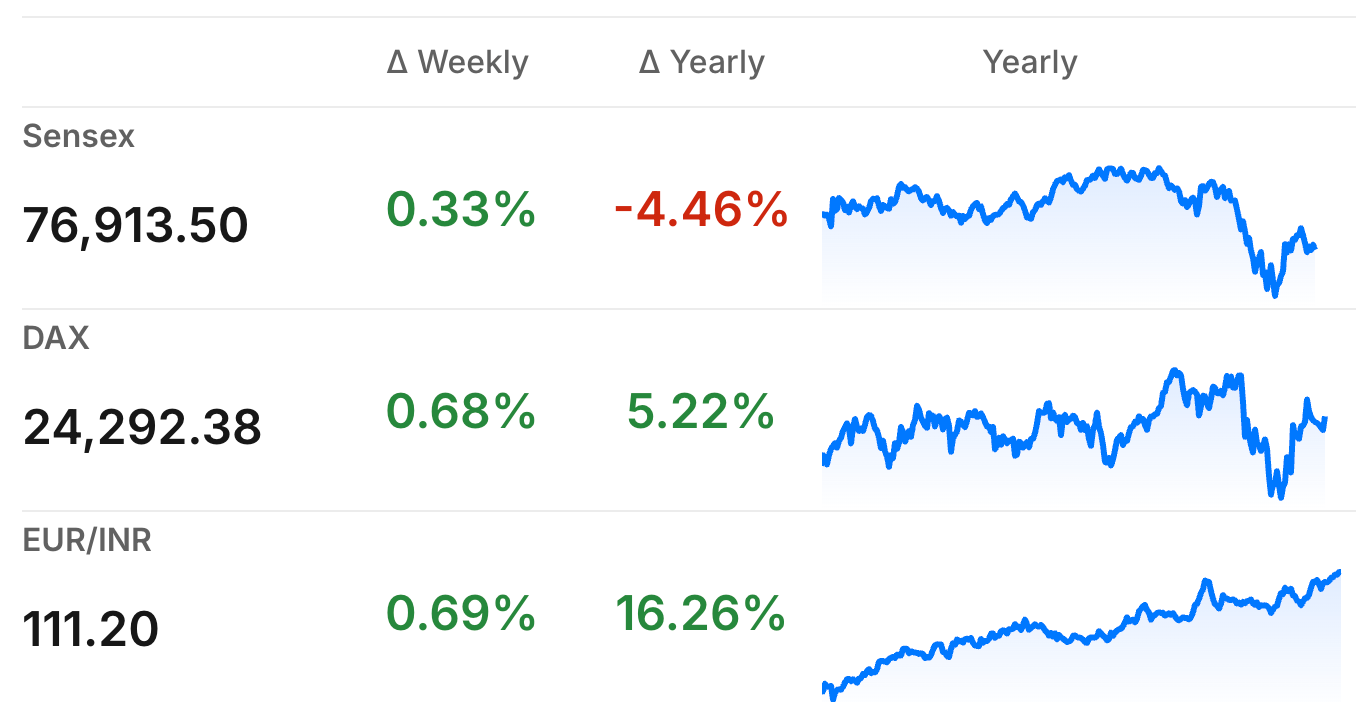
The Sensex showed a mild positive movement this week, closing at 76,913.5, up 0.33% from last week’s 76,664.21. Key factors influencing sentiment included steady performance in the IT and energy sectors, supported by strong quarterly results and stable global oil prices. Additionally, ongoing government reforms in infrastructure drew investor interest, helping to counterbalance concerns about inflationary pressures and geopolitical tensions impacting global trade.
In Germany, the DAX index rose by 0.68% to close at 24,292.38, up from 24,128.98 last week, continuing a positive trend amid a yearly gain of 5.22%. The market was buoyed by gains in the automotive and manufacturing sectors, which benefited from improved export figures and easing supply chain disruptions. Investors also responded to reassuring statements from the European Central Bank regarding inflation control. However, concerns related to the ongoing conflict in Eastern Europe and its impact on energy prices kept some caution in the market atmosphere.
Germany News Roundup
German Power Prices Hit Negative Record, driven by massive solar overproduction on May 1st, forcing grid operators to limit solar input to stabilize the network and avoid blackouts, burdening taxpayers with costs. - agrarheute
Iron Dome Maker Eyes Volkswagen Osnabrück Plant, to transform it into a production site for missile defense components, marking a shift from car manufacturing amid VW’s restructuring plans. - Bild
Germany’s Auto Capitals Face Deep Financial Crisis, stemming from structural shifts, declining trade taxes, and industry retooling pressures beyond just electric vehicle challenges affecting Stuttgart, Munich, and Wolfsburg. - Primary Ignition
U.S. to Withdraw 5,000 Troops from Germany, facing strategic reassessment amid tensions with Germany and ongoing conflicts in Iran and Ukraine, impacting NATO and European security dynamics. - NPR
Rheinmetall Secures €1.04B German Soldier Contract, to supply and modernize 237 platoon systems, enhancing the German army’s future soldier equipment with advanced digital communication by 2029. - BreakingDefense
Decarbonization Needs Clearer German Climate Policy, companies urge the government to provide planning certainty to boost investments and accelerate the green tech rollout amidst economic growth potential highlighted by Chancellor Merz. - Table.media
Germany April Unemployment Up 20,000, with jobless rate steady at 6.4%, highest since July 2020, showing no labor market turnaround amid weak spring upturn. - Investinglive
India News Roundup
India-New Zealand Sign Landmark Free Trade Agreement, boosting exports with 100% duty-free access, securing USD 20 billion FDI commitment, protecting sensitive sectors, and enhancing talent mobility and traditional medicine trade. - Vision IAS
India-China Discuss LAC Stability and Regional Security, focusing on peace and tranquillity along the Line of Actual Control and exchanging views on broader regional security including the West Asia situation. - The Hindu
India Raises Commercial LPG Prices Again, impacting restaurants and food businesses with higher costs amid ongoing global energy tensions and new domestic LPG distribution rules. - DW
Air India to Reduce International Flights, due to soaring fuel costs, airspace restrictions, and longer routes making several operations unprofitable through July. - IndiaToday
India Citizenship Rules 2026 Modernize OCI System, introducing digital OCI cards, online applications, biometric fast-track benefits, and simplifying compliance to enhance user experience and transparency for Overseas Citizens of India. - Vajiram and Ravi
France Waives Transit Visas for Indians, allowing bookings through French airports without separate paperwork, simplifying travel and echoing Germany's earlier policy change in 2026 for smoother European connections. - VisaHQ
Watchlist
Singapore’s government investment portfolio
The Government of Singapore's investment portfolio is one of the most closely watched institutional positions in Asian markets and for good reason. Sovereign wealth funds operate with decades-long horizons, deep research teams, and access to intelligence that most retail investors simply don't have. When Singapore's government takes a position in Indian equities, it signals something important: structured, long-term confidence in India's growth story. With 10 stocks in this portfolio already delivering gains of up to 70% in just one year, this is not a portfolio to ignore.
What makes this quarter's update particularly exciting is the addition of five fresh names alongside a roster of already-performing heavyweights.
TVS Motor, Eternal, Delhivery, Vishal Mega Mart, and Tata Motors CV
The new Q4 additions span electric mobility, quick commerce, logistics, value retail, and commercial vehicles. These aren't random picks; they reflect a deliberate bet on India's consumption boom, infrastructure buildout, and the shift toward organised retail and last-mile delivery.
The existing holdings including cover manufacturing, financials, defence electronics, and healthcare, painting a broad picture of where institutional money sees India heading.
Craftsman Automation, Hindalco Industries, Shriram Finance, Ashok Leyland, Bharat Electronics, Eicher Motors, Sona BLW Precision Forgings, Endurance Technologies, HDFC Bank, Syngene International, Info Edge, and Sapphire Foods
For a retail investor, the logic here is straightforward: track what the smartest long-term money is doing and understand *why* before acting. This portfolio skews heavily toward cyclical and consumption-driven sectors, which tend to reward patience. Risks include market volatility, currency movement for foreign investors, and sector-specific headwinds particularly in auto and logistics.
Read more information on Economic Times
Until Next Sunday…
Conclusion
As May arrives, it brings with it a quieter but telling moment on the calendar — Germany observed **Tag der Arbeit** on May 1st, Labour Day, a public holiday with deep roots in workers' solidarity, while India marks the same date in its own understated way. There is something grounding about a day that pauses both markets and machines across two very different economies, reminding us that behind every index move and policy rate sits an enormous human workforce. Next week, as trading desks reopen and the data flow resumes, that brief stillness may be worth holding onto.
See you next Sunday,
Jimit Patel