
Democracy and economics rarely move in straight lines and this week, both gave us plenty of proof.
West Bengal is in the thick of it. The state that has historically swung between political extremes from decades of Left dominance to the Trinamool's iron grip is once again at the centre of India's electoral conversation. Polling across phases has brought with it the familiar mix: massive turnout in some districts, reports of sporadic tension in others, and a three-way contest that is anything but predictable. The BJP continues to push hard into territory it made meaningful inroads in during 2021, while the Trinamool is banking on its welfare infrastructure and Mamata Banerjee's personal brand. The Congress-Left alliance, meanwhile, is hoping that vote splits work in their favour in a handful of key constituencies.
What makes Bengal worth watching beyond its 294 seats is what it signals for national politics. A strong Trinamool performance consolidates the regional opposition. A BJP surge reshapes the map ahead of future calculations. Either way, the results will be read carefully in Delhi, and not just for Bengal's sake. While India's political machinery is in full motion, Europe's largest economy is sitting unusually still.
Germany entered 2026 carrying a weight it has been reluctant to fully acknowledge the weight of stagnation. The numbers tell a story that has been building quietly for two years. GDP growth has been flat, industrial output has contracted, and the manufacturing sector once the backbone of German economic identity continues to struggle. The problems are structural as much as they are cyclical. Energy costs remain elevated compared to pre-2022 levels, even if the acute crisis has passed. German exports, particularly in the auto sector, face intensifying competition from Chinese manufacturers who have moved fast in the electric vehicle space. And domestically, consumer confidence has not meaningfully recovered.
For a country that has served as Europe's economic anchor for decades, this prolonged pause has consequences that ripple outward to its European neighbours, to the euro, and to the global companies that depend on German demand and German supply chains. The IMF and several independent economists have flagged that without meaningful structural reform, Germany risks a longer period of underperformance than its political class has been willing to admit publicly.
And in the middle of all this, capital keeps moving. Quietly, methodically, looking for places where the rules are clear and the potential is real. This week, in our Opportunity section, we take a close look at GIFT City again, India's international financial centre in Gujarat and specifically what it currently offers as an investment destination. It has been years in the making, and the frameworks around it are finally mature enough to deserve serious attention.
There is a lot to unpack this week. Let's get into it.
Stock Market
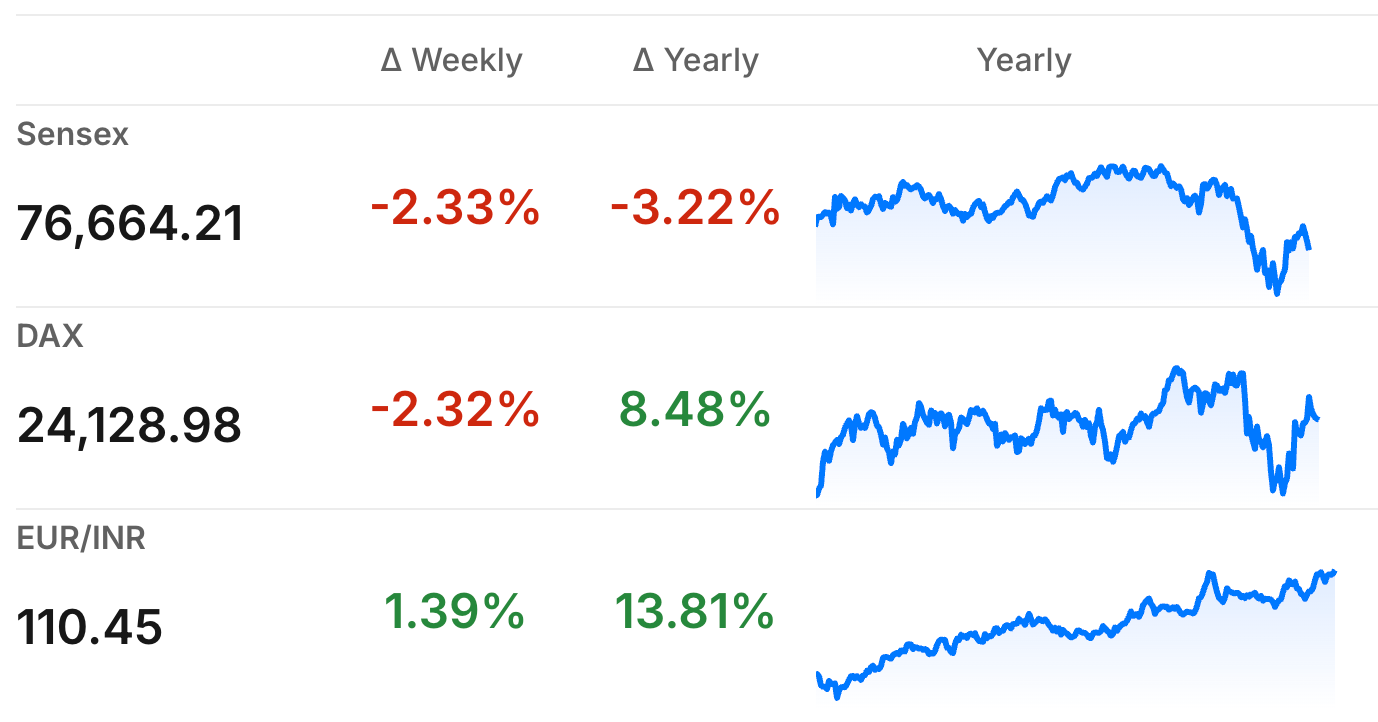
The Sensex closed at 76,664.21 on April 25, down 2.33% from 78,493.54 the previous week. This decline reflected cautious investor sentiment amid ongoing concerns over rising inflation and tighter lending conditions by Indian banks. The technology and finance sectors saw notable weakness, partly influenced by disappointing corporate earnings reports released during the week. Additionally, persistent geopolitical tensions in Asia added to market unease, limiting significant recovery attempts.
Germany’s DAX index fell 2.32% during the same period, closing at 24,128.98 from 24,702.24. The market was pressured by weaker industrial output data and ongoing energy supply concerns tied to the Ukraine conflict’s indirect effects on Europe’s resource security. The automotive sector, a key component of Germany’s economy, experienced notable dips as supply chain disruptions persisted. Meanwhile, cautious consumer sentiment translated to a downturn in retail stocks, contributing to the overall market decline.
Germany News Roundup
Germany’s Economic Rebound Stalled by Energy Shock, as soaring energy costs from the Iran war cause growth forecasts to be cut, impacting industrial production and prompting government fiscal response. - CNBC
China Challenges German Automakers’ Dominance, with competitively priced, well-equipped vehicles disrupting established German brands like Mercedes, Volkswagen, and BMW in the Chinese market amid rising local patriotism and technological advances. - FR.de
Rheinmetall’s Growth Amid German Auto Crisis, is driving job creation with plans to add 25,000 employees by 2030, yet experts say the arms industry won’t fully replace automotive sector jobs. - Bild
Anthropic’s Mythos AI Raises Security Concerns, highlighting risks of exclusive control over software vulnerabilities and potential shifts in cyber threat landscapes affecting national and European security. - Heise
Germany Shifts from Auto to Defense Industry, as automotive profits plunge and job cuts rise, defense production expands with government support and rising investments, making Germany Europe’s key arms manufacturing hub. - Logos
Lufthansa Ends Free Carry-On Suitcase Allowance, introducing a new Economy Basic fare from May 19, allowing only one small personal item free, with additional baggage fees starting at 15 euros for short and medium routes. - BR24
Milka Faces Court Over Reduced Chocolate Content, challenged for shrinking product size from 100g to 90g while keeping packaging almost unchanged, accused of misleading consumers about price and quantity changes. - GIGA
India News Roundup
Rajnath Singh Boosts Rs 90,000-Crore Submarine Deal, in Germany to advance Project 75I, enhancing India’s naval fleet with six advanced submarines through a strategic Indo-German partnership amid rising maritime security challenges. - India Today
India’s Largest Defence Deal with Germany Imminent, expected within 90 days, involving an $8 billion submarine agreement enhancing bilateral military cooperation and strategic defence capabilities. - Moneycontrol
India, South Korea to Boost Trade to $50B by 2030, signing MoUs in multiple sectors and launching the India-Korea Digital Bridge to deepen cooperation in AI, semiconductors, and IT for shared growth and innovation. - NewsOnAir
India-Russia Military Pact Enables Base Access, allowing mutual stationing of troops, warships, and aircraft to strengthen bilateral defence cooperation and strategic reach amid global geopolitical shifts. - AlJazeera
Finance Minister Chairs AI Risk Meeting, to address AI-related threats in banking, urging vigilance, coordination, cybersecurity strengthening, and real-time threat intelligence sharing among banks and authorities. - NewsOnAir
France Removes Transit Visa for Indians, enabling Indian passport holders to transit through French airports without an airport transit visa starting April 10, 2026, as declared by French President Emmanuel Macron. - Diplomatie.gouv.fr
Opportunity
List of GIFT City MFs
India's financial future is not evolving, it's accelerating. Gujarat International Finance Tec-City, better known as GIFT City, is India's first operational smart city and international financial services centre, designed to compete directly with global hubs like Singapore and Dubai. What makes this moment particularly significant is the speed of transformation: total fund commitments have exploded from under $500 million in 2020 to over $32 billion by 2025, a staggering leap in just five years. This is not a gradual trend quietly building in the background; it is a structural shift in how global capital views India, and it is happening right now.
The numbers behind GIFT City tell a compelling story. More than 200 fund management entities have set up operations there, collectively launching over 300 fund schemes. Crucially, around 85% of the capital raised is being deployed back into India, meaning this hub is not just a financial address, it is actively channelling global investment into the Indian economy. The appeal is clear: GIFT City offers international investors a regulated, tax-efficient environment to access Indian growth, while giving Indian investors easier pathways to global markets.
For a retail investor, particularly one based in Europe or with an interest in emerging markets, GIFT City mutual funds represent an increasingly accessible way to participate in India's growth story through a structured, internationally recognised framework. If you want to understand exactly which funds are active in this space and how they work in practice, the full breakdown is worth exploring.
Read the full analysis and specific investment recommendations here:
Belong - GIFT City Mutual Funds
Until Next Sunday…
Conclusion
As April gives way to May, the coming week brings a clutch of moments worth watching closely. The European Central Bank's policy signals will be parsed carefully in Frankfurt boardrooms, while India's manufacturing and services PMI data for April, due at the end of the month will offer the first real read on how the economy is absorbing global trade turbulence.
Meanwhile, May Day on the first falls mid-week, quieting markets across Europe and prompting reflection on labour, wages, and the changing nature of work themes that have quietly shaped headlines all year. The numbers, when they arrive, may well tell us whether resilience is holding, or merely being tested.
See you next Sunday,
Jimit Patel