
Some weeks arrive quietly. This one did not.
Two stories dominated the conversation this week, one playing out in the marble corridors of India's parliament, the other unfolding in the gleaming server rooms of Silicon Valley. On the surface, they have nothing in common. Look a little closer, and both tell the same story: about who holds power, who gets to shape the future, and what happens when the stated goal and the actual agenda begin to look suspiciously different.
Let's start in New Delhi, where the Indian government's ambitious Women's Reservation Bill collapsed before it could become law and the manner of its collapse was almost as revealing as the bill itself.
The legislation, in principle, was straightforward enough. It proposed reserving 33% of seats in India's Lok Sabha and state legislative assemblies for women. India ranks poorly on global indices of female political representation, and the ruling government had promoted this bill as a historic corrective, a long-overdue push to bring women's voices from kitchen table conversations into the halls of actual lawmaking. The optics were strong. The intent, at least on paper, was hard to argue against.
But there was a catch buried in the fine print. The bill stipulated that reservations would only come into effect *after* the next delimitation exercise, the redrawing of India's electoral constituency boundaries, a process that hasn't been completed in decades and isn't expected to conclude anytime soon. Critics were quick to point out that this clause effectively kicked the benefit into the indefinite future while simultaneously giving the government a mandate to reshape the electoral map in the present. Opposition parties, women's rights groups, and constitutional experts raised the same uncomfortable question: was this genuinely about representation, or was it a vehicle to accelerate a delimitation exercise that could redraw boundaries in ways that favour the ruling party electorally?
Meanwhile, on the other side of the world, Anthropic quietly released something that sent a different kind of shockwave through technology circles. Claude Mythos, the company's latest AI model, arrived with relatively little fanfare compared to recent OpenAI launches, but the people paying attention were paying very close attention.
What makes Mythos different is not just raw performance, though the benchmarks are impressive. It's the model's ability to handle extraordinarily long and complex reasoning chains, legal documents, scientific literature, multi-step financial analysis with a coherence that earlier models struggled to maintain.
The launch is currently targeted at enterprise clients and API developers, this is not yet a consumer product. Banks, law firms, research institutions, and large corporations are the intended early users. But the implications flow downstream quickly. When these tools embed themselves in professional workflows, they change what skills get valued, what work gets automated, and ultimately, who gets hired and for what.
Two stories this week. One about who gets a seat at the table, and one about who gets to build the table itself.
And on the note of building something in this week’s Opportunity Section, we’ve done the research on a theme that’s hard to ignore right now: 10 Best Stocks to Buy According to AI Bull Brad Gerstner, the investor whose early and vocal bets on AI infrastructure have made Wall Street pay close attention whenever he speaks. Worth a read before the markets open Monday.
Stock Market
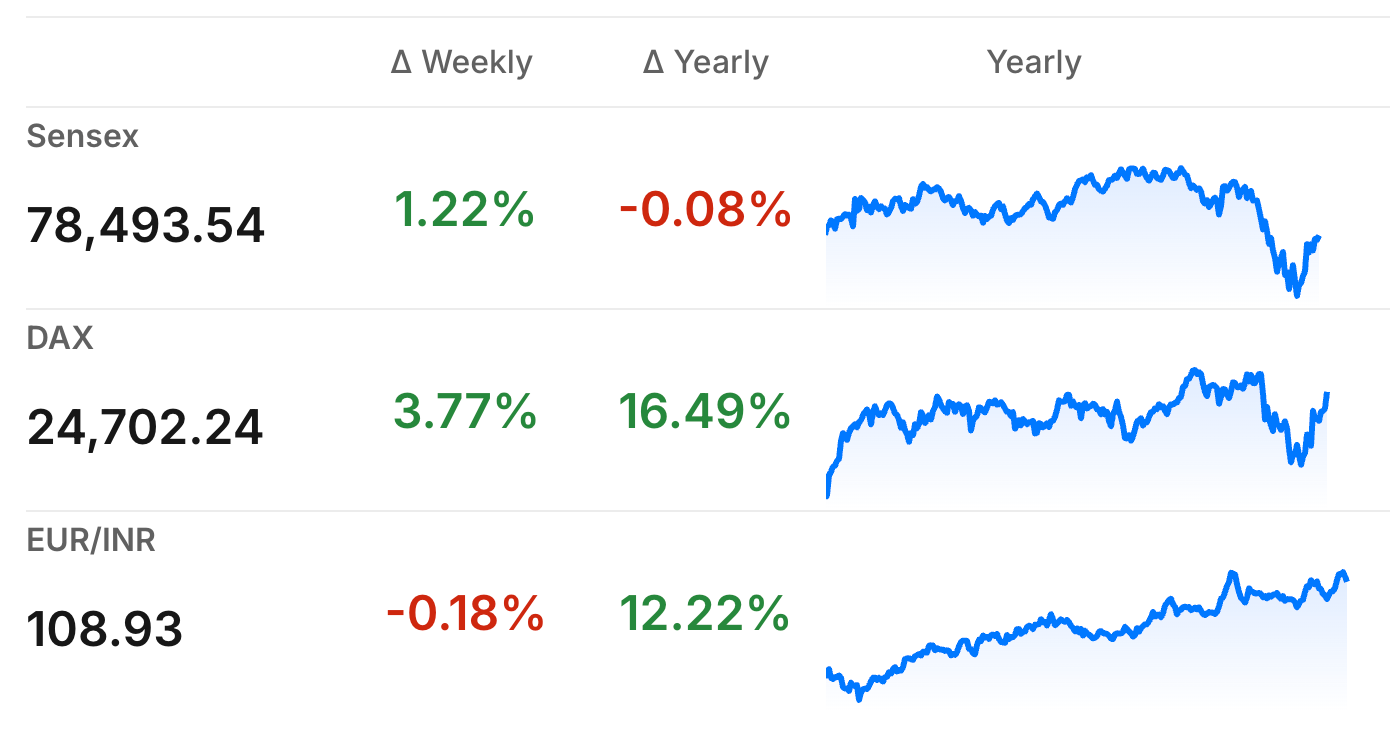
The Sensex closed the week at 78,493.54, up 1.22% from last week showing a steady positive trend. This week's market gains were largely supported by strong performances in the technology and financial sectors, which responded well to quarterly earnings reports that beat analyst expectations. Additionally, government announcements regarding infrastructure investments helped lift investor sentiment. Despite some lingering concerns over global economic conditions, domestic factors kept the market on an optimistic track.
In Germany, the DAX index rose 3.77% this week, closing at 24,702.24 compared to last week's 23,806.99. The market's upward movement was mainly driven by gains in the automotive and industrial sectors, reflecting increased export orders and positive corporate earnings updates. Furthermore, improved energy supply forecasts helped ease concerns about inflationary pressures impacting manufacturing costs. Overall, the DAX showed resilience amid ongoing geopolitical uncertainties affecting European markets.
Germany News Roundup
Debate on Germany’s Nuclear Power Reentry, questions the viability of restarting old plants due to long, costly processes and favors focusing on renewable energy storage solutions and grid modernization instead. - Tagesschau
Germany Plans Stricter Sick Leave Policies, aiming to curb high absenteeism and address economic slowdown by penalizing early sick leaves and rewarding fewer sick days under Chancellor Merz’s proposed reforms. - NYPost
Germany Approves $1.9B Fuel Relief Package, offering temporary tax cuts on gasoline and diesel, a €1,000 tax-free employer bonus, and tighter fuel price oversight amid economic and energy challenges caused by geopolitical tensions. - ESG News
Job Cuts Planned by One-Third of German Firms, reflecting prolonged economic crisis and rising production and export challenges intensified by geopolitical tensions and increased costs, pressuring reforms in Germany’s economic model. - Bild
Rewe Plans to Acquire Up to 40 Tegut Stores, aiming to integrate most locations into its network, modernize stores, and secure jobs, pending approval from the Bundeskartellamt for enhanced regional supply and customer benefits. - Osthessen-News
German Wholesale Prices Surge from War Impacts, driven by rising energy and raw material costs affecting the overall supply chain in Germany. - aa.com.tr
India News Roundup
India Blocks Bill Boosting Women's Representation, after parliament rejected proposal linked to controversial electoral map redrawing, sparking political opposition and regional protests over increased parliamentary seats and delimitation impacts. - The Guardian
India’s Forex Reserves Reach New Record High, climbing to $728.49 billion, aided by rising gold holdings and strong foreign currency assets, enhancing the RBI's capacity to stabilize the rupee amid global uncertainties. - Indian New England
Rajnath Singh's Germany Visit Highlights Submarine Deal, as he aims to strengthen defence collaboration, investment, and strategic partnerships through talks with German leaders and military officials in Berlin. - The Hindu
India Germany Strengthen Defence and Energy Ties, to deepen cooperation in defence, green hydrogen, renewables, technology, and strategic partnership amid West Asia and global geopolitical challenges. - Economic Times
India and Germany Launch AI Group for SMEs, aiming to boost AI adoption by connecting German SMEs with Indian AI expertise under a structured collaboration to enhance competitiveness and market access. - PressInsider
Greece Gains Appeal for Indian HNI Investments, as it offers lower investment thresholds, Schengen access, and diversification benefits, complementing rather than replacing Dubai's established business and tax advantages. - BusinessToday
Opportunity
10 Best Stocks to Buy According to AI Bull Brad Gerstner
The artificial intelligence revolution is no longer a distant promise, it is actively reshaping industries, business models, and investment portfolios right now. What makes this moment particularly compelling is the scale of capital being deployed: major technology companies are collectively committing hundreds of billions of dollars into AI infrastructure, software, and computing power over the coming years.
Brad Gerstner, a seasoned technology investor and vocal AI advocate, has built his entire investment thesis around the idea that we are still in the early innings of this transformation. His conviction is not casual, he has spent years positioning his firm specifically around companies he believes will define the next decade of economic growth.
What sets Gerstner's approach apart is his focus on businesses that are not just experimenting with AI, but are structurally embedded in its growth. He targets companies across the AI supply chain, from the hardware and infrastructure that powers AI systems, to the software platforms and consumer-facing applications built on top of them. His portfolio leans toward businesses with strong competitive advantages, massive user bases, and the ability to monetise AI capabilities at scale. Crucially, many of these are not speculative early-stage bets, they are established, revenue-generating companies whose AI integration is already driving measurable improvements in earnings and efficiency.
For retail investors, this represents a useful roadmap for thinking about AI exposure in a portfolio, particularly as markets in both Europe and Asia are increasingly influenced by the performance of AI-driven technology leaders. The key consideration is diversification: concentrating too heavily in any single theme carries risk, especially given how quickly sentiment around technology can shift. Valuations in this space are already elevated, so patience and a long-term horizon matter more than timing.
Read the full analysis and specific investment recommendations here:
Insider Monkey — 10 Best Stocks to Buy According to AI Bull Brad Gerstner
Until Next Sunday…
Conclusion
As markets digest this week's turbulence, attention turns to the European Central Bank's policy meeting on April 17, where rate-setters face the uncomfortable task of balancing stubborn inflation against slowing growth, a tension that feels increasingly familiar across the global economy.
See you next Sunday,
Jimit Patel