
Nuclear energy was in the news twice this week and the two stories could not have been more different in character.
In the Middle East, the shadow of a potential US-Iran conflict has not fully lifted, but the temperature dropped a few degrees. Talks are now underway with Pakistan playing an unlikely but quietly significant host bringing American and Iranian representatives to the same table, or at least to the same city. Nobody is calling it peace yet. The word being used carefully is *dialogue*. After months of escalating rhetoric, drone strikes, and oil markets flinching at every headline, even a conversation feels like progress. The details remain murky, and the trust deficit between Washington and Tehran runs deep. But the mere fact of a meeting, brokered in Islamabad, of all places signals that both sides may be calculating the cost of prolonged conflict as too high. Oil markets, which had been bracing for worst-case scenarios, took a cautious breath. For now, cautious is good enough.
Then, roughly 2,500 kilometres east of those negotiations, something historic and entirely forward-looking happened quietly in Tamil Nadu. India's first indigenous fast breeder reactor reached criticality at the Madras Atomic Power Station complex in Kalpakkam, a milestone that deserves far more attention than it received in the weekly news cycle. Prime Minister Modi was right to call it a milestone, though the significance goes beyond national pride. Fast breeder reactors are not just another type of nuclear plant. They produce more fuel than they consume, and they can run on thorium, a resource India has in extraordinary abundance. This is the kind of long-game energy infrastructure that takes decades to build and generations to benefit from. India joining the very small club of nations that have operationalised this technology alongside Russia and a handful of others.
And then there is Germany, where the conversation around security has taken a notably serious turn. The government has decided against requirements of registering men between the ages of 18 and 45 with military authorities before leaving the country for more than three months.
This week in opportunity section, we have convered European ETF with AI enhancement. Lets dive in.
Stock Market
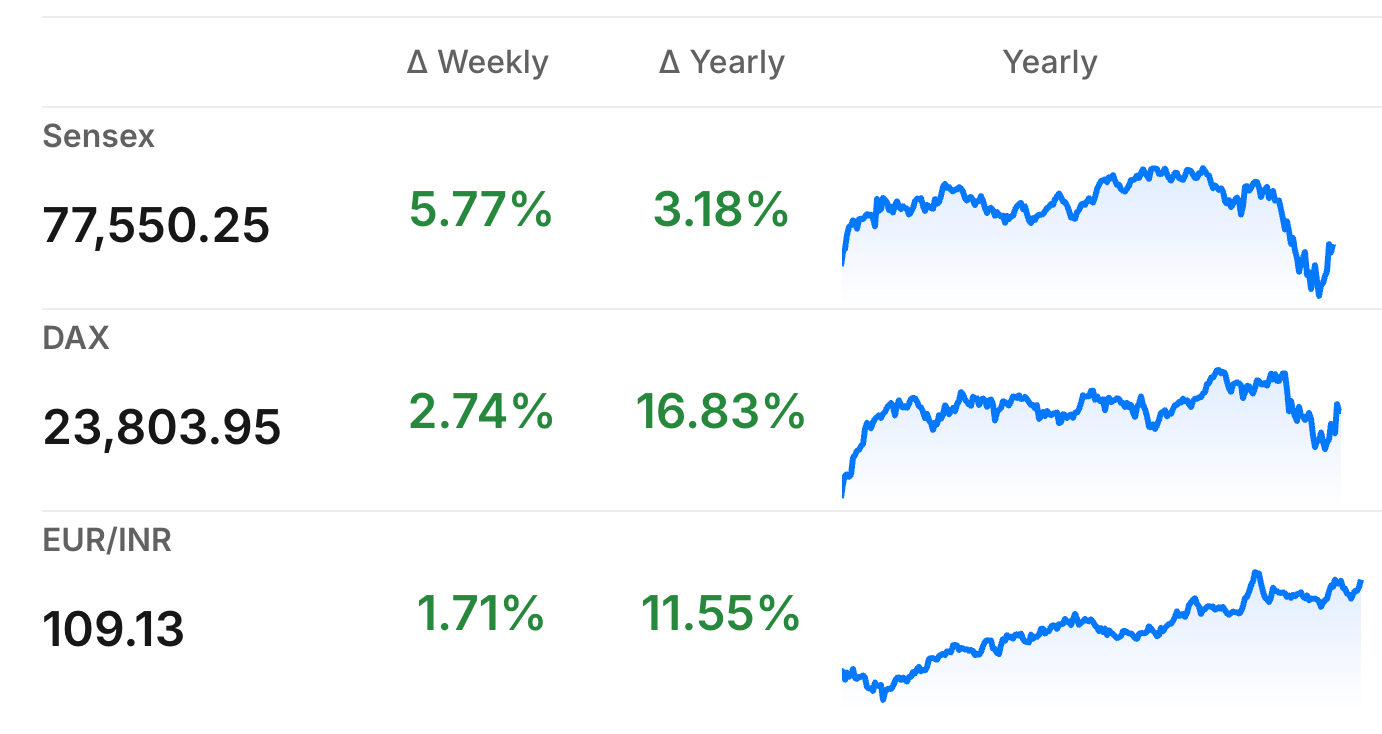
This week, the Sensex showed a notable rise, closing at 77,550.25 compared to 73,319.55 the previous week, marking an increase of approximately 5.77%. This upward movement reflected positive investor sentiment largely driven by strong performances in the IT and pharmaceutical sectors. Additionally, renewed government policies aimed at boosting manufacturing and exports helped bolster confidence, contributing to the overall market strength.
During the same period, Germany’s DAX also advanced, closing at 23,803.95 up from 23,168.08 the previous week, reflecting a 2.74% gain. This growth was supported by robust earnings reports from key industrial and automotive companies, which reassured investors about corporate health. Furthermore, positive developments in European trade negotiations helped improve market sentiment. The energy sector remained under pressure due to ongoing supply concerns linked to global conflicts, but this was offset by gains in technology stocks.
Germany News Roundup
VW Ends ID.4 Production in US, shifting focus to more profitable markets and adjusting to changing demand dynamics in the electric vehicle sector. - Golem
BYD Launches Luxury Denza Z9 GT in Germany, offering up to 800 km range and ultra-fast 5-minute charging with Flash-Charging technology, targeting premium electric vehicle segment from €115,000. - Netzwelt
German Economy Pre-War on Contraction Path, with industrial production declining and energy challenges worsening due to rising costs and Middle East conflict impact on imports and industrial sectors. - ING Think
Germany Suspends Military Stay Approval for Men, allowing men under 45 to travel freely without reporting lengthy stays abroad during peacetime, as military service remains voluntary under the new law. - BBC
Ingka Group Expands 110 MW Solar Capacity in Germany, advancing two solar parks to generate renewable power for 26,000 households as part of an $8.1 billion investment accelerating the energy transition. - ESG News
Minister Vivek Discusses Telangana Youth Jobs, aiming to expand skilled employment opportunities for Telangana youth in Germany’s robust economy through high-level diplomatic talks in Berlin. - The Hindu
India News Roundup
India Remains One of Fastest-Growing Economies, projected to grow 6.6% in FY27 despite Middle East conflict and supply disruptions, supported by strong fundamentals and policy resilience according to the World Bank. - World Bank
India Withdraws Bid to Host COP33 Summit, citing a review of 2028 commitments and leaving uncertainty over the upcoming climate talks' host nation among Asia-Pacific countries. - Climate Home News
India's Prototype Fast Breeder Reactor Achieves Criticality, marking a major step in the nuclear programme, showcasing advanced technology and boosting clean energy with indigenous development and self-reliance under Aatmanirbhar Bharat. - NewsOnAir
Marco Rubio to Visit India for Strategic Talks, focusing on trade, critical minerals, defense, and the Quad alliance to address US-Israel-Iran conflict impacts and strengthen bilateral relations. - DW
India’s Carbon Market Fuels New Business Strategies, transforming carbon credits into strategic assets that balance emissions reduction with economic value, offering fresh growth opportunities amid evolving global climate finance and decarbonization frameworks. - ET Edge Insights
India-US Launch Trade Portal Targeting $500 Billion, aiming to double bilateral trade by connecting Indian exporters with US buyers under Mission 500 by 2030, while negotiating tariff structures for a beneficial trade agreement. - CNBC TV18
Rajnath Singh to Visit Germany for Defence Summit, focusing on industry collaboration, strategic partnerships, and a $10-billion submarine deal involving German technology firms. - Economic Times
Opportunity
AI-Powered Investing in Europe
European investing is entering a new phase, one where artificial intelligence doesn't just power technology companies, but actively shapes how investment funds themselves are built and managed.
A well-established Swiss asset manager with deep roots in wealth management, Pictet, is now bringing five new exchange-traded funds to European markets, each constructed and monitored using AI-driven tools. This move reflects a broader shift happening across the global fund industry: the growing belief that machine intelligence can identify patterns, manage risk, and allocate capital more efficiently than traditional methods alone. For European investors, this represents a meaningful evolution in what low-cost, passive-style investing can actually deliver.
What makes this development particularly interesting is that these strategies are not simply technology funds, they span multiple themes and asset classes, using artificial intelligence as the engine underneath rather than the subject matter. The AI component is embedded in how the portfolios are constructed, how signals are interpreted, and how the funds adapt over time. This approach attempts to combine the cost advantages of traditional index-style investing with a layer of intelligence that can respond to changing market conditions. For retail investors, this could mean better risk management and smarter diversification, without the high fees typically associated with actively managed funds.
From an investor's perspective, the appeal here lies in accessibility, these are structured as ETFs, meaning they are tradeable, transparent, and generally lower in cost than traditional active funds. However, AI-driven strategies are still relatively new, and their long-term track records remain limited. Investors should consider how these fit alongside existing holdings and remain mindful that even intelligent systems cannot eliminate market risk. That said, for those curious about where fund innovation is heading, this is a space worth watching closely.
Read the full article here: ETF Stream
Until Next Sunday…
Conclusion
As markets digest this week's turbulence, attention turns to Wednesday's release of Germany's ZEW Economic Sentiment Index for April, a closely watched gauge of investor confidence that could either steady nerves or deepen concerns about Europe's largest economy.
Meanwhile, across the subcontinent, the air carries the first warmth of Baisakhi, the harvest festival marking new beginnings in Punjab and beyond, a reminder that renewal often arrives not through headlines but through seasons. Whether the coming days bring clarity on trade negotiations or fresh uncertainty, the underlying question remains the same: are we watching a temporary disruption or something more structural reshaping the global economic order? Next week may offer a few more pieces of that puzzle. Until then, trade carefully and think long.
See you next Sunday,
Jimit Patel