
When missiles start hitting data centers, the world realizes that modern war has a new front, and it runs through fiber optic cables, not just borders.
This week, the conflict involving Iran escalated in ways that few analysts had fully anticipated. Strikes landed across multiple locations, infrastructure, military installations, and in a development that sent a chill through the global tech and financial community, a major data center took a direct hit. The implications of that single moment rippled far beyond the region. Data centers are not just buildings full of servers. They are the beating heart of banking systems, cloud platforms, payment gateways, and communications networks. When one goes dark under fire, it raises a question that boardrooms from Frankfurt to Bengaluru are now quietly asking: how exposed is our digital infrastructure to a conflict we assumed was happening somewhere else?
The attack also accelerated something that was already building, oil market anxiety. Iran's position in global energy flows is well understood, but markets this week moved not just on supply fears. They moved on uncertainty itself. That particular kind of fear, shapeless, hard to price tends to be the most expensive kind. Crude benchmarks swung. Freight risk premiums climbed. And the broader sense that this conflict is entering a more unpredictable phase settled over commodity traders and policymakers alike. For an economy like India, which imports the overwhelming majority of its oil, every dollar added to the barrel price is a slow tax on growth, on inflation management, and on the household budgets of millions.
Meanwhile, roughly 7,000 kilometers away in Germany, a different kind of reckoning was unfolding quieter, but no less significant for those paying attention.
Germany's public health insurance system, long regarded as one of the more robust models in Europe, is heading into a reform debate that has been building for years but can no longer be delayed. The Gesetzliche Krankenversicherung, the statutory health insurance framework that covers the vast majority of people in Germany is under serious financial pressure. Costs are rising, an aging population is drawing more from the system than it puts in, and the funding model is straining at its seams. The political conversation this week shifted from whether reform is needed to what shape that reform should take.
The proposals on the table range from increasing contribution rates to restructuring how premiums are calculated, and whether higher earners should bear more of the burden. For a country that has prided itself on universal, employer-shared health coverage, the debate touches something deeper than policy, it touches the social contract that postwar Germany built its stability upon. The outcome of these conversations will shape not just healthcare access, but labor costs, employer decisions, and the broader attractiveness of Germany as a place to work and build a life.
This week in opportunity section, we have convered Gift City Fund, explaining why it might be the smart decision for NRIs to invest in Indiae.
Stock Market
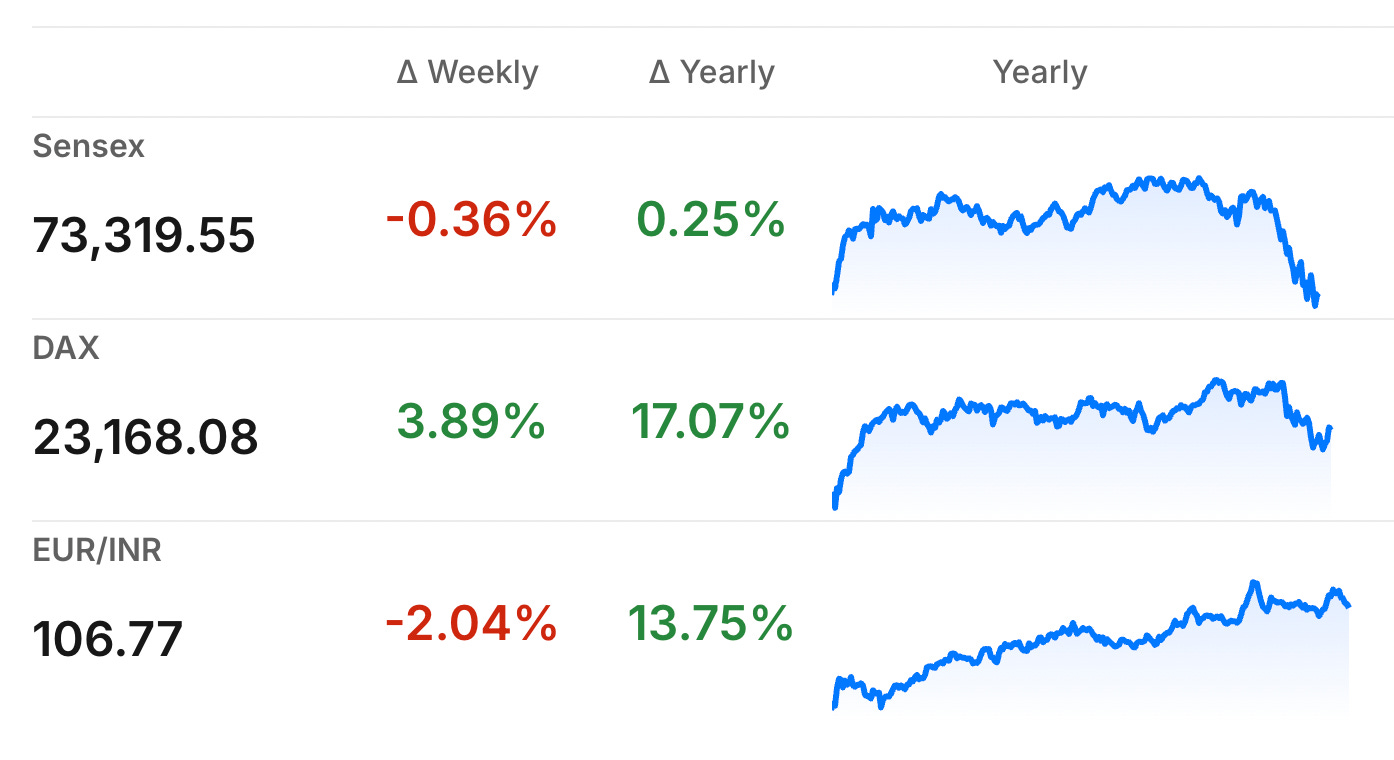
The Sensex closed the week at 73,319.55, down 0.36% from last week’s 73,583.22. The market was weighed down by cautious investor sentiment amid mixed corporate earnings and concerns over inflation’s persistent impact. Key sectors influencing the index included banking, which faced pressure due to rising loan defaults, and consumer goods, where demand showed signs of slowing.
In Germany, the DAX rose notably by 3.89% to close at 23,168.08 compared to last week’s 22,300.75. The market gained momentum driven largely by better-than-expected industrial output and positive earnings reports from the automotive and manufacturing sectors. Investor confidence was further supported by easing energy price concerns after favorable supply updates, which eased cost pressures for energy-intensive industries.
Germany News Roundup
Diesel Prices Hit Record High in Germany, reaching an unprecedented 2.327 euros per liter amid new pricing regulations and ADAC’s call for cartel authority intervention to moderate fuel costs. - Hallo München
Oil Price Shock Raises Asphalt Costs 30%, impacting Germany’s road construction industry with soaring Bitumen prices and risking project delays amid fixed-price contracts and supply concerns. - Merkur
Explosion in German ICE Train Investigated, with authorities probing political motives after multiple blasts caused minor injuries and a suspect linked to right-wing extremism was detained in custody. - DW
Every Sixth German Firm Eyes Defense Sector, actively exploring opportunities in the defense industry amid growing market interest and potential government contracts. - Wiwo
Merz Faces Backlash Over Syrian Refugee Return Plan, with critics highlighting lack of legal basis and economic risks, while underscoring Syrians’ vital role in Germany’s workforce and demographic stability. - Politico
German commission proposes health cost caps, to address insurance shortfall and control rising expenses through tighter treatment pay, pharmaceutical limits, and higher taxes on tobacco and alcohol. - Economic Times Healthworld
Germany Imposes Travel Permissions for Young Men, requiring men aged 17-45 to obtain approval before leaving for over three months, part of military expansion efforts to strengthen Bundeswehr by 2035. - United24Media
Sirius Acquires €93m German Defence Park, expanding its defence-related assets with a high-occupancy business park anchored by Rheinmetall near Kiel’s naval base, promising steady income and growth potential. - IPE Real Assets“
India News Roundup
India Sends Critical Fuel Support to Sri Lanka, delivering 38,000 metric tonnes amid West Asia conflict-induced supply chain disruptions to ensure Sri Lanka's fuel continuity with strategic cooperation between the two nations. - The Hindu
India Launches World's First Digital Census 2027, set to begin on April 1, 2026, transforming data collection with advanced digital technology for comprehensive demographic insights. - VisionIAS
Can India Thrive in Trump's World?, analyzing India's economic and geopolitical strategies to adapt and succeed amid shifting US policies under the Trump administration. - Carnegie Endowment
India’s Defence Exports Soar to Rs 38,424 Crore, driven by a 63% surge with the US as the top importer, reflecting growing global acceptance and increased exporter numbers in FY26. - ThePrint
FSSAI Makes Food Permits Permanent, enabling lifetime validity unless cancelled, simplifying registration, reducing renewal hassles, and introducing risk-based inspections while maintaining strict hygiene standards. - Times of India
Jan Vishwas Bill Enhances Ease of Living, Business, by amending 784 provisions across 79 laws to decriminalise minor offences and simplify legal processes, promoting Modi's vision of a New India. - Times of India
3M India Exits Precision Grinding Business, following global sale with shareholders approving key leadership and related party transactions in a decisive postal ballot process concluded March 26, 2026. - ScanXNews
Opportunity
Gift City Fund
India's GIFT City (Gujarat International Finance Tec-City) is rapidly emerging as one of Asia's most exciting financial hubs, deliberately designed to compete with Singapore, Dubai, and Luxembourg. Located in Gandhinagar, Gujarat, it operates as an International Financial Services Centre (IFSC), meaning funds domiciled here follow international regulations, offer dollar-denominated investing, and enjoy significant tax advantages. For the Indian diaspora globally, and particularly the estimated 32+ million Non-Resident Indians (NRIs) worldwide, this represents a rare moment: a regulated, Indian-government-backed gateway to invest in India's booming economy without the traditional friction of domestic compliance hurdles.
The Opportunity in Detail
GIFT City funds are structured as Alternative Investment Funds (AIFs) or fund-of-funds registered under IFSCA (the regulatory authority), allowing NRIs and foreign investors to invest in Indian equities, debt, and hybrid strategies using foreign currency, primarily US dollars. The key advantages are compelling:
Tax efficiency: No capital gains tax within the IFSC jurisdiction for many instruments
No FEMA complications: Investments flow smoothly without complex foreign exchange management rules
Dollar-denominated returns: Protects against rupee volatility for overseas investors
Access to Indian growth: Exposure to one of the world's fastest-growing major economies
Several asset management companies have launched active funds here. Notable ones currently operating include:
Mirae Asset GIFT City Fund
Motilal Oswal IFSC Fund
ICICI Prudential GIFT City AIF
Nippon India GIFT City Fund
360 ONE GIFT City Fund
These funds primarily target Indian equities and offer professional management tailored for internationally-based investors.
Investment Angle & Considerations
For NRIs sitting on foreign savings seeking India exposure, GIFT City funds offer a genuinely cleaner, tax-smart route compared to traditional NRE/NRO account investments. Minimum investment thresholds can be higher than typical retail mutual funds, and liquidity terms vary by fund structure. Regulatory frameworks, while improving, are still maturing. Always verify fund credentials through the official IFSCA registry before investing.
Until Next Sunday…
Conclusion
As April begins, attention turns to the Reserve Bank of India's monetary policy meeting scheduled for the week ahead, where the committee faces the delicate task of balancing stubborn inflation against slowing growth, a tension that has defined much of the past year. Across the Atlantic, the United States releases its latest employment figures, a data point that continues to ripple through currency markets from Frankfurt to Mumbai.
Meanwhile, the first full trading week of April traditionally sets the tone for the second quarter, and investors worldwide will be watching closely to see whether the cautious optimism of recent weeks holds firm or quietly fades. The numbers will tell their own story soon enough.
See you next Sunday,
Jimit Patel