
When oil crosses $100 and stays there, it doesn't just hurt at the petrol pump, it rewires how governments spend, how businesses plan, and how ordinary people think about the future.
The Strait of Hormuz, that narrow stretch of water through which roughly a fifth of the world's oil travels, remained at the centre of global anxiety. US-Iran tensions showed no sign of cooling, and every rumour of a ceasefire was quickly cancelled out by fresh escalation. Oil markets responded accordingly: sharp rallies, sudden reversals, and by Friday, prices still stubbornly above $100 a barrel with no resolution in sight. For energy-importing economies, this is the kind of sustained uncertainty that quietly erodes growth forecasts and forces central banks into uncomfortable corners.
Global equity markets tried to make sense of it all, and largely failed. A strong mid-week recovery built hopes of a decisive directional move, but those gains evaporated almost as fast as they appeared. By the weekend, most major indices had returned to roughly where they started, leaving investors reading mixed signals and sitting on their hands. In market language, this is called indecision. In practical terms, it means money stays cautious, big investments get delayed, and sentiment remains fragile.
India wasn't immune. The rupee held near record lows against the dollar, a reflection not just of oil import costs, but of broader risk-off sentiment pulling capital toward safer havens. The India VIX (Volatility Index),, a measure of how nervous the market is about near-term swings, stayed elevated above 18 through the week. That number matters: it tells you that traders are paying up for protection, which is rarely a sign of confidence. For a market that had been quietly rebuilding momentum through early 2026, this week felt like a step backward.
Meanwhile, across a very different kind of policy table, Germany was quietly working through a reform that could reshape the economic lives of millions of households. The new coalition government is discussing a significant change to how statutory health insurance works: specifically, the proposal to end the long-standing practice of allowing non-working spouses to be covered under their partner's health insurance for free. The idea, currently under review by an expert commission, is part of a broader fiscal recalibration that also includes conversations around VAT increases and adjustments to income tax brackets.
The logic behind the change is straightforward, and deliberately dual-purpose. On one hand, it's designed to raise state revenues at a time when Germany needs to fund ambitious spending commitments, including defence and infrastructure. On the other, it's an economic nudge: by making non-employment more expensive for households, the government hopes to push more people, particularly spouses who have stepped out of the workforce back into paid work. Germany has a well-documented labour shortage, and this reform is partly an attempt to address it through the tax and benefits system rather than immigration alone. Whether it succeeds in that goal, or simply adds financial pressure to families in transition, remains a live debate.
Let's dive in.
Stock Market
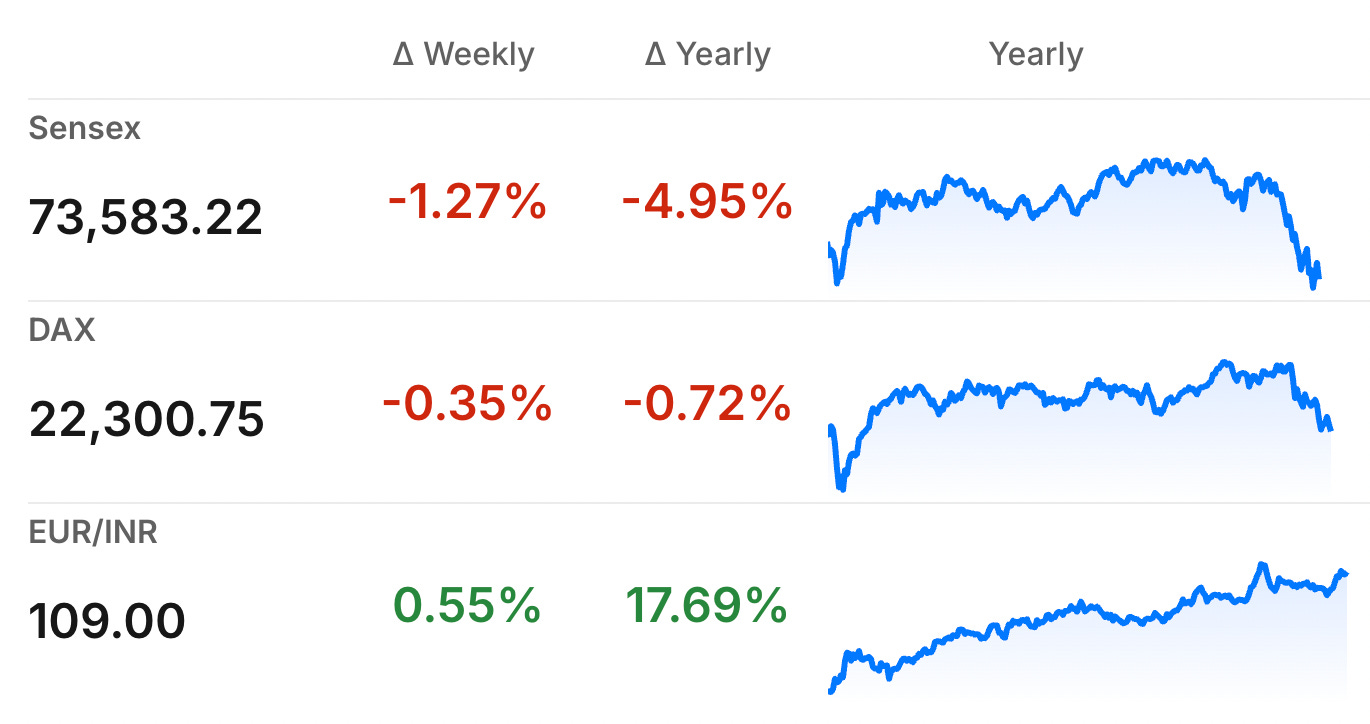
The Sensex closed at 73,583.22 this week, down 1.27% from last week’s 74,532.96. The market fell amid concerns over rising inflationary pressures and mixed corporate earnings results. The banking sector saw a cautious response following Reserve Bank of India comments suggesting a possible interest rate hike to curb inflation. Additionally, the tech sector faced selling pressure after a few key companies reported slower growth, which affected overall sentiment. Investors remained wary as global economic uncertainties continued to weigh on Indian equities.
The DAX ended the week at 22,300.75, a slight loss of 0.36% compared to 22,380.19 last week. Market movement was restrained due to ongoing concerns about economic growth in the Eurozone and the impact of recent energy price fluctuations. The automotive sector reacted negatively to disappointing export figures, while manufacturing stocks were pressured by weaker industrial output data released earlier in the week. Meanwhile, financial services showed some resilience, but overall the index traded cautiously against the backdrop of geopolitical tensions and mixed economic signals.
Germany News Roundup
Lufthansa Agrees Wage Deal for 20,000 Employees, including a 4.6% pay raise across over two years amid economic challenges, ensuring job security and no strike disruptions for ground staff in Germany. - Lufthansa Group Newsroom
RENK Secures Major Puma Gearbox Contract, to supply 188 HSWL 256 gearboxes for Puma IFV’s 800-kW power system between 2027 and 2030, enhancing vehicle mobility and operational capability. - Hartpunkt
SAP Acquires AI Data Specialist Reltio, to integrate advanced data management capabilities, enhancing AI readiness and data reliability across its Business Data Cloud platform. - Handelsblatt
EU Imposes Fee on Small Parcels from Third Countries, aimed to cover rising costs of handling cheap imports mainly from China, effective from November to ensure fair competition and enhance package inspections at EU borders. - DIE ZEIT
Deutsche Bahn Parts Ways with CFO Dohm Early, due to differing visions on the company’s future despite no doubts about her qualifications or integrity after just four months in the role. - DIE ZEIT
Germany Considers Social Media Ban for Children, aiming to restrict or complicate access to protect young users after similar steps in Australia and ongoing legal challenges in the U.S. - PBS
Germany’s €500bn Infrastructure Fund Falters, facing criticism for minimal new investment and primarily reshuffling existing expenditures, casting doubts on its effectiveness and economic impact under Chancellor Merz. - defence24.com
Germany Invests in STRILA Drones for Ukraine, supporting production of 15,000 interceptor drones to enhance Ukrainian air defenses and enable future exports of surplus units. - RBC Ukraine
India News Roundup
India Explores Local Currency for West Asian Oil, to cut costs and counter fiscal pressure from surging oil prices and rupee depreciation by paying about 80% of oil imports in local currencies instead of U.S. dollars. - The Hindu
India Cuts Fuel Taxes Amid Iran War, bearing increased energy costs to shield consumers from soaring global oil prices, impacting fiscal revenue and economic growth projections. - CNBC
India Secures Fuel Supplies Amid West Asia Tensions, ensuring 60 days of crude oil and one month of LPG availability, with increased domestic LPG production reducing import reliance and steady supply chains maintained despite demand surges. - The Hindu
Foreign Investors Withdraw Record $12 Billion, from Indian stocks in March 2026 due to Middle East conflict disrupting oil supplies and triggering fears of slowed economic growth and a weaker rupee. - CNBC
Jaishankar Rejects India as Geopolitical Broker, stating India will not serve as a mediator in US-Iran talks despite Pakistan's proposal to host negotiations amid West Asia conflict. - India Today
RBI Requires Two-Factor Authentication April 1, introducing enhanced security for all digital payments to prevent unauthorized transactions and protect user accounts across India. - Upstox
Kotak Mahindra Nears Rs 4,500 Crore Deal, to acquire Deutsche Bank India's retail portfolio worth ₹27,000 crore, enhancing its consumer banking and wealth management segments. - Moneycontrol
India Travel Booking Market to Hit $132B by 2032, driven by rising leisure travel, expanding middle class, digital and offline booking channels, and evolving consumer preferences fueling strong market growth. - Yahoo Finance
Opportunity
European Energy Stocks Are Back in Focus
The energy sector in Europe is quietly staging a comeback, and some of Wall Street's sharpest minds are taking notice. After years of turbulence driven by the pandemic, the Russia-Ukraine conflict, and wild swings in oil and gas prices, the European energy landscape is entering a more stable but still highly dynamic phase. Energy remains the backbone of every economy, and with the twin pressures of energy security and the green transition pulling in opposite directions, companies that can navigate both worlds are becoming increasingly attractive to investors. The timing matters: policy support, infrastructure investment cycles, and recovering demand are all converging right now.
Goldman Sachs, one of the world's most closely watched investment banks has identified a shortlist of energy companies it believes are particularly well-positioned for the months ahead. The bank's analysts are looking at firms that combine strong cash generation with credible long-term strategies, whether in traditional fossil fuel operations, energy infrastructure, or the transition toward cleaner sources. What makes this noteworthy is that Goldman is not simply chasing renewable energy trends it is focusing on businesses with solid fundamentals. These are not speculative bets; they are companies with proven business models that happen to sit at a critical intersection of current energy demand and future energy needs.
For a retail investor, the energy sector offers an interesting mix of income potential through dividends and moderate growth exposur, but it is not without risk. Energy stocks can move sharply with oil prices, regulatory changes, or geopolitical events, so position sizing and diversification matter. If you are building a portfolio with some exposure to real assets and global energy trends, this space deserves a closer look.
Read the full analysis and specific investment recommendations here: Business Insider Germany
Until Next Sunday…
Conclusion
As March gives way to April, attention will turn to a busy week of economic signals worth watching closely. India's fiscal year draws to a close on March 31st, a moment that tends to bring both reflection and recalibration across boardrooms and balance sheets.
Meanwhile, global markets will be parsing fresh manufacturing and services data from major economies, seeking clues about whether resilience or caution will define the second quarter. For Germany, the question of industrial momentum remains quietly open. Sometimes the turn of a calendar page is less a milestone than a prompt.
See you next Sunday,
Jimit Patel