
When oil tankers start nervously rerouting through the Strait of Hormuz, the ripple effects don't stay in the Middle East, they show up in your electricity bill, your car purchase decision, and quietly, in the earnings reports of companies you may own a share of.
This week, the fault lines between the US-Israel coalition and Iran deepened further. Diplomatic back-channels that were barely functional a month ago have now gone almost completely silent, as military posturing intensified across the Persian Gulf. The United States reinforced its naval presence in the region while Israeli strikes on Iranian-linked infrastructure continued into their third consecutive week. Iran, for its part, has responded with carefully calibrated threats, stopping just short of outright escalation, but doing enough to keep markets on edge. The critical question that traders, governments, and ordinary households are all asking in their own way is the same: How long before this disruption becomes permanent?
The answer is already showing up in energy markets. Germany, which spent much of 2024 and 2025 cautiously celebrating its progress toward energy stabilisation after the Russia shock, is now watching that hard-won stability come under fresh pressure. Wholesale electricity and gas prices have ticked upward sharply this week, as the market prices in the risk of supply disruption from a region that still moves an uncomfortable share of the world's oil. German industrial output, already fragile, is particularly exposed. Energy-intensive manufacturers who locked in contracts earlier this year are watching their margins quietly erode, and the political pressure on Berlin to respond with relief measures is building again. The ghost of the 2022 energy crisis has not quite left the room.
And yet, amid this anxiety, one story from the other side of the world offered a strikingly different kind of signal. Volkswagen has reclaimed the top spot in China's auto market in early 2026, overtaking BYD in overall sales figures for the first time in what feels like years. This is not a small footnote. China is the single largest automobile market on the planet, and for much of the past two years, the dominant narrative was that legacy Western automakers were being systematically outpaced by nimble, tech-forward Chinese EV brands. VW's return to the summit, even if provisional, suggests that the story is more complicated and more interesting than the headlines had made it seem. Whether this is a genuine strategic turnaround or a temporary blip ahead of BYD's next product wave remains to be seen.
And in this week's Opportunity section, we look away from the geopolitical noise entirely toward India's tyre industry, where falling raw material costs and rising vehicle volumes are quietly expanding profit margins in one of the most unglamorous but fundamental sectors of the economy. Sometimes the best investment stories don't make headlines.
Let's dive in.
Stock Market
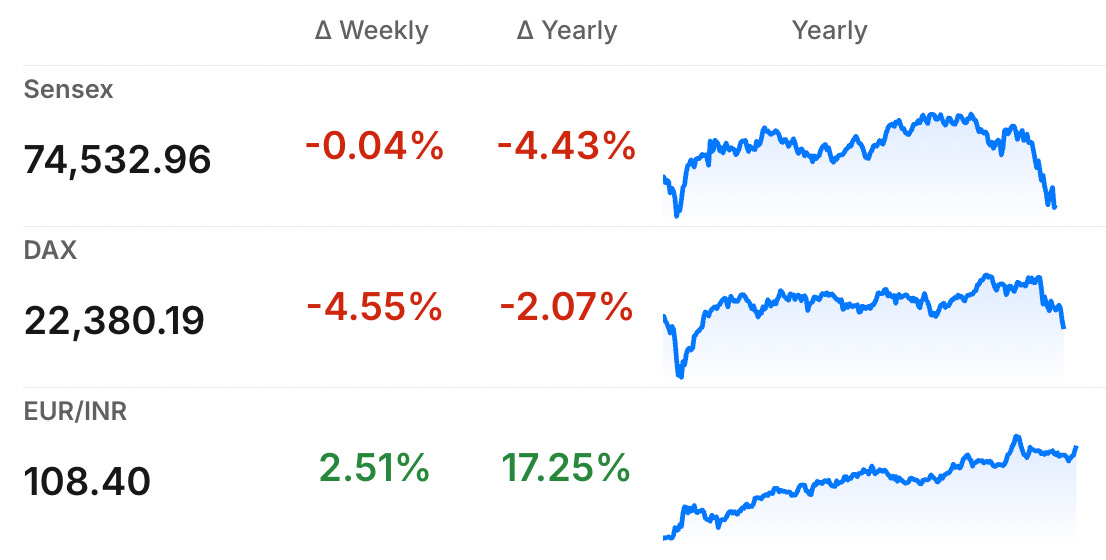
This week, the Indian Sensex edged down marginally by 0.04% to close at 74,532.96, showing relative stability amid a modestly negative sentiment. Market activity was influenced primarily by mixed corporate earnings reports and cautious reactions to global economic signals. The IT sector remained a key focus, with several major firms reporting steady quarterly results, helping to anchor investor confidence. Meanwhile, the banking sector faced some pressure due to concerns over rising loan default rates and tightening credit conditions.
In Germany, the DAX index experienced a notable decline, falling 4.55% to close the week at 22,380.19. This drop reflected heightened investor concerns following weaker-than-expected industrial data and clouds over the European economic outlook. The automotive sector, a significant component of the DAX, came under selling pressure due to ongoing supply chain disruptions and reduced demand forecasts. Additionally, the technology and manufacturing segments were weighed down by disappointing export figures and cautious corporate earnings guidance.
Germany News Roundup
Copper Price Faces Sharp Collapse, amid rising US producer prices and a strong dollar pressuring metals, indicating a potential correction in precious and industrial metals markets. - wallstreet-online
Knorr Faces Potential Billion-Euro Sale, with Unilever negotiating to sell its food division including Knorr to US spice maker McCormick amidst strategic business shifts, though deal certainty remains unclear. - t-online
EU Imports More Cars from China Than Exports, reflecting a shift with a 6 billion euro trade deficit, pressuring German auto industry and causing job cuts amid a strategic electric vehicle investment reevaluation. - Tagesschau
Thyssenkrupp Steel Deal with Jindal Falters, as negotiations stall with unanswered workforce questions, prompting IG Metall to demand clarity while exploring alternative plans excluding Jindal. - RP-Online
Aldi Ends Kiosk-Free Shopping Experiment, after challenges with upfront deposits and customer dissatisfaction led to reverting to traditional checkout in London, reflecting broader retail trends questioning such technologies. - Web.de
DAX Crash Reveals Europe’s Energy Crisis, as the conflict in the Middle East triggers soaring gas prices, prolonged supply disruptions, and stagnant economic outlooks with major financial impacts on German companies and markets. - Business Punk
Germany’s Economy Faces Rapid Decline, grappling with energy policy failures, industrial decline, rising costs, and political inertia hindering structural reforms despite fiscal resources. - TradingView
Germany’s Infrastructure Fund Misused, Sparking Debate, with reports showing up to 95% of its 500-billion-euro allocation diverted from the intended investment projects, raising concerns over government spending priorities. - Devdiscourse
Germany Pushes EU for Stronger Syria Support, to accelerate Syria’s economic recovery and energy sector revival post-conflict through enhanced investments, policy focus, and multibillion-euro aid packages amid ongoing challenges. - Tekedia
India News Roundup
AI's Limited Impact on India's IT Industry, explores why artificial intelligence has not triggered major disruptions within India's established IT sector, analyzing industry resilience and adaptation challenges. - Economist
Honda Boosts Indian Motorcycle Production Capacity, by adding a new line at its Rajasthan plant to increase annual output to 2.01 million units, creating 2,000 jobs and expanding overall capacity to 8 million by 2028. - Honda Global Corporate Website
India Diversifies LPG Imports Beyond West Asia, boosting US LPG imports to 176,000 tonnes to reduce reliance on West Asia amid supply disruptions and seeking other sources like Russia and Japan. - Times of India
India's Semiconductor Market to Expand Rapidly, with growth to $300 billion by 2035 driven by AI, automotive, and data centres, supported by local production and major investments under government initiatives. - The Hindu
India's Affordable Weight-Loss Drugs Revolution, will enable widespread access to semaglutide generics, drastically lower costs, and expand global obesity treatment through competitive domestic pharmaceutical production. - BBC
Thomas Cook India to Demerge Resort Business, enhancing capital structure, improving earnings per share, and enabling focused growth with the potential future listing of Sterling Holiday Resorts Ltd. - The Hindu Business Line
Bengaluru Hosts Berlin's Third International Office, supporting startups expanding between Berlin and India by easing business setup and market entry in both regions. - Deccan Herald
Hapag-Lloyd and India Sign Maritime Intent, marking a strategic step to strengthen maritime collaboration between German shipping and Indian government sectors for enhanced economic and trade relations. - Hapag-Lloyd
Opportunity
The Tyre Sector - India
India's tyre industry is one of those sectors that rarely makes headlines, yet quietly powers one of the world's fastest-growing automobile markets. For years, tyre manufacturers were squeezed hard, raw material costs, particularly natural rubber and crude-oil-derived inputs, were stubbornly high, eating into margins and keeping profitability under pressure. But something meaningful has shifted. Input costs have begun moderating, and with India's vehicle volumes continuing to climb across passenger cars, commercial vehicles, and two-wheelers, the demand side of the equation looks increasingly compelling. This is not a flashy tech story, it is a fundamentals story, and those tend to be the most durable kind.
What makes this moment particularly interesting is the convergence of two positive forces arriving at the same time: falling costs and rising volumes. Tyre companies are seeing their profit margins expand as the gap between what they spend to produce and what they earn from sales widens. The replacement market, where vehicle owners buy new tyres independent of buying a new vehicle, adds a reliable, recurring layer of demand that is less sensitive to economic cycles than new vehicle sales alone. Additionally, the gradual shift toward larger, premium vehicles in India is nudging consumers toward higher-value tyre categories, which carry better margins for manufacturers. Export opportunities are also quietly growing as Indian tyre makers build global credibility.
For a retail investor, this sector offers an interesting entry point into a domestic consumption story with relatively straightforward business mechanics, companies buy raw materials, manufacture tyres, and sell them to automotive and retail channels. The key risks to watch include any sharp reversal in rubber or crude oil prices, which would compress margins again, and any slowdown in vehicle demand. Neither appears imminent based on current trends, but both deserve monitoring. If this kind of under-the-radar, margin-recovery story appeals to you, the full analysis breaks down exactly where the opportunity sits.
Read the full analysis and specific investment recommendations here:
Value Research - The tyre sector’s silent comeback
Until Next Sunday…
Conclusion
As markets digest this week's signals, attention turns to a packed calendar ahead, the Reserve Bank of India's monetary policy committee wraps up its deliberations in early April, but before that, global investors will be watching flash PMI readings from the eurozone and India due late next week, offering the first real economic snapshot of March's business conditions.
Meanwhile, in Germany, the political calendar quietly advances as coalition-building conversations continue to shape who ultimately holds the reins in Europe's largest economy. Spring is arriving in both hemispheres, cherry blossoms in Frankfurt's parks, festival colours returning to Indian streets, a reminder that renewal has a habit of arriving whether markets are ready or not.
See you next Sunday,
Jimit Patel