
There are roughly 33 kilometres of water between Oman and Iran at its narrowest point. The Strait of Hormuz handles 20% of the world’s daily oil trade. This week, that sliver of water became the most consequential piece of geography on the planet, and its closure is now touching everything from your gas cylinder at home to factory energy bills in Germany.
Two weeks ago, Operation Epic Fury began. The US and Israel launched coordinated strikes on Iran on February 28th, killing Supreme Leader Ali Khamenei and targeting nuclear facilities, military installations, and leadership. Iran’s response was swift and asymmetric: missile barrages on US bases in the UAE, Qatar, and Bahrain, drone strikes on Israeli cities, and, most critically for the global economy, an effective blockade of the Strait of Hormuz. Iranian Revolutionary Guard officials made their position clear: no oil leaves the Gulf without Iran’s permission. They have been enforcing it with drone strikes on tankers attempting to pass.
Now fourteen days in, the conflict shows no sign of cooling. Iranian missiles are still striking central Israel; US and Israeli jets are still hitting Tehran neighborhoods. Trump has deployed an additional 5,000 sailors and marines to the region while publicly downplaying the Hormuz threat. The US Navy has destroyed Iranian mine-laying vessels in the strait, but the blockade remains effectively in place for Western-flagged ships. The one sliver of hope? Iran has selectively allowed certain vessels through, a Turkish ship cleared passage on March 13th, and critically, two Indian-flagged gas carriers and a Saudi tanker carrying one million barrels of crude destined for India were permitted to pass. India, it seems, is being kept in a separate diplomatic lane, for now.
But “for now” is doing a lot of heavy lifting. India is the world’s second-largest LPG importer, with 85-90% of its LPG imports sourced from the Middle East. The impact is already at kitchen. Indian Oil Corporation raised the price of a 14.2kg domestic LPG cylinder by 7%, from ₹853 to ₹913 in Delhi. Commercial cylinders used by restaurants and hotels jumped from ₹1,768 to ₹1,883. Commercial cylinder supply has been completely suspended in some areas and some state introduced a 25-day rule between successive cylinder bookings to prevent hoarding. India’s government has urged domestic refiners to maximize LPG production, but the math is uncomfortable: India simply cannot substitute two-thirds of its LPG imports from domestic production overnight.
Germany is feeling different but equally real pain. The country doesn’t import directly from the Gulf for most of its energy, relying primarily on Norwegian gas pipelines. But energy markets are interconnected, when Iran’s drone strikes disrupted Qatari LNG production, European wholesale gas prices surged regardless of where Germany physically sources its supply. Germany’s chemical, steel, glass, paper, and automotive industries already struggling after two years of near-recession, are now facing their second major energy shock in four years. The ifo Institute, Germany’s leading economic research body, has revised its spring forecast downward, warning that the Iran war consequences will dampen Germany’s recovery, though it stops short of predicting a return to recession if the conflict remains contained. The European Commission’s Ursula von der Leyen has called for emergency subsidies and potential gas price caps to protect households and businesses.
On a lighter note, Germany delivered one this week, the country’s healthcare system announced something genuinely useful. From April onwards, heavy smokers aged between 50 and 75 who have smoked for at least 25 years will be entitled to a free annual lung cancer screening using low-dose CT scans, fully covered by statutory health insurance. The programme targets approximately 2 million people in Germany who meet the criteria, addressing a disease that kills around 45,000 Germans every year, almost all from long-term heavy smoking.
This week’s markets reflected all of this anxiety with painful clarity, Sensex shed over 5% in its worst weekly performance in four years, while DAX quietly bled as well, weighed down by energy cost concerns. We cover the full market breakdown in the Market Update section. And in our Opportunity section, we look at something that sits right at the intersection of this week’s conflict story and long-term European rearmament: the upcoming Frankfurt IPO of Vincorion, a German defense supplier that manufacturers critical power systems for NATO military platforms, and whose order backlog has grown to nearly five times its annual revenue.
Let’s dive in.
Stock Market
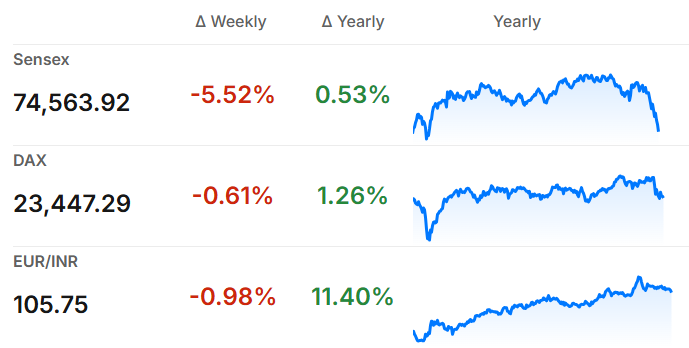
The Sensex registered its biggest weekly loss in four years this week. The index collapsed relentlessly through the week, closing Friday March 13th at 74,563, a staggering loss of over 5% in just five trading sessions. The driver was clear: the escalating US-Israel-Iran conflict triggered a wave of panic selling. Energy stocks, auto stocks, and cement companies bore the brunt as oil price concerns hit sentiment hard. The only survivors were defensive names, consumer goods and telecom stocks, which ended marginally positive. Foreign institutional investors were net sellers throughout the week, amplifying the decline.
Germany’s DAX wasn’t spared either. The index closed Friday at 23,447, a weekly decline of approximately 0.6%. Over the past month, the DAX has shed over 6%, weighed down by the same Iran conflict fears, rising energy costs, and global risk-off sentiment. German industrial companies with energy-intensive operations are particularly vulnerable to oil price spikes.
Germany News Roundup
Iran War Could Spike Inflation to 6%, raising concerns over prolonged conflict driving oil prices up and risking Germany’s entry into a fourth recession year with critical gas storage shortages. - Spiegel
VW Regains Market Leadership in China, with a combined joint venture market share of 13.9%, surpassing competitors like Geely and Toyota in the Chinese automotive sector. - Handelsblatt
Rheinmetall Rejects VW Osnabrück Factory Takeover, leaving the plant’s future uncertain as VW plans to decide on its fate by year-end amid dwindling production and ongoing industry talks. - NDR
China Cuts Chemical Exports Disrupt Supply Chains, raising concerns as critical chemical supply chains face initial breaks impacting global industries and trade flows, particularly in Europe. - Wiwo
Germany Faces Crucial Regional Elections, marking a pivotal political year with five key elections impacting national governance and policy direction. - Deutsche Welle
Germany Upholds Nuclear Power Phase-Out, rejecting calls for a return despite EU support, with Chancellor Merz emphasizing energy policy consistency and opposition parties firmly against reviving nuclear energy amid economic and political challenges. - DW
New AI Data Centre Investment in Amberg, marks a strategic step towards European tech independence with a 30MW facility, costing hundreds of millions, aiming for operational status by 2027 without state subsidies. - Brandsit
Tesla Triumphs in German Labour Council Vote, defeating IG Metall union’s bid to control the works council amid accusations of employee pressure and union-busting tactics at its Berlin factory. - Times of India
India News Roundup
PM Discusses Iran's Situation with President, expressing concern over regional security, emphasizing dialogue, and prioritizing safety of Indian nationals and uninterrupted transit of energy and goods. - PMO India
US-Iran Conflict Impacts India and Asia More, with India, Japan, and South Korea facing direct economic and security challenges unlike China due to energy, labor, and geopolitical dependencies in the Middle East. - ORF Online
India Secures Majority Crude Imports Outside Hormuz, ensuring stable supply through 40 countries and enhanced LNG procurement amid regional tensions, while government monitors seafarer safety and port operations remain stable. - Newsonair
India's Supreme Court Permits First Passive Euthanasia, authorizing withdrawal of artificial life support for a vegetative 32-year-old man after 12 years, marking the first judicial approval of passive euthanasia in India. - Aljazeera
India Plans $11B Fund to Boost Chipmaking, aiming to become a global hub by subsidising chip design, manufacturing equipment, and supply chain development with launch expected in 2-3 months. - CNBC TV18
Indonesia to Acquire BrahMos Missiles from India, enhancing its military hardware and maritime defense capabilities through this significant procurement deal valued between $200-$350 million. - Business Times
India Strengthens Tourism Ties at ITB Berlin, with Germany and Indonesia, focusing on sustainable travel, air connectivity, and cultural exchanges to boost tourism flows and showcase India's diverse tourism offerings globally. - PIB
Opportunity
Vincorion’s Frankfurt IPO
Europe’s defense spending surge is creating a rare window: established, profitable defense companies rushing to go public before the opportunity window narrows. The latest and most immediately actionable is Vincorion, a Hamburg-area German defense supplier specializing in power systems and mechatronics for military platforms. The company makes hybrid energy systems, emergency power generators, stabilization systems for tanks, heaters for military aircraft, and critical components for air defense systems including the US-made Patriot missile system.
The business fundamentals are compelling. Vincorion generated €240 million in revenue in 2025, more than double its revenue just three years ago and sits on an order backlog worth approximately €1.1 billion, nearly five times its annual revenue. That backlog isn’t speculative; it represents confirmed future work from NATO member countries, Rheinmetall, KNDS, and Airbus. Institutional investors Fidelity, Invesco, and T. Rowe Price have already pre-committed €105 million before the IPO even opens, a strong signal of institutional confidence. The company is being valued at €850 million, six times its valuation when private equity firm Star Capital acquired it just four years ago, reflecting how dramatically the European defense investment landscape has transformed.
The IPO opens for subscription on Monday, March 16th, with shares priced at a fixed €17 each, and trading expected to begin on the Frankfurt Stock Exchange on March 20th. For retail investors in Germany, this is accessible through standard brokerage accounts, a direct way to participate in Europe’s rearmament cycle without buying into already-expensive defense giants trading at elevated valuations. As with any IPO, risks exist: geopolitical developments could shift defense priorities, and post-IPO price volatility is common. But with a locked-in order backlog and cornerstone institutional investors already committed, Vincorion’s debut deserves serious attention.
Read the full details on the Vincorion IPO here:
MarketScreener: Defense Supplier Vincorion Rushes Toward IPO
Until Next Sunday…
Conclusion
The Strait of Hormuz has been disrupted before, and every time, the world found a way through. Whether through diplomatic back-channels, alternative shipping routes, or strategic reserves buying time, these crises eventually resolve. The question was never if, but how long. As we head into Week 12, watch Trump's diplomatic signals toward Iran, any ceasefire hint will trigger an immediate oil price drop and market relief rally.
See you next Sunday,
Jimit Patel