
This week, war stopped being abstract. Since February 28th, the United States and Israel have been conducting coordinated military strikes on Iran in what is now officially the largest Middle East military operation in decades. By day eight, US forces had targeted over 1,700 Iranian installations, Israeli jets had conducted over 1,600 sorties dropping more than 4,000 munitions. Iran has retaliated by targeting American military bases across the Gulf, forcing the closure of two US embassies and prompting evacuation warnings for American citizens in the region. President Trump declared he would accept nothing short of Iran’s “unconditional surrender”. The conflict that many analysts had feared for years has arrived and its consequences for global oil supply, Middle East stability, and financial markets are still unfolding in real time.
For India, this isn’t just a geopolitical headline. India imports approximately 85% of its crude oil, with a significant portion traditionally sourced from the Gulf region. Iran’s retaliatory strikes on oil facilities and airports in neighboring countries have already rattled energy markets. A sustained conflict means higher oil import bills, upward pressure on Indian inflation, potential rupee depreciation, and fiscal stress on a government that had just presented a growth-oriented budget. It also means anxiety for the millions of Indian workers employed across Gulf states, whose remittances are a critical lifeline for families back home.
Amid the geopolitical turbulence, two distinctly German stories also made headlines this week. From September this year, visitors to Cologne Cathedral, one of Germany’s most iconic landmarks attracting 6.6 million tourists annually, will need to pay an entrance fee for the first time in the cathedral’s centuries-long history. The cathedral chapter cited rising costs of maintenance, security, and operations.
And then there’s bahn.bet. A Vienna-based artist named Caio van Caarven launched a satirical website this week that looks exactly like a sports betting portal except users bet fictional Euros on how late specific Deutsche Bahn trains will arrive. Using real-time train data and AI-generated code, the platform gives new users 1,000 fictional Euros to place wagers on actual long-distance train delays. The website went viral almost immediately.
In this week’s Opportunity section, we look at the defense stocks analysts identify as direct beneficiaries of the Iran conflict, and what this means for investors navigating an increasingly volatile geopolitical landscape.
Let’s dive in.
Stock Market
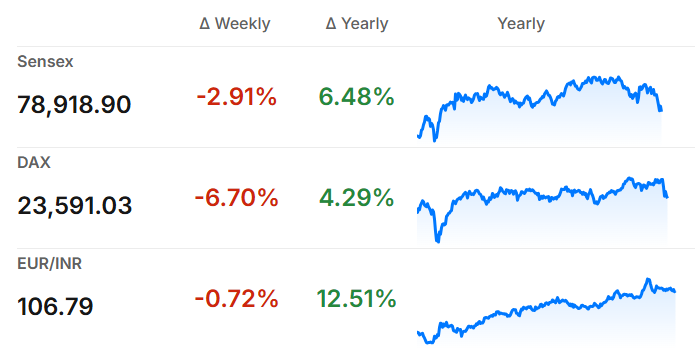
The Indian equity market ended the week on a bearish note, with the Sensex closing at 78,918.9, down 2.9% from the previous week’s 81,287.2. The decline was mainly driven by broad-based selling pressure across key sectors, particularly financials and IT, amid concerns over tightening liquidity conditions.
The DAX closed the week at 23,591.03 points, down approximately 6.7% from the previous week’s 25,284.26, marking a notable correction. Despite the decline, the index showed resilience on Friday by resisting negative pressure stemming primarily from a sell-off in US tech stocks.
Germany News Roundup
Trump Meets Germany’s Merz Amid Iran Conflict, discussing leadership uncertainties in Iran and collaboration on post-conflict strategies while addressing rising oil prices and international responses to the U.S.-Israel military campaign. - PBS NewsHour
Iran Conflict Pushes Oil Prices Higher, as crude oil prices surge 14%, surpassing a crucial threshold amid escalating tensions, impacting global energy markets and economic stability. - Handelsblatt
German Industry Warns on China’s Five-Year Plan, expressing concerns about China’s push for high-tech dominance and urging investment in key technologies and resilient supply chains amid climate policy shortcomings. - FAZ
European Airlines See Demand Rise Amid Iran Conflict, as Gulf carriers reduce flights, benefiting Lufthansa and others despite operational challenges caused by regional instability. - Handelsblatt
German Property Prices Decline Three Months, with mixed trends showing rising condo prices but slight falls in new single-family house values according to the Europace House Price Index. - FinanzMarktWelt
Merz Proposes Pension Linked to Working Years, urging citizens to start saving early, suggesting even €50 monthly can secure a substantial pension by retirement at 65 or later. - Tagesspiegel
Bundeswehr Conducts Large-Scale NATO Medical Drill, simulating evacuation and treatment of up to 1000 wounded soldiers daily from Lithuania, highlighting logistical challenges and readiness gaps before a potential conflict with Russia. - BILD
US Excludes Rosneft Germany from Russia Sanctions, allowing the energy company to continue operations despite ongoing sanctions on Russia. - TVP World
India News Roundup
Mark Carney Resets Canada-India Relations, focusing on a Comprehensive Economic Partnership, energy cooperation, critical minerals, and academia despite lingering security tensions from 2023 diplomatic fallout. - The Conversation
India-Finland Elevate Ties with Strategic Partnership, agreeing to deepen cooperation in digitalization, sustainability, trade, and multilateral issues to enhance bilateral relations and global collaboration by 2030. - pmindia.gov.in
India Secures Uranium via Canada Deal, boosting nuclear fuel supply from 2027 to 2035 to support expanding nuclear power and military programs despite challenges in domestic uranium extraction and program delays. - The Hindu
Middle East Conflict Risks $50B Indian Remittances, threatening income of millions of Indian workers in the Gulf and possibly impacting India's economy if the conflict prolongs beyond six months amid rising oil prices and higher aviation costs. - CNBC
US Grants 30-Day Waiver for Indian Russian Oil Imports, allowing India limited time to continue purchasing Russian oil despite sanctions, impacting global energy trade dynamics. - VisionIAS
India Revises GDP Measurement Framework, introducing updated base year 2022–23 and improved calculation methods for more accurate economic representation and growth projections. - Finshots
India-Germany AIP Submarine Deal Boosts Naval Power, acquiring six advanced submarines built in India with German technology to enhance underwater warfare capabilities and maritime security by 2036 under Project-75I. - Indian Masterminds Stories
ePlane Integrates HENSOLDT for Electric Air Taxi, enhancing the e200X with advanced avionics for safe, efficient urban flight and supporting certification under India’s DGCA regulations. - Indianweb2
Opportunity
When Conflict Drives Defense Demand
The US-Israel strikes on Iran this week didn’t just reshape Middle East geopolitics-they sent an immediate signal to defense investors. When military conflict escalates, the demand for specific defense capabilities follows a predictable two-phase pattern that creates identifiable investment opportunities. KeyBanc analyst Michael Leshock has mapped this playbook clearly: the companies that benefit first are those supplying systems that get consumed or damaged fastest in active combat - drones, kamikaze systems, air defense, and surveillance platforms.
The first phase of any sustained conflict drives immediate demand for battlefield-ready systems. Unmanned aerial vehicles - both reconnaissance drones and so-called kamikaze drones that self-destruct on impact, are central to modern warfare in a way they weren’t a decade ago. Iran’s conflict history and geography make air superiority and intelligence-gathering capabilities particularly critical. Alongside direct weapons systems, companies specializing in military maintenance, spare parts, and logistics services benefit significantly, the harder military aircraft and systems are used, the faster they require servicing and replacement components. These aftermarket defense businesses are often overlooked but generate highly recurring, predictable revenue streams during extended conflicts.
The second phase is where long-term investors pay close attention. As conflicts extend beyond weeks into months, military stockpiles deplete and governments shift from immediate procurement to systematic replenishment programs. This phase typically involves larger contracts, longer production cycles, and companies with capabilities in propulsion systems, hypersonic weapons, and precision strike technologies. One important note of caution from Leshock himself: most of these companies are already trading at elevated valuations, markets have anticipated much of this upside. For investors considering entry, disciplined risk management and strict stop-loss orders are essential rather than optional.
Read the full analyst breakdown with detailed company analysis on stock3:
stock3: Direct Beneficiaries of the Iran War — Analyst Names These Companies
Until Next Sunday…
Conclusion
As the Iran conflict enters its second week with no ceasefire in sight, all eyes next week turn to Wednesday’s US CPI data, which will tell us whether war-driven oil prices are already feeding into American inflation, and consequently, how the Federal Reserve responds.
For India, the RBI finds itself in a difficult spot: oil assumed at $70 per barrel in its last policy review is now trading above $80, potentially forcing an uncomfortable revision to India’s inflation and growth forecasts. Every passing day of conflict reshapes the economic math quietly and next week’s data will begin putting numbers to that reality
See you next Sunday,
Jimit Patel