
If the world felt unusually restless this week, that’s because it was. From diplomatic corridors in Beijing to war-torn skies over Tehran, this week delivered a cascade of events that reminded us how quickly the geopolitical chessboard can shift.
Let’s start closer to home. Germany’s new Chancellor Friedrich Merz made one of his first major foreign policy moves by travelling to Beijing for talks with Chinese leadership. The symbolism was deliberate, Europe’s largest economy signalling that despite transatlantic tensions with Washington, it intends to maintain its own independent relationship with China. For German industry, which has billions of euros tied up in Chinese supply chains and markets, Merz’s trip was less about geopolitics and more about pragmatism: Germany needs trading partners, and China, complicated as it is, remains one of its largest. How these conversations evolve will have direct implications for German exports, DAX-listed companies with China exposure, and ultimately the broader European economic outlook.
Back in Germany itself, daily life was disrupted this week as public transport workers launched another strike, bringing buses, trams, and regional trains to a standstill in major cities. For the millions of commuters who depend on Germany’s public transport network, it was a frustrating reminder that wage negotiations between unions and transport operators remain far from resolved. For the broader German economy already navigating sluggish growth, recurring strikes add friction at precisely the wrong moment.
Meanwhile, across the Mediterranean, Prime Minister Narendra Modi landed in Israel, a visit carrying enormous diplomatic weight. India has historically maintained carefully balanced relationships in the Middle East, and Modi’s presence in Tel Aviv signals both solidarity with an old strategic partner and a desire to keep diplomatic channels open during one of the region’s most volatile periods in decades. India imports significant quantities of oil from the region and has hundreds of thousands of workers employed across Gulf states. Any escalation affects India directly, and Modi’s visit was as much about protecting India’s interests as it was about diplomacy.
And then came the development that overshadowed everything else: the United States and Israel launched coordinated strikes on Iran. Details remained fluid as this newsletter went to press, but the implications are already reverberating through global markets. Oil prices spiked. Safe-haven assets moved. The Gulf region, which accounts for a significant portion of India’s oil imports and employs millions of Indian workers, is once again at the center of a crisis that no one can fully predict.
In this week’s opportunity section, we cover why global India funds offer NRIs in Germany a smarter way to access India’s growth story.
Let’s dive in.
Stock Market
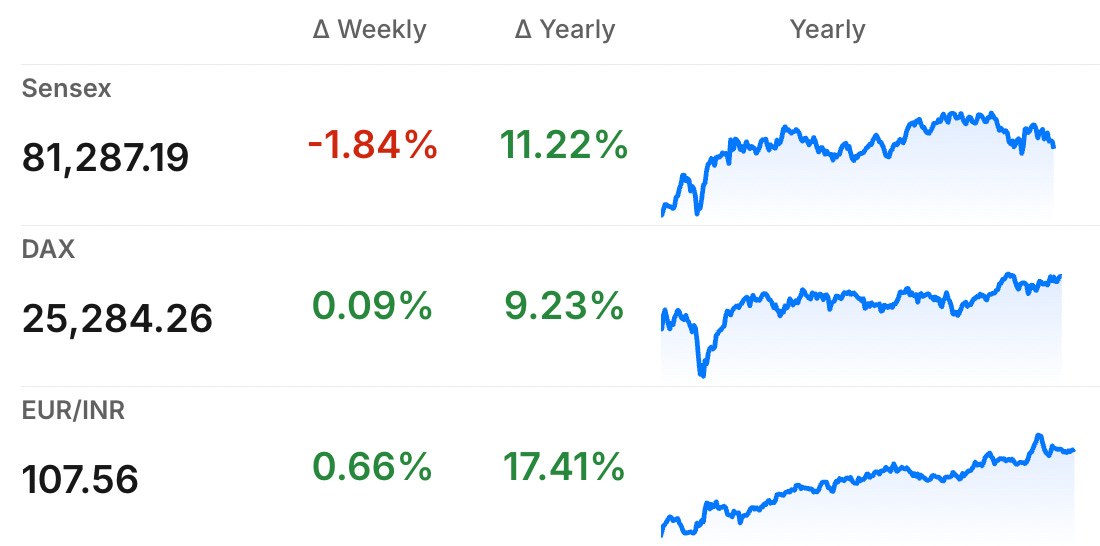
The Indian stock market experienced a modest bearish trend this week, with the Sensex closing at 81,287.19, down 1.84% from the previous week’s 82,814.71. Sector performance was mixed, with power and select financial stocks maintaining relative strength, while IT and export-oriented sectors faced profit-taking pressures. RBI’s dovish stance along with steady PMI readings supported sentiment, but cautious FII flows and subdued GST collections indicated tempered domestic demand. Market participants will closely watch upcoming inflation data and corporate earnings for directional cues next week.
The German stock market (DAX) showed marginal gains this week, closing at 25,284.26 points, just 0.09% above last week’s close of 25,260.69. Investor sentiment remained cautious amid ongoing concerns about artificial intelligence (AI) disruptions, which have led to significant sell-offs in US technology stocks, notably the Nasdaq. However, the DAX exhibited relative stability in comparison. Market participants closely monitored geopolitical tensions between the US and Iran, with the potential for military action spooking markets temporarily.
Germany News Roundup
Merz’s Visit to Reaffirm Germany-China Cooperation, aims to boost bilateral economic ties, deepen political dialogue, and promote pragmatic cooperation amidst global uncertainties and EU’s cautious stance on China. - China Daily
Germany’s Major Push for One-Way Attack Drones, includes contracts worth billions for domestic makers to supply advanced kamikaze drones, signaling a shift in military strategy and adaptation to modern warfare realities. - Defense News
Amazon Faces Major Ordering Disruption, impacting users in Germany and the UK, causing technical errors and preventing order placements across platforms worldwide. - Merkur
Ikea to Cut Hundreds of Jobs in Germany, affecting nearly 280 staff at Rostock call center in response to automation and retail changes, sparking criticism over needed social protections. - t-online
Bosch to Cut 22,000 Jobs in Germany, aims to secure competitiveness and adapt to the changing auto industry with voluntary job cuts, impacting mobility sector until 2025 and beyond. - Heise
Germany Plans to End Small Solar Installation Subsidies, halting fixed feed-in tariffs and mandating direct marketing for new solar systems up to 25 kW, risking reduced citizen adoption of renewable energy solutions. - Tagesspiegel
German Job Market Still Faces Over 3 Million Unemployed, with minimal decline in unemployment and high demand for social benefits signaling ongoing economic challenges in early 2026. - BILD
India News Roundup
India-Israel Strengthen Trade and Defence Ties, with agreements enhancing collaboration in defence technology, AI, cybersecurity, and increasing Indian workforce in Israel despite Gaza conflict tensions. - Al Jazeera
India Signs Critical Minerals Deal with Brazil, to reduce Chinese dependency by boosting supply chain resilience and expanding trade, particularly in rare earths vital for technology and renewable energy sectors. - Aljazeera
AI Pressures Indian IT Stocks Sharply, prompting significant market decline despite strategic partnerships and growth opportunities in AI technology adoption by major companies like TCS and Infosys. - CNBC
India Unveils Comprehensive PRAHAAR Counter-Terror Policy, establishing a unified intelligence-led framework addressing hybrid threats, digital radicalization, and international cooperation to strengthen national security and preempt terror attacks effectively. - ORF Online
Indian Startup Layoffs Surpass 4,500 in Eight Months, reflecting significant business pressures affecting the sector's employment landscape amid economic challenges. - People Matters
Bombardier Sees Growth in India's Business Jet Sector, India's aviation infrastructure upgrades present a significant opportunity for Bombardier to expand its business jet sales in the long term, says CEO Eric Martel. - The Hindu Business Line
India-Germany Collaborate on AI Veterinary Care, advancing diagnostic accuracy and student exchanges through a strategic partnership fostering veterinary innovation and research from 2026 to 2030. - Times of India
Germany's INDEX Opens Bengaluru Tech Centre, to enhance manufacturing solutions and customer support, tapping into India's growing industrial demand with CNC machine showcases and consulting services. - Deccan Herald
Opportunity
The Global Indian Funds
India’s growth story is genuinely compelling. GDP growing at 8.2% annually, Morgan Stanley comparing India’s current trajectory to the United States of the 1980s, corporate earnings rising, and $270 billion in fresh AI investment commitments just this week. You already know this story better than most global investors, you’ve lived it. But as someone earning Euros in Germany, how you invest in India matters as much as whether you invest.
Here’s what most people overlook. If you invest directly in Indian markets through an NRE/NRO account in INR, you carry a hidden currency risk. EUR/INR moved from approximately 90 to 107 over the past year, nearly 19% Euro appreciation. A healthy 15% Sensex return during the same period would have delivered a net loss in Euro terms after currency conversion. Your Indian portfolio grew, but your actual purchasing power in Germany shrank. This is the structural challenge every NRI faces with direct INR-denominated investments.
Global India ETFs and funds solve this elegantly. Your investment stays denominated in Euros. The fund internally tracks Indian stocks, capturing India’s growth but when the Rupee depreciates against the Euro, the fund price adjusts accordingly, protecting your purchasing power in Germany. You get the best of both worlds: exposure to one of the world’s fastest-growing equity markets, with the currency stability of a Euro-denominated product. For NRIs managing finances across two countries, this isn’t just convenient, it’s genuinely smarter portfolio construction. Over 4,800 listed Indian companies, including roughly 600 with market caps above $1 billion, are accessible through these funds without a single currency conversion headache.
Read DAS Investment’s full ranking of the best-performing India funds over five years here:
DAS Investment: The Best India Funds 2026
Until Next Sunday…
Conclusion
This week the world moved fast, perhaps too fast to fully digest. But markets have a way of catching up with reality, and next week will likely be about exactly that: digestion. In India, all eyes will be on the RBI's monetary policy response to the Iran escalation and its impact on oil import costs, a spike in crude prices is effectively a tax on the Indian economy, and the central bank cannot ignore it.
In Germany, wage negotiation deadlines loom for transport workers, and Merz returns from Beijing with either a trade framework or empty hands, either outcome moves markets differently. And somewhere in the background, the EU-India free trade agreement implementation begins its first formal review cycle, quietly laying the foundation for a trading relationship that could define the next decade far more than any single week's headlines.
Stay informed, stay invested, and see you next week.
See you next Sunday,
Jimit Patel