
There’s a certain irony that wasn’t lost on me this week. While Wall Street analysts were still writing post-mortems on last week’s AI selloff, questioning whether the hundreds of billions being poured into artificial intelligence would ever generate returns while New Delhi was hosting 3,250 speakers, five lakh visitors, and the CEOs of the world’s most powerful technology companies, collectively committing $270 billion to build AI infrastructure on Indian soil.
The India AI Impact Summit 2026 was arguably the most significant technology event ever hosted on Indian soil. Sam Altman called India his second-largest and fastest-growing market. Sundar Pichai announced a $15 billion Google AI hub. And 88 countries signed the New Delhi Declaration, making India the first developing nation to chair a global AI governance framework.
In this week’s newsletter, we cover India’s landmark AI summit and what it means for Indian equity markets, the beauty industry’s surprisingly resilient investment case, market updates from both India and Germany, and keep you informed on the developments that matter.
Let’s dive in.
Stock Market
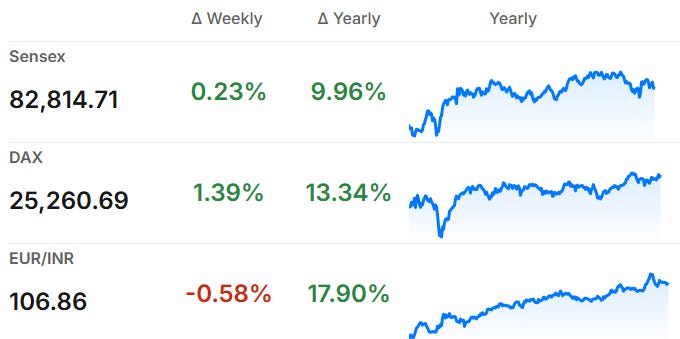
The Indian stock market exhibited marginal gains this week, with the Sensex closing at 82,814.71, up 0.23% from the previous week’s 82,626.76. Market breadth remained mixed amid cautious investor sentiment, supported by steady domestic demand and positive earnings in the power and financial sectors. However, IT stocks showed moderate consolidation.
The German stock market, as measured by the DAX, closed the week at 25,260.69 points, marking a moderate weekly gain of approximately 1.39% from the previous close of 24,914.88. The market saw initial calmness early in the week but faced renewed investor caution from Thursday onwards, mainly driven by concerns over the artificial intelligence (AI) sector. Large technology stocks were notably impacted, reflecting investor scrutiny of tech giants’ profitability amid soaring AI-related investments and widening discrepancies between reported earnings and free cash flow.
Germany News Roundup
Germany Inflation Climbs 2.1% in January, with food and services driving price rises despite falling energy costs, indicating stronger price pressures at the start of 2026. - DW
Renault Earns More Per Car Than Volkswagen, outperforming major competitors with a 6.3% operating margin despite industry challenges and high losses from Nissan stake revaluation. - Handelsblatt
New MVG Strike Expected in Munich, Verdi plans a strike in Munich’s public transport within two weeks, demanding higher wages and reduced hours, causing concern over potential service disruptions and fare increases. - tz
Chancellor Merz Advocates Real Name Policy Online, aiming to end internet anonymity to protect liberal society and counteract harmful algorithmic influences and threats to democracy, while SPD opposes this measure. - Tagesschau
Massive Job Cuts Threaten Deutsche Bahn IT Subsidiary, with plans to cut up to 4000 jobs by 2029 amid proposed decentralization and concerns over cybersecurity risks from Deutsche Bahn’s IT service unit DB Systel. - heise.de
Raising Retirement Age to 70 Under Discussion, potentially affecting those born from 1970 onwards with financial and policy implications amid debates on early retirement penalties and contribution adjustments. - Merkur
Plato Raises $14.5M Seed Funding, to enhance its AI-powered platform for wholesale distributors, focusing on customer service, procurement, and international growth opportunities. - The SaaS News
Munich Re’s Ergo Plans Major Job Cuts, to reduce approximately 1,000 positions in Germany, citing increased artificial intelligence use in its operations. - Intelligent Insurer
Germany’s DB Cargo Plans Major Job Cuts, aiming to cut 6,000 jobs as part of efforts to restore profitability in a challenging market environment. - Global Banking & Finance Review
Berlin-Hamburg Railway Renovation Delays Persist, with severe winter weather and underground cabling issues pushing completion beyond the original April deadline, affecting thousands of daily passengers and extending train journeys. - Yahoo News
India News Roundup
Modi's Vision: Top 3 AI Superpower by 2047, aims for India to lead globally in AI creation, impacting healthcare, education, governance, and empowering citizens with inclusive, human-centric technology and strong safety regulations. - PMIndia
Lufthansa Group Expands Partnership with Air India, to enhance market access, increase connections, and jointly market flights, strengthening ties between India and the EU's aviation sectors. - Lufthansa Group Newsroom
India-France Elevate Partnership With 21 Agreements, covering defence upgrades, joint technology initiatives, critical minerals cooperation, innovation networks, and renewable energy collaboration through strategic dialogues and centres of excellence. - Newsonair
India Considers Age Restrictions on Social Media, continuing discussions with companies to regulate access for minors amid growing global adoption and concerns over digital content and safety. - CNBC
India Joins US-Led Pax Silica Coalition, partnering with major economies to secure resilient electronics and critical minerals supply chains against geopolitical risks and economic coercion. - The Hindu
EAM Jaishankar Meets G-4 Counterparts in Germany, to discuss reformed multilateralism during their first meeting at Munich Security Conference 2026, highlighting cooperation between India, Germany, Japan, and Brazil. - News On AIR
Sarvam Launches Two Advanced AI Language Models, optimised for real-time efficiency and complex reasoning to support enterprise applications like coding assistance and analytics while reducing inference costs. - The Economic Times
AI Impact Summit - India
New Delhi was the center of the global technology universe this week. Not Silicon Valley. Not Beijing. Not London. New Delhi.
From February 16-21, Bharat Mandapam hosted the India AI Impact Summit 2026—the fourth in a series of landmark global AI summits following previous editions in the UK, South Korea, and France. But this one was different. For the first time in the history of these global gatherings, the host country was from the Global South and it arrived not as a student seeking guidance, but as a confident host setting the agenda.
Over five lakh visitors attended, with 3,250 speakers across 500+ sessions. The who’s who of global technology was present: OpenAI’s Sam Altman, Google’s Sundar Pichai, Microsoft’s leadership, AMD, Blackstone.
The numbers that emerged were jaw-dropping. Total AI infrastructure investment commitments crossed $270 billion. Out of this, $250 billion was pledged for AI infrastructure alone data centers, compute capacity, semiconductor facilities, and energy systems. Another $20 billion came in venture capital and deep-tech investments.
To put that in context: India’s entire Union Budget for 2026-27 is approximately ₹50 lakh crore (roughly $580 billion). The AI summit generated investment pledges worth nearly half the national budget in just five days.
The individual corporate announcements were equally significant:
OpenAI launched “OpenAI for India” committed to building data center infrastructure in partnership with Tata Consultancy Services (TCS) to run its most advanced models securely within India
Google announced a $15 billion full-stack AI hub in India, calling it one of its most significant global investments
Microsoft confirmed it is on pace to invest $50 billion in AI across the Global South by the end of the decade, with India as the primary destination
AMD declared collaboration with Tata Group for AI capabilities
Blackstone joined a $600 million equity funding round for Indian AI infrastructure firm Neysa
Sam Altman, who met PM Modi personally, said it best: “India is already our second-largest market, growing incredibly fast. The energy here, the excitement of builders with AI in India for the entire stack is amazing to see”. Coming from the CEO of the world’s most valuable AI company, that’s not diplomatic courtesy that’s a genuine business assessment.
The summit concluded with the adoption of the New Delhi Declaration on AI Impact, endorsed by 88 countries and international organizations. Structured around seven pillars from democratizing AI resources to secure and trusted AI, the declaration positions India as the defining voice for how AI should be governed and deployed in the developing world.
PM Modi framed India’s vision around three core principles and seven focus areas (”Sutras” and “Chakras”), emphasizing that AI must be human-centric, inclusive, and environmentally sustainable. India also unveiled 12 indigenous foundation models under the IndiaAI Mission, trained on Indian datasets and supporting all 22 official languages—demonstrating that India isn’t just attracting foreign AI, it’s building its own.
Opportunity
The Business of Looking Beautiful
Here’s an industry that doesn’t care about recessions, trade wars, or AI selloffs: the global beauty and medical aesthetics market. People spent $38 billion on medical aesthetics alone in 2024, treatments like Botox, hyaluronic fillers, and non-invasive skin procedures and analysts expect this market to grow at around 10% every year until 2035. To put that in perspective, it took from 2020 to 2024 for the number of people getting cosmetic procedures worldwide to jump from 25 million to 38 million annually. That’s not a trend, that’s a structural shift.
Three forces are driving this growth simultaneously. First, aging populations in Europe, the U.S., and Japan, people are living longer and increasingly willing to spend on looking younger. Second, rising middle-class incomes in Asia, particularly China, where beauty treatments are becoming mainstream rather than luxury. Third, and this is particularly interesting: social media. Nearly one in four patients under 30 say Instagram and TikTok directly influenced their decision to get a cosmetic treatment. The share of Botox treatments among under-30s jumped from 7.1% in 2024 to 8.8% in just one year. GenZ is becoming the beauty industry’s fastest-growing customer segment.
Interestingly, experts describe a phenomenon called the “Lipstick Effect”, even during economic hardships, people keep spending on small beauty indulgences. Lipstick sales rose during America’s Great Depression in the 1930s. This makes beauty stocks somewhat recession-resistant, which is a rare quality in today’s volatile markets. For retail investors wanting exposure to this theme without picking individual stocks, ETF options exist that bundle this opportunity across multiple companies.
Read the full analysis with specific ETF recommendations here:
DAS Investment: ETFs that invest in Beauty Stocks
Until Next Sunday…
Conclusion
This Friday, February 27th, India will release its brand new GDP series with base year 2022-23. This isn’t a routine quarterly update. It’s a complete statistical overhaul incorporating GST transaction data, UPI payment flows, E-Vahan portal data, and more modern data sources that better capture India’s digitally transformed economy.
On the European side, Wednesday, February 25th brings Germany’s Q4 2025 GDP figures alongside Eurozone inflation data for January. Markets expect modest German quarterly growth of around 0.3%, small, but meaningful for an economy that contracted in 2024. The same day, ECB President Lagarde is scheduled to speak, potentially offering clues about the pace of future interest rate decisions. For EUR/INR watchers, her tone matters.
Stay informed, stay invested, and see you next week.
See you next Sunday,
Jimit Patel