
If you thought last week’s budget drama was confusing, this week showed us that nothing in financial markets makes sense when panic takes over.
It started quietly enough. On Monday, February 9th, Tokyo’s Nikkei 225 exploded upward by 5%, hitting an all-time high above 57,000 after Prime Minister Sanae Takaichi’s Liberal Democratic Party secured a supermajority in parliamentary elections, Japan’s largest election win since World War II. Investors celebrated the decisive mandate, betting that Takaichi’s growth-oriented policies and strategic industry investments would finally revive Japan’s economy.
But while Tokyo celebrated, Wall Street was having an identity crisis.
For the past two years, anything remotely connected to artificial intelligence was Wall Street’s favorite trade. Microsoft, Alphabet, Nvidia, if you had “AI” in your investor presentation, money poured in. But this week, that narrative collapsed spectacularly. The Nasdaq tumbled 2% on Thursday alone as investors suddenly questioned whether the $527 billion that tech giants are expected to spend on AI infrastructure in 2026 will ever generate returns.
By Monday, another bombshell: Bloomberg reported that Chinese regulators had quietly urged banks to reduce their holdings of U.S. Treasury bonds, citing concentration risk and market volatility. While officials framed it as risk management rather than geopolitical posturing, the timing was uncomfortable. Chinese banks collectively held about $298 billion in dollar-denominated bonds, and the message was clear: diversify away from America.
Amid all this chaos, two quieter stories unfolded in India. On February 13th, Prime Minister Narendra Modi inaugurated Seva Teerth, a new government complex in Delhi symbolizing what he called “transformation from a mindset of power into a spirit of service”. From his new office, Modi approved four major schemes covering women, agriculture, accident care, and startups—signals that despite global volatility, India’s domestic policy focus remains steady.
And in Nuremberg, Germany, India was conferred the prestigious title “Country of the Year” at BIOFACH 2026, the world’s largest trade fair for organic products. This isn’t just ceremonial recognition; it positions India as a global leader in organic agriculture and opens doors for exporters of organic rice, spices, pulses, cashews, turmeric, and essential oils to European markets.
In this week’s opportunity section, we've covered Morningstar's top 10 blue-chip stocks trading at significant discounts, quality companies that provide exactly the kind of stability investors need when everything else is falling apart.
Let’s dive in.
Stock Market
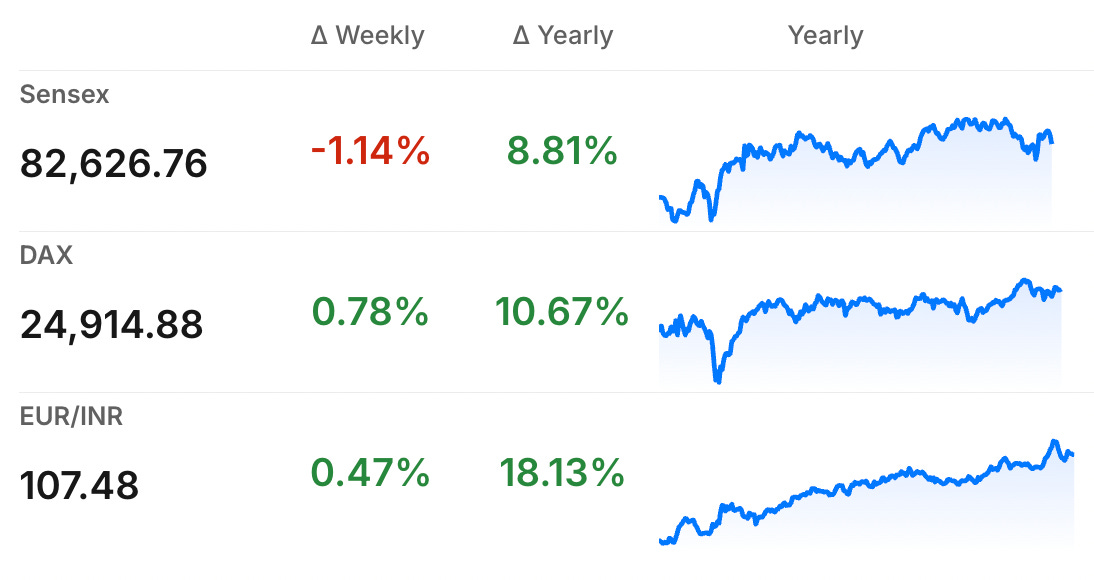
The Indian stock market ended the week with a modest bearish tone, as the Sensex declined by approximately 1.14% to close at 82,626.76 from last week’s 83,580.40. The market saw mixed sector performance, with financials and IT showing resilience while power stocks lagged amid profit booking. RBI’s continued calibrated policy stance and easing inflation supported risk sentiment, though subdued GST data and cautious foreign institutional investor flows weighed on momentum. Investors will closely watch upcoming inflation and corporate earnings updates for directional cues next week.
The German stock market showed a modest gain this week, closing at 24,914.88 points, up 0.78% from last week’s 24,721.46. Investor sentiment was influenced by sharp declines in precious metals; gold and silver experienced significant price drops amid speculative trading and industrial demand dynamics. Technology stocks came under pressure due to hefty investments in artificial intelligence by major players such as Alphabet and Amazon, dampening sector performance despite strong underlying business.
Germany News Roundup
Europe’s Ariane 64 Rocket Launches Internet Satellites, marking its first commercial mission by carrying 32 Amazon Leo satellites, doubling payload capacity compared to previous versions. - Space.com
Europe Must Review Carbon Market Policies, with German Chancellor Merz urging openness to revise or postpone EU emissions system if it fails to support industrial green transition and competitiveness. - GMK Center
Sweden Resists Macron’s ‘Buy European’ Push, arguing that protecting European companies from international competition may harm EU’s economic competitiveness despite calls for self-reliance amid transatlantic tensions. - Politico
Elster App Enables One-Click Tax Filing, starting July 2026, single, childless employees and pensioners can file tax returns via the Elster app with one click, based on pre-filled official tax data to simplify submission. - Stadt Bremerhaven
Commerzbank Embraces European Payment App Wero, rejoining the initiative to offer its 10 million customers access to Wero’s mobile and online payment services across Europe, starting discussions for rollout timing. - marketscreener
SAP Launches Defense Innovation Hub in Munich, to boost digital military readiness through AI, data analytics, and strategic partnerships enhancing resilience and operational agility amid rising cyber threats. - SSBCrack News
Mercedes Profits Plunge Over 50% in 2025, hit by weak China sales, global tariffs, and EV transition challenges, with hopes pinned on cost cuts and new products for 2026 recovery. - Euronews
Toyota Outsells VW in China’s BEV Market, selling 100,000 battery-electric cars in China in 2025, surpassing VW’s 85,000 despite VW’s stronger global EV focus and market share in China. - electrive.com
BYD and MG Expand Dealer Networks in Germany, aiming to reach more private customers by offering bonuses and incentives, with BYD targeting to double its registrations by 2026. - Table.Media
Tesla Files Complaint Over Union Recording Incident, after IG Metall representative secretly recorded an internal meeting at its Berlin factory, escalating tensions amid declining German sales and unionization efforts. - eletric-vehicles.com
Frankfurt Challenges Protest Ban at Imam-Ali Mosque, after a court ruled the ban invalid, citing the protesters’ rights under assembly freedom despite city concerns over traffic disruptions. - hessenschau.de
India News Roundup
PM Modi Unveils Seva Teerth in Delhi, consolidating key government offices into modern complexes to enhance citizen-centric governance, security, and efficiency across ministries. - Illustrated Daily News
India Introduces One Central Registration for Employers, streamlining compliance by replacing multiple registrations with a unified digital system valid across states, reducing paperwork and costs while maintaining worker protections by April 2026. - India Briefing
Gujarat CM Launches ‘Amul AI’ Initiative, bringing AI technology to revolutionize India’s largest dairy cooperative, enhancing efficiency from milk collection to farmer payments across 18,500 villages and 36 lakh producers. - Illustrated Daily News
India-Malaysia Expand Trade and Defence Partnership, including semiconductors, healthcare, food security, local currency trade, and defence with aims to boost bilateral trade beyond $18.6bn and deepen collaboration. - Al Jazeera
India Mandates Three-Hour Social Media Takedown, compelling platforms like Meta, YouTube, and X to act swiftly on unlawful and AI-generated content, raising concerns of automation-led censorship and feasibility challenges. - BBC
India: Indispensable Partner for Europe, Greek Defence Minister highlights India's crucial role for Europe and supports the EU-India Free Trade Agreement to enhance strategic and economic ties. - Newsonair
India Approves $40 Billion Rafale Jet Purchase, marking a major defense upgrade with 114 jets amid growing military needs, coinciding with President Macron's upcoming India visit to boost bilateral ties. - CNBC
Rolls-Royce to Expand Operations in India, focusing on defence, civil aviation, and energy with potential for technology transfer, job creation, and increased local manufacturing partnerships. - New Indian Express
India Climbs 79 Ranks in Ease of Doing Business, reflecting major reforms and digitalization efforts that streamlined regulations and reduced compliance burdens over five years under the Business Reforms Action Plan. - SarkariTel
Angela Merkel to Give First Manmohan Memorial Lecture, focusing on India-Germany relations during global changes, honoring former PM Manmohan Singh's legacy in economic reforms and cooperation. - The Hindu
Opportunity
10 Best Blue-Chips Stocks - Morning Star
While markets obsess over AI hype and defense contractors, some of the world’s highest-quality companies are quietly trading at significant discounts. Morningstar just released their list of the 10 best blue chip stocks to buy for the long term as of January 27, 2026, all trading at least 12% below calculated fair value.
What Are Blue Chip Stocks?
Think of blue chip stocks as the reliable, proven companies that form the backbone of any solid investment portfolio. The term comes from poker, where blue chips have the highest value. In investing, these are large, financially strong companies with decades of track record, the household names you recognize immediately.
What Makes These Special?
Wide economic moats: Competitive advantages competitors can’t easily replicate
Predictable cash flows: Revenue you can forecast years in advance
Smart management teams: Leaders with proven capital allocation track records
Market caps above $100 billion: Established, financially stable giants
The Top 10 Undervalued Blue Chips
Here’s the complete list with their discount levels:
Sony Group (SONY) - Trading 30% below fair value at $22.75 vs. $32.50 fair value
SAP (SAP) - 25% discount, diversified enterprise software leader
Intuit (INTU) - 24% discount, dominates small business accounting and tax software
TSMC (TSM) - 21% undervalued, world’s largest chip foundry with 70% market share
Microsoft (MSFT) - 20% discount, cloud computing and AI leader worth $3.6 trillion
Bristol-Myers Squibb (BMY) - 16% undervalued, pharmaceutical giant with 4.54% dividend yield
Automatic Data Processing (ADP) - 14% discount, payroll and HR software leader
Nestlé (NSRGY) - 13% undervalued, world’s largest food manufacturer with 3.86% dividend
Danaher (DHR) - 13% discount, life sciences and diagnostics equipment maker
GSK (GSK) - 12% undervalued, major pharmaceutical and vaccine company with 3.36% dividend
Read the full analysis with detailed company breakdowns, analyst commentary, and investment theses here:
Morningstar: 10 Best Blue-Chip Stocks to Buy for the Long Term
Not Get-Rich-Quick Schemes
Let me be clear: these won’t 10x in two years. Microsoft isn’t going from $3.6 trillion to $36 trillion. But that’s not the point. Blue chips survive recessions, pay dividends through crashes, compound steadily at 8-12% annually over decades, and will still be around when you retire.
Until Next Sunday…
Conclusion
As we close, one lesson stands out: when fear takes over, everything falls together. Gold, silver, Bitcoin, stocks, traditional diversification failed because panic doesn’t discriminate.
But here’s the truth: the best investments are made when everyone else is running for the exits. AI spending concerns will pass. Markets will stabilize. Quality companies will survive and thrive.
This week reminded us why we focus on blue-chip stocks, why diversification across geographies matters, and why patience beats panic every single time. The noise is loud now, but fundamentals ultimately prevail.
Stay informed, stay invested, and see you next week.
See you next Sunday,
Jimit Patel