
This week, Finance Minister Nirmala Sitharaman stood up in Parliament on February 1st to present India’s Union Budget 2026-27. For those of us following the markets, what happened next was like watching a thriller unfold in real-time.
As she began reading the budget speech around 11 AM, the Sensex was trading comfortably above 82,000 points. Investors were hoping for tax relief, clarity on capital gains, and pro-growth measures. But as the speech progressed, or more accurately, as traders realized what wasn’t in the speech, the market started sliding. No income tax cuts. Higher STT on derivatives. More infrastructure spending but nothing dramatic for middle-class taxpayers.
By the time the Finance Minister finished, the Sensex had shed nearly 1,000 points in a matter of hours. The immediate disappointment was palpable. But here’s where it gets interesting: over the next few days, cooler heads prevailed. Investors started digesting the actual content, ₹12.2 lakh crore for infrastructure, doubled NRI investment limits, simplified compliance, and a one-time window to regularize foreign assets. The market began recovering, and by week’s end, we closed at 83,580, actually up 1.59% for the week.
Then came Tuesday, February 2nd. President Trump announced a trade deal with India, and the initial headlines sounded promising: tariffs on Indian goods would be cut from a punitive 50% down to 18%. The market’s first reaction was euphoric, finally relief from the trade war that had been dragging down sentiment since August 2025.
But as details emerged, the euphoria turned cautious. Yes, the 18% tariff is better than 50%, but it’s still substantially higher than the pre-2025 baseline of around 10%. And the concessions India made weren’t trivial: halting Russian oil purchases, committing to buy more American energy and agricultural products, and gradually reducing our own tariffs toward zero. For a country that had been getting discounted crude from Russia, this means potentially higher energy costs down the line.
Some sectors, particularly gems and diamonds, pharmaceuticals, and select agricultural products secured zero-tariff access to the US market, which is genuinely positive. But for textiles, leather, footwear, and chemicals, the 18% tariff remains a significant hurdle. The Sensex reflected this mixed reality: a brief spike on the announcement, followed by consolidation as investors calculated the real impact on corporate margins.
In this week’s newsletter, we’ll break down the budget in plain language, explore why Indian markets bounced back despite the initial selloff, and continue our deep dive into Ukraine’s defense sector reconstruction, an opportunity that’s just beginning to unfold for European investors.
Let’s dive in.
Stock Market
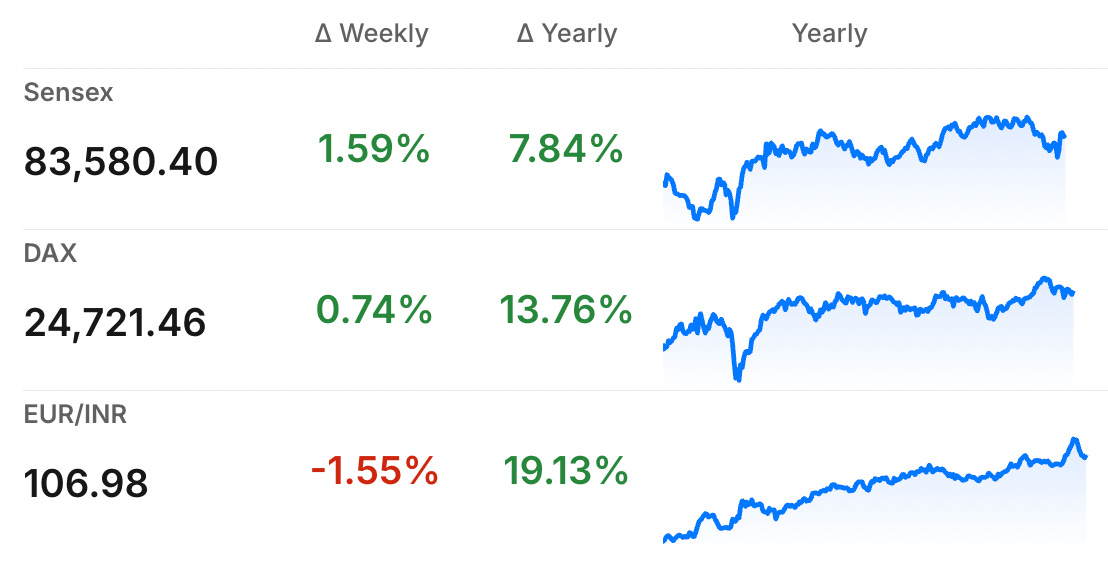
The Sensex bounced back nicely this week, climbing from 82,269.78 on January 30 to 83,580.40 by February 6, a gain of about 1.59%. This recovery was much needed after January turned out to be the worst month since last year, with the index falling roughly 3% during the month. The weekly uptick signals that investor sentiment is improving, though markets remain cautious after heavy foreign institutional investor selling in January.
Germany’s DAX index also had a positive week, rising from around 24,538.81 on January 30 to 24,721.46 by February 6, a weekly gain of approximately 0.74%. The index closed Friday with gains led by companies like Siemens Energy and HeidelbergCement. Despite this weekly improvement, the DAX has been undedr pressure recently, declining about 1.60% over the past month, though it’s still sitting comfortably with a 13.76% gain compared to last year.
The Euro weakened against the Rupee this week, dropping from 109.58 on January 30 to 106.98 by February 6, that’s about a 1.55% decline. However, looking at the bigger picture, the Euro has still strengthened significantly, up nearly 19% compared to a year ago.
Germany News Roundup
Telekom’s Underground AI Data Center Unveiled, is a modernized, high-security facility in Munich’s Tucherpark offering industrial AI cloud services powered by Nvidia GPUs, with a focus on data sovereignty and German industry needs. - teltarif.de
Rheinmetall Shares Drop 9%, BaFin Investigates, following a weak 2026 sales outlook, while CEO and insiders buy shares amid analyst downgrades and moderate target cuts. - wallstreetONLINE
ADAC Warns on Rising Car Navigation Subscription Costs, car owners face unexpected annual fees up to 329 euros as manufacturers push costly digital service subscriptions after initial free periods expire. - FR.de
Siemens Wins €3 Billion Driverless Train Deal, to supply and maintain 226 automated trains for Copenhagen’s S-Bahn, enhancing capacity and frequency with driverless technology by 2040. - BR24
German ID Cards Now Cost More, prices for new ID cards increased due to higher manufacturing and personnel costs, with adults paying 46 euros and younger applicants 27.60 euros. - Spiegel
Major Rail Line Closures in NRW and Bavaria, impact commuters with up to five months of full closures for extensive modernisations, bus replacements, and diverted long-distance trains until July 10, 2026. - Tagesschau
Merz Government Proposes 48-Hour Workweek, facing strong public opposition due to concerns over work-life balance, health, and skepticism about meeting personal and family needs under extended hours. - come-on.de
Turkish Conductor Killed by Ticketless Passenger, after a violent attack on a German train, prompting calls for stronger safety measures for railway staff amid rising workplace violence concerns. - Daily Sabah
India News Roundup
SEBI Launches Saarthi 2.0 Mobile App, offering young investors unbiased, objective tools and resources to enhance their investment decisions and financial knowledge efficiently. - Upstox
Bharat Taxi Launches Driver-Centric Cooperative Service, offering Rs 10 lakh insurance, retirement benefits, and cheaper rides to challenge Ola and Uber in India’s ride-hailing market. - DynamiteNews
Can India Shift from Russian to Venezuelan Oil? India faces logistical, cost, and refining challenges in replacing Russian oil imports with Venezuelan crude despite US pressure and trade incentives from Trump. - Al Jazeera
Deadly Blast Hits Illegal Indian Coal Mine, killing 18 with others feared trapped as authorities investigate the explosion and rescue efforts continue under hazardous conditions. - Al Jazeera
Adani and Leonardo Partner to Build Indian Helicopter Ecosystem, to develop indigenous manufacturing, sustainment, and training infrastructure, boosting India’s defense self-reliance and positioning it as a global helicopter production hub. - Leonardo
India-Germany Collaborate on Rare Earths for Wind Energy, strengthening supply chain resilience by jointly developing rare earth magnets critical for renewable energy, reducing dependency on China amid growing offshore wind ambitions. - The Hindu
India-Netherlands Boost Green Hydrogen Collaboration, with a new fellowship program and MoU enhancing academic ties to accelerate hydrogen tech research, capacity building, and deployment for clean energy goals. - Department Of Science & Technology
Germany’s Opportunity Card Poses Migration Risks, many skilled Indians face job market challenges and low-wage work despite eligibility for the new visa, risking financial strain and unstable residency in Germany. - The News Minute
India Budget 2026: Key Highlights
Finance Minister Nirmala Sitharaman presented the Union Budget 2026-27 on February 1, focusing on long-term economic growth, infrastructure development, and simplifying compliance for taxpayers. Here’s what matters most for you and our readers.
Infrastructure & Economic Focus
Public infrastructure spending increased to ₹12.2 lakh crore for FY 2026-27, continuing the government’s push to build capacity
Development of seven High-Speed Rail corridors to improve connectivity between major cities
Defence budget allocation raised to ₹7.85 lakh crore due to global tensions
Focus on Tier II and Tier III cities with populations above 5 lakh as new growth centers
₹10,000 crore SME Growth Fund launched to create Champion SMEs and support growing enterprises
Tax & Compliance Changes
For Individual Taxpayers
Revised return filing deadline extended from December 31 to March 31 (with nominal fee)
ITR filing deadline for non-audit business taxpayers extended to August 31
Securities Transaction Tax (STT) increased on futures (from 0.02% to 0.05%) and options (premium from 0.10% to 0.15%)
No changes to income tax slabs or rates
NRI-Specific Benefits
Investment Opportunities
Individual NRI equity investment limit doubled from 5% to 10% per listed company
Overall aggregate limit for all NRIs increased from 10% to 24%
Property Transactions Made Simple
TDS on NRI property sales can now be paid using buyer’s PAN instead of requiring a separate TAN, eliminating 2-4 weeks of waiting time
Money Transfers
TCS on education remittances reduced from 5% to 2%
TCS on medical remittances reduced from 5% to 2%
TCS on overseas tour packages reduced from 5%/20% to flat 2%
Foreign Asset Disclosure Scheme
A one-time six-month window to regularize undisclosed foreign assets
Category A (Undisclosed income/assets up to ₹1 crore):
Pay 30% tax plus 30% penalty (total 60%)
Get complete immunity from prosecution
Category B (Income disclosed but asset not reported, up to ₹5 crore):
Pay flat fee of ₹1 lakh
Get immunity from penalty and prosecution
Compliance Relief
Small foreign assets (under ₹20 lakh non-immovable) get immunity from prosecution, effective retrospectively from October 1, 2024
Pre-payment requirement for tax appeals reduced from 20% to 10%
Many technical defaults converted from penalties to fees, reducing fear of criminal prosecution
Investment Perspective
The budget shows clear intent to attract foreign capital and make compliance easier rather than punitive. For NRIs, the doubled equity investment limits and simplified procedures signal that India sees its diaspora as partners in development, not just sources of remittances.
The infrastructure push, particularly in Tier II/III cities and high-speed rail, creates long-term investment opportunities in sectors like real estate, logistics, and construction. The SME Growth Fund also indicates potential in mid-cap companies that could become tomorrow’s champions.
However, increased STT on derivatives means active traders need to factor in higher transaction costs . For long-term investors, this is less of a concern.
Opportunity
Russia-Ukraine Peace Deal and Reconstruction - Part 6
Defence Sector
While Rheinmetall and Hensoldt are the most direct German plays, the Ukraine reconstruction story extends across European defense companies and offers accessible options through ETFs for retail investors who want diversified exposure.
Why Peace Doesn’t Mean Less Defense Spending
Here’s the counterintuitive part: a peace deal might actually accelerate defense investment rather than reduce it. Defense analysts at Morningstar and Granville describe the recent selloff in defense stocks after peace deal rumors as “overdone” and a “buying opportunity”.
The reasons are structural:
Replenishment Needs: Countries like Germany that supplied weapons to Ukraine will need a decade or more just to restore their own inventories[cnbc]
NATO Spending Commitments: The increase to 2%+ of GDP for defense spending is locked in and won’t reverse regardless of peace[cnbc]
Long-term Ukraine Support: Even with peace, Ukraine will need years of military modernization, training, and equipment upgrades to NATO standards[janushenderson]
Strategic Autonomy: Europe recognizes it can no longer rely solely on U.S. protection, creating a permanent shift in defense priorities[cnbc]
As one Hensoldt spokesperson put it: “A halt to hostilities would allow Russia to rebuild its military strength. From a European security standpoint, the fundamental threat persists and could even escalate”.[cnbc]
European Defense Companies Worth Watching
BAE Systems (BA - London Stock Exchange)
The UK’s defense giant ranks among Europe’s top defense contractors with strong ties across European militaries. BAE is heavily involved in ground systems, naval vessels, and aerospace, all areas critical for Ukraine’s long-term defense modernization.
Thales (HO - Euronext Paris)
French defense powerhouse specializing in aerospace, defense, digital identity, and ground transportation. Thales has already supplied Ukraine with air defense systems and signed a joint venture agreement with Ukrainian Defence Industry in February 2025 to manufacture air defense systems, radars, and electronic warfare equipment locally in Ukraine.
Leonardo S.p.A (LDO - Borsa Italiana)
Italy’s leading defense and aerospace company ranks among Europe’s largest defense contractors. Leonardo has expertise in helicopters, electronics, cyber security, and defense systems.
Saab AB (SAAB - Stockholm Stock Exchange)
Swedish defense manufacturer known for fighter aircraft, submarines, and advanced radar systems. Saab’s expertise in ground-based air defense and sophisticated electronics makes it relevant for Ukraine’s long-term defense needs.
Renk AG (R3NK - Frankfurt Stock Exchange)
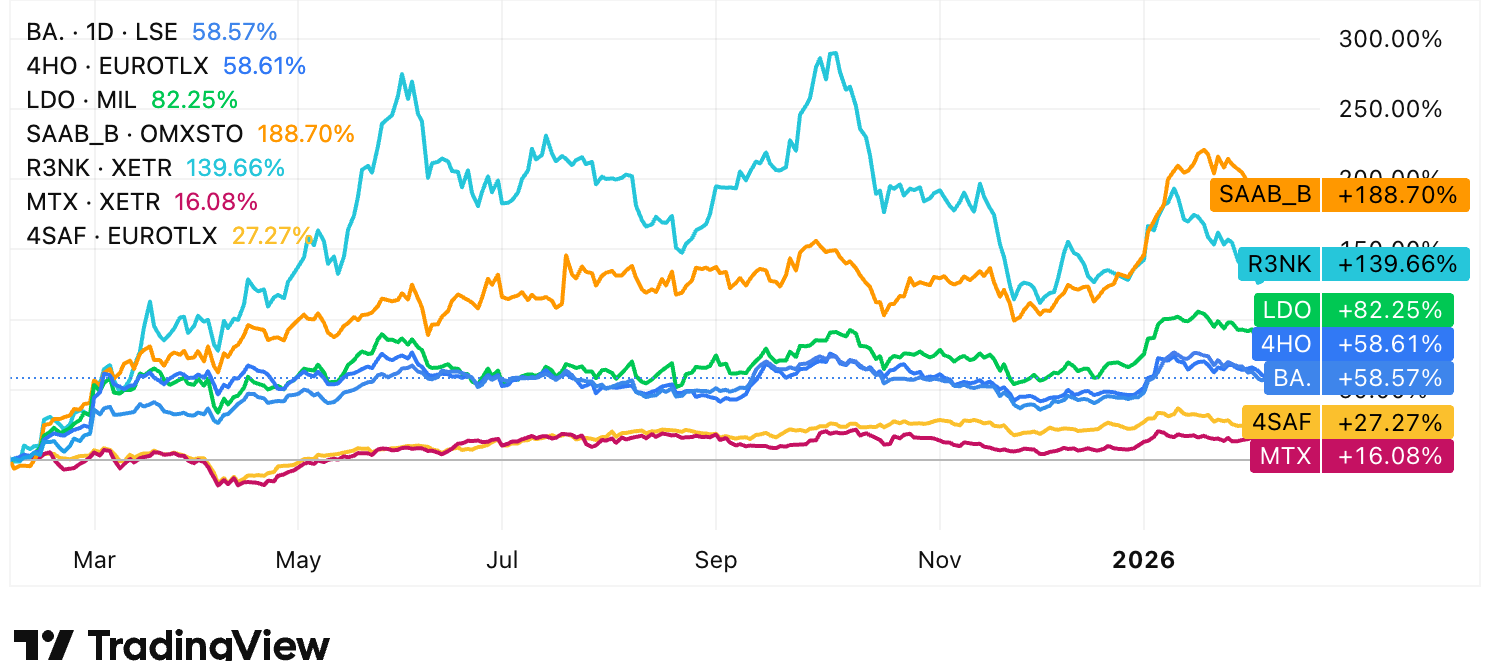
Recently listed German manufacturer of vehicle transmission systems and propulsion solutions serving over 70 armies worldwide. While smaller than the giants, Renk’s stock has surged approximately 194% in 2025.
MTU Aero Engines (MTX - Frankfurt Stock Exchange)
German manufacturer of aircraft engines and components for both civil and military aviation. As Ukraine rebuilds its air force and European militaries modernize, MTU benefits from the aerospace component of defense spending. The company appears in broader aerospace & defense indices.
Safran (SAF - Euronext Paris)
French aerospace and defense group specializing in aircraft engines, landing systems, and defense electronics. Safran’s dual civil-military business model provides diversification while capturing defense spending increases.
Defense ETFs for Retail Investors
If individual stock picking feels too risky or you want diversified exposure, several ETFs target European defense:
WisdomTree Europe Defense ETF (WDEF)
A U.S.-domiciled, Europe-focused defense ETF offering “pure-play exposure” to European defense companies. The fund holds 20 companies with top country exposures in Germany (25%), UK (22%), Italy (16%), France (16%), and Sweden (10%).
VanEck Defense ETF (DFEN)
The largest defense-focused ETF globally with $3.93 billion in assets. While U.S.-heavy, it maintains 32% European exposure including Thales, Leonardo, and Saab. Tracks 28 holdings across defense technology, cybersecurity, and defense services.
The bottom line: Ukraine reconstruction isn’t just about rebuilding what was destroyed, it’s about building a permanent European defense industrial base that didn’t exist at this scale before. That’s a decade-long story, not a one-year trade.
Until Next Sunday…
Conclusion
As we close this week’s newsletter, the coming days promise to bring clarity on questions that have been lingering in investors’ minds, particularly around inflation and economic momentum.
In India, all eyes will be on Thursday, February 12th, when the government releases its brand-new Consumer Price Index (CPI) series with 2024 as the base year. This isn’t just another monthly inflation number, it’s a complete recalibration of how India measures price changes, reflecting structural shifts in our economy over the past decade. The new series will provide January 2026 inflation data alongside a back series going all the way to January 2013 for comparison.
One final note: next week's US retail sales data (Tuesday, February 10) and US CPI data (Wednesday, February 11) will set the tone for global risk appetite. If American consumers are still spending and inflation stays contained, it supports the "soft landing" narrative that's been driving markets higher. If either disappoints, expect volatility.
Stay informed, stay invested, and see you next week.
See you next Sunday,
Jimit Patel