
History was made in New Delhi this week, at least, that’s what the headlines proclaimed.
On January 27, India and the European Union formalized what they’re calling the “mother of all deals”: a comprehensive free trade agreement creating a market of 2 billion people and representing nearly $27 trillion, roughly a quarter of global GDP. European Commission President Ursula von der Leyen and European Council President António Costa attended India’s Republic Day celebrations as chief guests before signing the landmark pact alongside Prime Minister Modi.
This week’s newsletter includes a special deep-dive section examining why this “mother of all deals” might not be enough to offset the economic headwinds both economies face, particularly given Trump’s aggressive trade posture and ongoing global uncertainties.
Meanwhile, West Bengal confirmed two cases of Nipah virus, a deadly pathogen with no cure and fatality rates between 40-75%, making it far more lethal than COVID-19. Both cases were healthcare workers at the same private hospital in Barasat, suggesting possible hospital transmission from an undiagnosed patient.
India’s health ministry declared the situation “contained” after tracing 196 contacts who all tested negative, but the timing highlights a uncomfortable reality: while trade deals dominate headlines, infectious disease threats remain ever-present. Oxford University is conducting phase-two clinical trials of a Nipah vaccine in Bangladesh, but no approved treatment exists yet.
Let’s dive in.
Stock Market
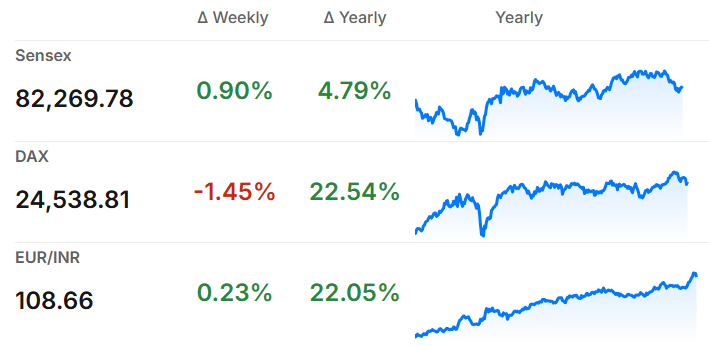
The Indian market had a choppy week with the Sensex swinging between gains and losses. Mid-week saw some recovery with the Sensex climbing to 82,626 on January 29, but profit booking ahead of the Union Budget announcement pulled it back down on Friday. The market sentiment remained cautious as traders were hesitant to take aggressive positions before the Budget announcement expected over the weekend.
The German market also faced volatility this week but managed to end on a positive note. The DAX closed at around 24,539 on Friday, January 30, posting a gain of nearly 0.9% for the day after halting a three-day losing streak. However, looking at the weekly performance, the DAX fell about 1.5% over the week.
The Euro strengthened significantly against the Rupee during this week. Starting the week at 108.40 on January 23, the EUR/INR rate climbed to a peak of 110.26 on January 29 - its highest level in 2026 so far. However, it pulled back sharply on Friday, closing the week at 108.66.
Germany News Roundup
Ver.di Calls Nationwide Public Transport Strike Monday, aiming to pressure employers for improved working conditions including shorter shifts, better pay, and reduced stress for about 100,000 transit workers across Germany. - DIE ZEIT
Consumers to Finance New German Gas Power Plants, rising electricity costs are expected as subsidies fund new gas power plants, with a levy planned for consumers from 2027, amid uncertain pricing and capacity market adjustments. - WELT
Klingbeil Demands Auto Industry Commitment, he urges German automakers to guarantee investments and secure jobs following government concessions on combustion engine phase-out regulations. - DIE ZEIT
VW’s €90M Investment in Auto Recycling, aims to convert its Zwickau plant for vehicle dismantling, recycling raw materials, and scaling circular economy efforts via AI and new business models by 2030. - Resource Recycling
Germany Restarts EV Subsidies with €3.5B Budget, aiming to boost demand by supporting 800,000 EV purchases and benefiting companies like BYD, Volkswagen, BMW, Tesla, and Infineon with flexible incentives through 2029. - The Globe and Mail
India News Roundup
India-EU Free Trade Agreement Boosts Trade and Mobility, links India with the EU's vast market, reduces tariffs on most goods, enhances service and professional mobility, benefiting several sectors but challenging some domestic industries. - Finshots
India Targets 7.2% Economic Growth in 2027, surpassing major economies with strong domestic stability, trade deals, and export diversification despite currency and capital flow challenges. - CNBC
India's Nipah Virus Outbreak Raises Global Alarm, prompting stricter airport screenings across Asia amid concerns of spread during Lunar New Year travel despite limited human transmission and ongoing monitoring by health authorities. - Al Jazeera
Common Man's Budget 2026 Key Expectations, highlight relief on LTCG taxes, better home loan benefits, stronger pension incentives, insurance push, HRA updates, and faster income tax refunds for ordinary Indians. - Upstox
India - EU Free Trade Agreement
Why Markets Yawned at the “Mother of All Deals”
India and the European Union announced the conclusion of their Free Trade Agreement on January 27, calling it a historic breakthrough after 18 years of on-and-off negotiations. External Affairs Minister S. Jaishankar proudly declared it the “mother of all trade deals,”
The numbers look impressive on paper: tariff elimination on 96.6% of EU goods exports to India and nearly 99% of Indian exports to the EU. Yet, both German and Indian stock markets barely moved. Perhaps they know something we should pay attention to.
The Long Road Ahead
The muted market reaction likely stems from a sobering reality: this deal won’t actually kick in until early 2027 at the earliest. Before a single tariff gets reduced, the agreement needs legal scrubbing, translation into 24 EU languages, ratification by the European Parliament, and approval through India’s domestic legislative processes. That’s 12-15 months of bureaucratic hurdles, and we all know how unpredictable ratification processes can be.
Beyond Tariffs: The Real Barriers
Here’s the bigger issue that markets seem to understand better than the celebratory press releases suggest, tariff cuts alone won’t magically boost trade. Indian exporters of basmati rice, spices, marine products, and pharmaceuticals face strict EU sanitary and phytosanitary (SPS) standards, heightened inspections, and complex certification requirements that function as invisible trade barriers.
The Missing Pieces
The real work begins after signing. India needs to secure “data adequacy” status under EU’s General Data Protection Regulation (GDPR) to enable seamless digital trade and IT services exports.
Indian IT professionals and skilled workers need easier visa access and mutual recognition of professional qualifications. Current Mode 4 commitments (temporary movement of professionals) remain limited, which is a major disappointment for India’s services sector.
Perhaps the thorniest issue is the EU’s Carbon Border Adjustment Mechanism (CBAM), which takes effect in 2026. Unless exemptions are negotiated, Indian exporters of steel, aluminum, cement, and fertilizers could see their tariff gains completely negated by carbon taxes.
The Bottom Line
Think of tariff elimination as getting a highway built between two cities – necessary but not sufficient. You still need functioning toll booths, clear signage, compatible vehicle standards, and border checkpoints that work efficiently. That infrastructure takes years to build.
Opportunity
Russia-Ukraine Peace Deal and Reconstruction - Part 5
Banking and Financial Services
When it comes to rebuilding a war-torn country, you need more than just cement mixers and solar panels, you need massive amounts of capital. This is where German banks and financial institutions could play a starring role in Ukraine’s reconstruction story. (kfw)
Germany has taken the lead in setting up financial infrastructure for Ukraine’s recovery. In July 2025, KfW (Germany’s state development bank) launched a European reconstruction fund that’s expected to mobilize over €1 billion in private capital, which could translate into €7 billion in actual investments on the ground. Think of it as a multiplier effect – for every euro of public money, several more euros of private investment follow. (kfw-entwicklungsbank)
Why This Matters for Banking Sector
Ukraine will need financing across three key areas: project loans for infrastructure, trade finance for imports/exports, and risk insurance to protect investments in a post-war environment. The reconstruction estimate runs into hundreds of billions of euros over the next decade, creating a long-term revenue stream for banks involved in financing these projects. (dragon-capital)
German-Listed Companies to Watch
Major Banks:
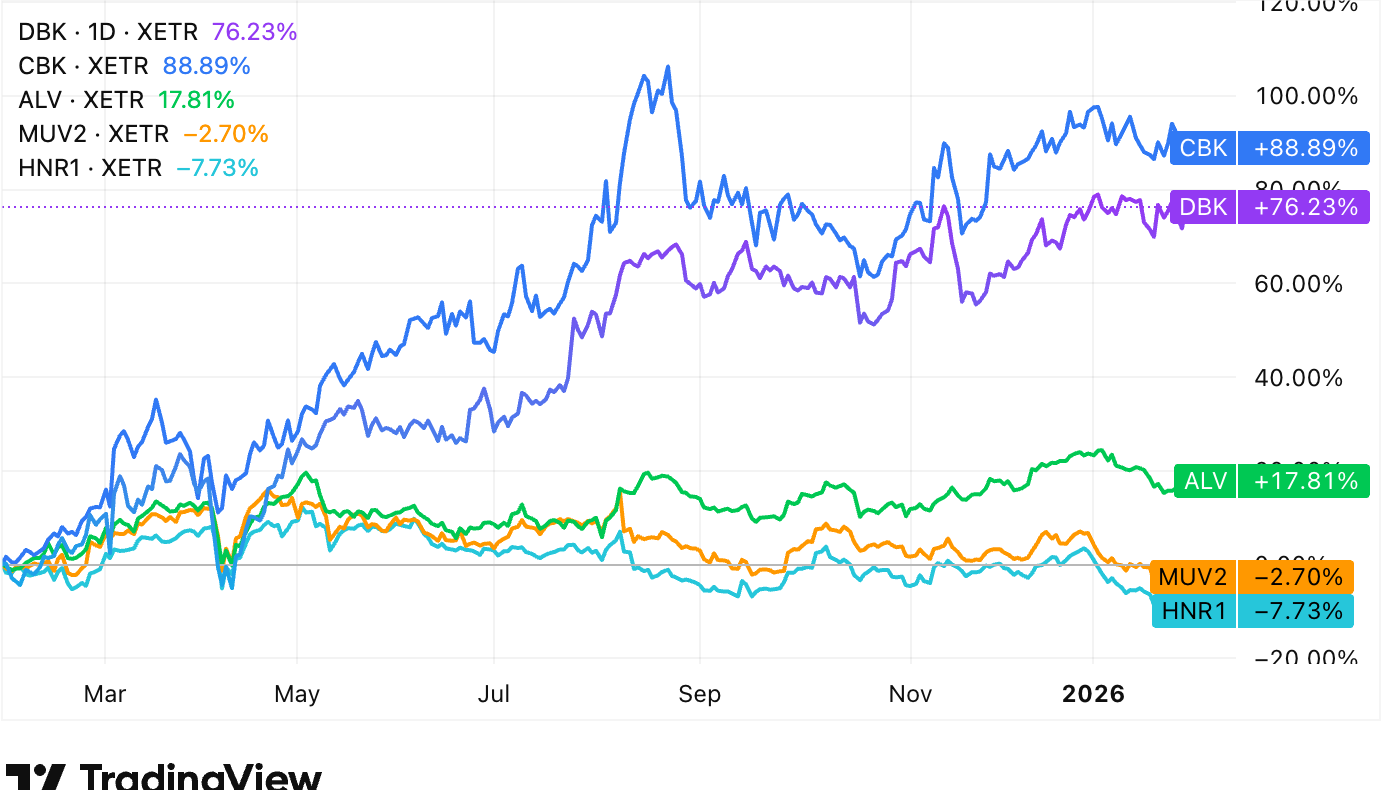
Deutsche Bank (DBK) - Germany’s largest bank with established Ukraine operations since 1993, offering corporate banking services and ranked as the #1 cash management bank in Ukraine.
Commerzbank (CBK) - Germany’s second-largest private bank with a representative office in Kyiv, positioned for trade finance and corporate lending.
Insurance & Reinsurance:
Allianz (ALV) - Europe’s largest insurer, critical for providing political risk and project insurance for reconstruction investments.
Munich Re (MUV2) - World’s leading reinsurer, essential for backstopping war risk and construction insurance that will be mandatory for Ukraine projects.
Hannover Re (HNR1) - Another major German reinsurer that could participate in Ukraine risk pools.
Specialized Banks:
Aareal Bank (ARL) - Specialist in property financing, though it previously had Russia exposure that it wound down. Could be relevant for commercial real estate reconstruction financing.
Deutsche Pfandbriefbank (PBB) - Commercial real estate finance specialist, listed in DAXsector Banks index.
Bottom Line
However, keep the risks in mind – we’re talking about a country still technically at war, with significant political and credit risks. That’s why reinsurance companies like Munich Re and Allianz are equally important; they’re developing specialized war risk insurance products to make these investments viable.
Until Next Sunday…
Conclusion
All eyes now turn to Finance Minister Nirmala Sitharaman, who will present her record ninth consecutive Union Budget on February 1 at 11:00 AM, marking the first Sunday budget presentation in recent history. With India’s economy forecast to expand 7-7.5%, expectations center on income tax relief, infrastructure spending, and measures to counter global uncertainties including Trump’s tariff threats.
Key sectors watching closely include agriculture (44% of India’s workforce but excluded from the EU-FTA), renewable energy amid the 500 GW target by 2030, and MSMEs seeking easier credit access. The budget arrives at a crucial juncture, balancing domestic growth priorities against external headwinds while implementing the newly-signed India-EU trade agreement.
Next week, we’ll analyze the Budget 2026 announcements, sectoral allocations, and investment implications.
Stay informed, stay invested, and see you next week.
See you next Sunday,
Jimit Patel